
Understanding Why Smart People Behave Irrationally At Work

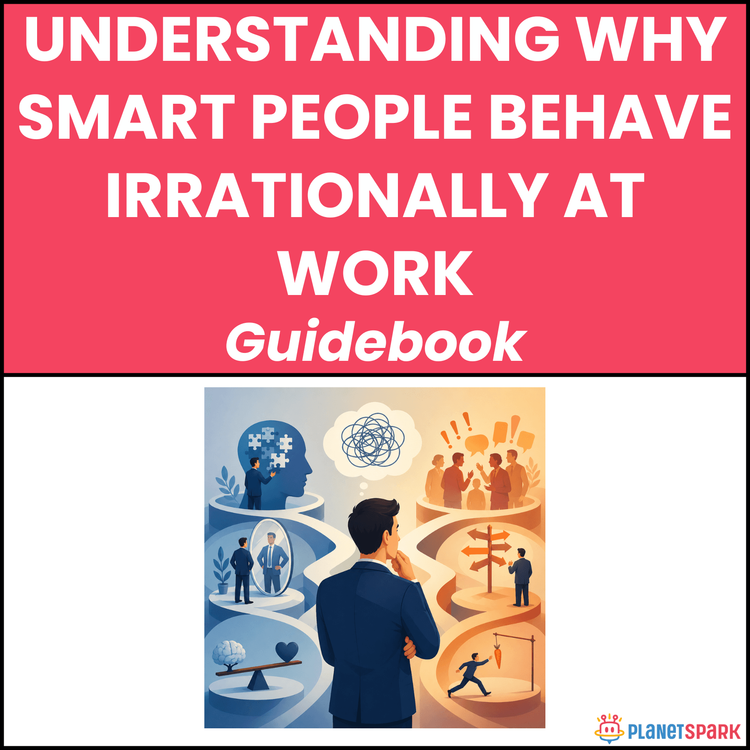
Understanding Why Smart People Behave Irrationally At Work
Why Smart People Make Irrational Decisions at Work (And How to Fix It): A Practical Guide for Professionals
You’re smart. You’ve worked hard to get where you are.
And yet—there are moments at work where you surprise yourself.
You say something you didn’t mean. You defend a decision that clearly isn’t working. You stay silent when you should speak. Or worse—you double down on something just because you’ve already invested time and effort into it.
This isn’t a lack of intelligence.
It’s something deeper—and far more common.
The resource “Understanding Why Smart People Behave Irrationally at Work” breaks this down in a practical, actionable way. It shows you why this happens—and more importantly, how to respond differently in real situations.
Who Is This Resource For?
This guide is ideal for:
- Working professionals navigating complex decisions and workplace dynamics
- Managers and leaders making high-stakes calls under pressure
- Consultants and client-facing professionals handling ambiguity
- Mid-career professionals transitioning into leadership roles
- Anyone who has ever thought: “Why did I react like that?”
If your work involves decisions, people, or pressure (which it always does), this resource is highly relevant.
What Does This Resource Contain?
This is not a theoretical psychology guide. It is a practical decision-making and behaviour toolkit.
Here’s what you’ll find inside:
- A clear explanation of how the brain actually works in professional settings
(System 1 vs System 2 thinking explained on page 3) - The 5 Core Drivers of Irrational Behaviour (page 4):
- Cognitive biases
- Emotional reactivity
- Social conformity pressure
- Sunk cost fallacy
- Ego protection
- Real-world workplace biases explained with examples (page 5):
- Confirmation bias
- Halo effect
- Anchoring
- Attribution error
- In-group bias
- Dunning-Kruger effect
- Bias Audit Worksheet
Helps you identify your own decision-making blind spots - Emotional Regulation Framework:
- Pause → Name → Choose model (page 7)
- Practical toolkit (page 8):
- 90-second rule
- Affect labelling
- Curious reframing
- “Parking lot” response
- Group dynamics insights (page 9 diagram):
- How groupthink and social pressure distort decisions
- Sunk Cost Decision Framework
Helps you stop investing in failing initiatives - SCARF Model (page 14):
Explains how status, certainty, autonomy, relatedness, and fairness impact behaviour - CLEAR Framework (page 15):
A real-time decision tool:- Check
- Label
- Examine
- Assess
- Respond
- Case study (Priya’s project example):
Shows how multiple irrational drivers combine in real scenarios - Self-evaluation tool:
Measures your behavioural intelligence (BQ)
Everything is designed to be used in real work situations—not just understood.
Summary of the Resource
In simple terms:
This guide helps you understand why smart professionals behave irrationally—and gives you tools to think clearly and act deliberately under pressure.
It moves you from:
- Reaction → Awareness
- Awareness → Control
- Control → Better decisions
How Will This Resource Be Useful?
Most professionals believe better decisions come from more intelligence.
In reality, better decisions come from better awareness of how your mind works under pressure.
This resource helps you:
- Recognise when you’re about to make a poor decision
- Reduce emotional reactions in high-stakes situations
- Avoid common thinking traps and biases
- Speak up confidently in group settings
- Handle disagreements without defensiveness
- Exit failing projects without ego attachment
- Improve leadership and decision-making credibility
As explained in the guide, irrational behaviour is not a flaw—it’s a predictable neurological pattern that can be managed with the right tools.
How Should You Use This Resource?
To get the most value, treat this as a practice system—not a one-time read.
Step 1: Build Awareness
Understand the 5 drivers of irrational behaviour and identify which ones affect you most.
Step 2: Use the Bias Audit
Reflect on recent decisions and identify patterns in your thinking.
Step 3: Apply the CLEAR Framework
In real situations:
- Notice the signal
- Label what’s happening
- Examine the evidence
- Consider alternatives
- Respond deliberately
Step 4: Practise Emotional Regulation
Use:
- 90-second pause
- Emotion naming
- Reframing
Step 5: Improve Group Decision-Making
Encourage dissent, question assumptions, and avoid blind agreement.
Step 6: Review and Improve
Use the self-evaluation tool monthly to track your behavioural intelligence.
Action Steps
Start immediately with this:
- Think of one recent decision you regret
- Identify which bias or driver influenced it
- Write down what you ignored or assumed
- Use the CLEAR framework on your next important decision
- Practise the 90-second pause in your next emotional moment
- Ask yourself one powerful question daily:
“Am I reacting—or choosing?”
The truth is simple:
Being smart is not enough.
In fact, the smarter you are, the easier it is to justify poor decisions.
What separates high-performing professionals from the rest is not intelligence—it’s behavioural awareness.
The ability to pause, think clearly, and respond deliberately.
This resource gives you that ability.
Use it consistently, and you won’t just make better decisions—you’ll become someone others trust to make them.