
What Not to Include in Your Resume (Red Flags to Avoid)

What Not to Include in Your Resume (Red Flags to Avoid)
Resume Red Flags to Avoid: A Practical 2026 Guide for Working Professionals
If you’ve ever applied for roles you were fully qualified for but never heard back, your resume may be working against you. Recruiters typically spend just a few seconds scanning each resume, and in that short window, even small mistakes can raise red flags. These are not about your capability, but about signals that suggest outdated practices, poor judgment, or lack of alignment with modern hiring standards.
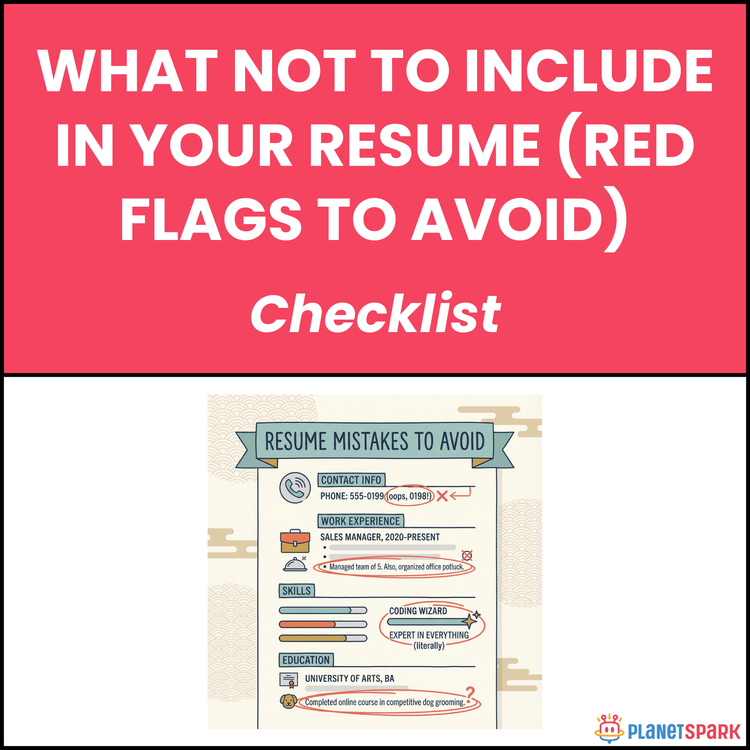
This is exactly why the Resume Red Flags: What Not to Include checklist exists. It helps working professionals identify and eliminate the common resume elements that silently cost interviews, often without candidates realizing it.
Who is this resource for?
This checklist is designed for:
- Working professionals with 0–15 years of experience
- Job seekers who are not getting interview callbacks
- Career switchers updating resumes for new roles or industries
- Consultants, managers, and individual contributors targeting competitive roles
- Professionals returning to the job market after a gap
- Anyone who wants a clean, modern, ATS-friendly resume
If you want recruiters to focus on your impact instead of questioning your resume choices, this resource is highly relevant for you.
What does this resource contain?
This PDF is a structured, easy-to-use checklist that highlights resume red flags across five critical areas:
Personal information overshares
You’ll learn what personal details no longer belong on a professional resume, such as photos, age indicators, marital status, full addresses, and other outdated inclusions that can trigger bias or privacy concerns.
Outdated or irrelevant content
The checklist explains why objective statements, very old work history, and obsolete skills weaken your resume and how to replace them with content that reflects current professional value.
Poor formatting and presentation choices
It breaks down common formatting mistakes like unprofessional email IDs, excessive design elements, tiny fonts, inconsistent styling, and dense text blocks that hurt readability and ATS parsing.
Content that raises recruiter concerns
This section focuses on unexplained employment gaps, job hopping without context, listing duties instead of achievements, and relying on generic buzzwords instead of measurable outcomes.
Inappropriate or controversial elements
You’ll see why political or religious affiliations, controversial hobbies, salary information, and listing references prematurely can work against you during screening.
The resource also includes:
- A clear action checklist of items to remove immediately
- A before-and-after resume example showing real transformation
- Step-by-step guidance to rewrite roles using quantified achievements
- Practical next steps to test and refine your resume
Summary of the resource
This checklist helps working professionals quickly audit their resumes, identify hidden red flags, and remove content that lowers credibility. Instead of guessing what recruiters dislike, you get clear guidance on what to delete, replace, or reframe so your resume reflects modern hiring expectations.
How will this resource be useful?
Using this checklist helps you:
- Avoid instant rejection due to resume red flags
- Improve ATS compatibility and keyword relevance
- Present yourself as a polished, current professional
- Shift focus from duties to measurable achievements
- Reduce unconscious bias caused by unnecessary personal details
- Increase your chances of getting shortlisted and called for interviews
The real value lies in clarity. You stop second-guessing your resume and start submitting applications with confidence.
How should you use this resource?
Start by reviewing your current resume alongside the checklist. Go line by line and honestly flag anything that matches a red flag category. Remove outdated sections completely rather than trying to reword them.
Next, rewrite your experience bullets to focus on outcomes using numbers wherever possible. Update your skills to reflect current tools and methodologies relevant to your target role. Finally, clean up formatting to ensure readability and ATS-friendliness.
This is not a one-time read. Revisit the checklist whenever you update your resume or apply for a new role.
Action steps
1. Print or open the checklist next to your resume
2. Highlight every red flag that applies to your current version
3. Delete personal, outdated, or irrelevant information immediately
4. Convert responsibilities into quantified achievements
5. Standardize formatting, fonts, and spacing
6. Share the revised resume for feedback or test it with an ATS checker
Small changes here can dramatically improve how your resume is perceived.
Your resume is not just a document; it’s your professional first impression. Removing red flags helps ensure that impression is strong, credible, and aligned with today’s hiring standards. Continuous refinement and upskilling are part of long-term career growth, and this checklist is a practical step in that direction.