
Workforce Development Experiment Planner

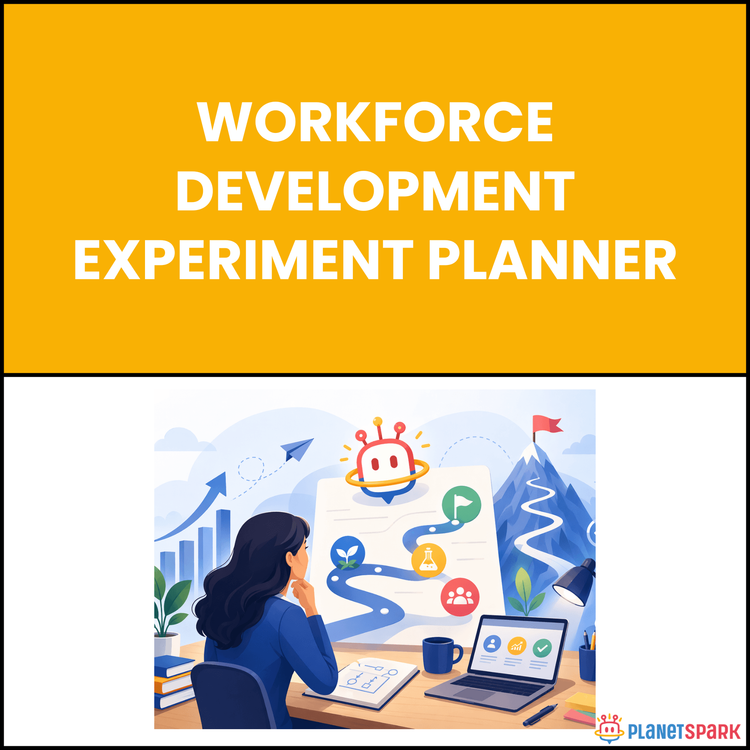
Workforce Development Experiment Planner
How to Design Workforce Development Experiments That Actually Work: A Practical Planner for Career Growth
Most professionals don’t struggle because they lack access to learning—they struggle because their learning doesn’t translate into real-world results.
You attend workshops, complete courses, and consume content… but when it comes to applying those skills at work, very little actually changes. The result? Time invested, but minimal impact.
That’s exactly the gap the “Workforce Development Experiment Planner” is designed to solve.
Instead of treating learning as a one-time event, this resource helps you approach it like a structured experiment—clear, measurable, and designed for real outcomes. Whether you're building your own capabilities or developing a team, this planner gives you a practical system to turn learning into visible performance improvement.
Who Is This Resource For?
This planner is especially valuable if you are:
- A working professional (0–15 years of experience) focused on continuous growth
- A manager or team lead responsible for developing team capabilities
- A consultant designing learning or development interventions
- A career switcher trying to build new, job-relevant skills quickly
- A mid-career professional looking to take ownership of your development
- Someone frustrated with courses that don’t translate into real performance
If you prefer practical execution over passive learning, this resource is built for you.
What Does This Resource Contain?
This is not a theoretical guide—it’s a structured, action-oriented planner designed for immediate application.
Inside the resource, you’ll find:
- A clear explanation of the “experiment mindset” for workforce development
- A complete 3-phase framework: Design, Execute, Review
- A structured method to identify real performance gaps (not vague skill goals)
- A hypothesis-building model using “If we… then… within…” format
- A cohort definition framework to target the right learners
- A success metrics system (behavioural, quantitative, qualitative)
- A detailed experiment design worksheet to plan your initiative
- Execution guidance based on the 70-20-10 learning principle
- A weekly experiment rhythm to maintain consistency and accountability
- A participant practice log template for tracking real-world application
- A structured review framework to evaluate outcomes and extract insights
- A real-world case example showing measurable results from an experiment
- Common mistakes in workforce development—and how to fix them
- A simple 3-step quick-start plan to launch your first experiment
Everything is designed to help you move from vague intentions to measurable results.
Summary of the Resource
The “Workforce Development Experiment Planner” is a practical system that helps you design, run, and evaluate learning initiatives that actually improve performance.
It shifts your approach from passive learning consumption to active experimentation—where every development effort is tied to a clear goal, tested in real conditions, and refined based on results.
If you want your learning to lead to visible outcomes—not just completed courses—this planner gives you the structure to make that happen.
How Will This Resource Be Useful?
This resource helps you bring clarity, structure, and accountability to your professional development.
You’ll gain:
- Clear direction on what to learn and why
- The ability to translate learning into observable workplace behaviour
- A structured way to test and validate skill development
- Better ROI on time spent learning
- Increased confidence in designing your own growth strategy
- Stronger alignment between learning efforts and business outcomes
- A repeatable system for continuous improvement
Most importantly, it helps you stop “hoping” your learning will work—and start proving that it does.
How Should You Use This Resource?
To get the best results, follow a phased approach aligned with the planner:
Start by reading the entire guide once to understand the experiment mindset and overall structure. This will help you see how each phase connects.
Next, begin with Phase 1 (Design). Identify a specific performance gap and define your hypothesis clearly. Use the worksheet to capture your thinking before moving forward.
Then move into Phase 2 (Execute). Apply the recommended learning methods, establish a weekly rhythm, and use the practice logs to track real-world application.
Finally, complete Phase 3 (Review). Measure your results against the predefined metrics, analyse what worked (and what didn’t), and extract insights for your next iteration.
This is not a one-time activity. You can reuse this planner whenever you:
- Take on a new role or responsibility
- Lead a team or project
- Plan skill development for a career transition
- Design learning interventions for others
Action Steps
After accessing this resource, take these steps immediately:
1. Identify one clear performance gap in your current role or team
2. Write a simple hypothesis using the “If we… then…” format
3. Define 2–3 measurable success metrics
4. Choose a small, focused group (or just yourself) to run the experiment
5. Block time weekly for practice, reflection, and tracking
6. Schedule a review date before you begin
7. Document your results and decide: Stop, Modify, Continue, or Scale
Small, well-designed experiments can create faster growth than months of unstructured learning.
Learning doesn’t fail because of lack of effort—it fails because of lack of structure.
When you start treating your development like an experiment, you gain control. You define success before you begin, test your assumptions in real work scenarios, and continuously refine your approach based on evidence.
This shift—from passive learner to active experiment designer—is what separates professionals who grow consistently from those who plateau.
Use this planner to take ownership of your development, build skills that actually stick, and create measurable impact in your work.
Book your free session today!