

Workplace Communication Improvement Roadmap
Workplace Communication Improvement Roadmap: A Practical Guide to Communicate with Clarity, Confidence, and Impact
In today’s fast-moving work environment, poor communication isn’t just frustrating—it’s costly. Ideas get misunderstood, emails go unanswered, meetings feel unproductive, and talented professionals often go unnoticed simply because they struggle to express their value clearly.
If you’ve ever felt like you’re doing great work but not getting the recognition, alignment, or results you deserve, the problem may not be your capability—it may be your communication.
The Workplace Communication Improvement Roadmap is designed to close that gap. It gives you a structured, practical system to improve how you communicate across meetings, emails, presentations, and high-stakes conversations—without relying on guesswork.
Who Is This Resource For?
This roadmap is especially valuable for:
- Early to mid-career professionals (0–15 years of experience)
- Managers and team leads who want to communicate more effectively with teams
- Professionals transitioning into new roles or industries
- Individuals who struggle with clarity, confidence, or visibility at work
- Anyone who feels misunderstood in meetings or overlooked despite strong performance
Whether you’re a job seeker, consultant, or working professional aiming to grow faster, this resource meets you exactly where you are.
What Does This Resource Contain?
This is not a theoretical guide—it’s a structured, action-oriented playbook. Inside, you’ll find:
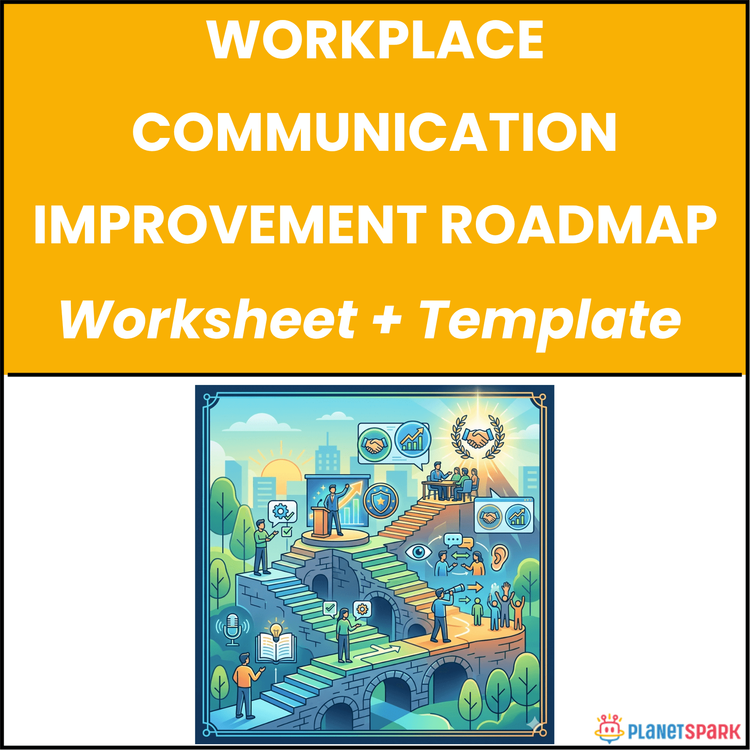
- A 5-phase communication improvement journey:
- Awareness: Identify your current communication patterns
- Foundation: Build core skills like clarity, listening, and tone
- Application: Improve communication in meetings and emails
- Advanced Skills: Handle presentations, feedback, and difficult conversations
- Influence: Strengthen persuasion and personal communication brand
- Practical frameworks you can apply immediately:
- PEEL Framework for structured meeting contributions
- 5-Line Email Formula for concise, effective emails
- SBI Model for feedback and difficult conversations
- BLUF (Bottom Line Up Front) for executive communication
- Checklists and self-assessment tools:
- Communication self-audit to identify strengths and gaps
- Meeting contribution checklist
- Email review checklist before sending
- Real-world guidance:
- Common communication mistakes and how to fix them
- A case study showing a professional’s transformation in 90 days
- A 30-day communication sprint to build consistent habits
Every section is designed to be practical, skimmable, and reusable in real work situations.
Summary of the Resource
This roadmap is a step-by-step system that helps you move from unclear and inconsistent communication to structured, confident, and impactful communication.
Instead of overwhelming you with theory, it gives you simple frameworks and repeatable habits that improve how you write, speak, present, and interact at work—one step at a time.
How Will This Resource Be Useful?
The real value of this roadmap lies in its ability to translate communication into measurable career outcomes.
By using it consistently, you will:
- Communicate ideas more clearly in meetings and presentations
- Write emails that get faster responses and fewer follow-ups
- Build confidence in high-pressure conversations
- Handle feedback and conflict more professionally
- Improve how leaders and peers perceive your competence
- Increase your visibility, credibility, and influence at work
Most importantly, it helps you bridge the gap between “knowing what good communication looks like” and actually applying it under pressure.
How Should You Use This Resource?
To get maximum value, use the roadmap in a structured yet flexible way:1. Start with a quick read-through
Skim all sections to understand the full communication journey and how the pieces connect.
2. Conduct a self-audit
Use the communication self-assessment to identify your strengths and blind spots.
3. Focus on one phase at a time
Work through one phase or skill area each week instead of trying to fix everything at once.
4. Apply frameworks in real situations
Use PEEL in meetings, the 5-Line Email Formula in your inbox, and SBI in conversations.
5. Use it as a reference tool
Return to specific sections whenever you face a real communication challenge.
6. Track your progress
Revisit the self-audit after a few weeks to measure improvement and adjust focus areas.
Action Steps
To start improving your communication immediately:
1. Complete the communication self-audit today
2. Choose one framework to focus on this week (PEEL, SBI, or 5-Line Email)
3. Apply it in at least one real work situation daily
4. Review your emails before sending using the checklist
5. Commit to speaking early in your next meeting
6. Schedule one feedback or difficult conversation you’ve been avoiding
7. Start the 30-day communication sprint for consistent improvement
Small, consistent actions will create noticeable changes faster than occasional effort.
Strong communication is not a talent you either have or don’t—it’s a skill you build deliberately over time. The professionals who grow fastest are not always the smartest or most experienced—they are the ones who can clearly express ideas, influence decisions, and build trust through how they communicate.
This roadmap gives you the structure, tools, and confidence to do exactly that. The more consistently you apply it, the more naturally effective your communication will become—and the more your work will be seen, understood, and valued.