
Workplace Conflict Psychology Framework

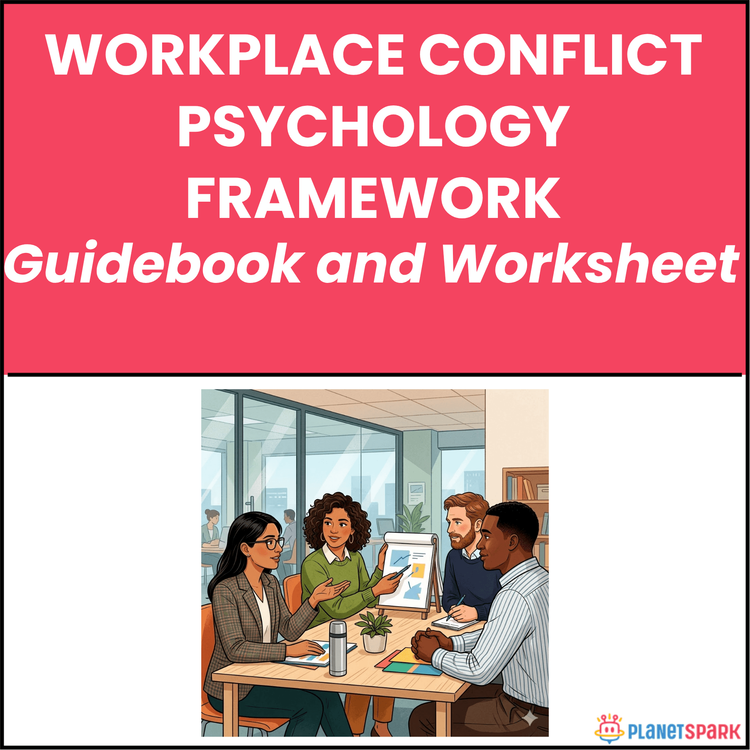
Workplace Conflict Psychology Framework
Workplace Conflict Psychology Framework: A Practical Guide to Managing Conflict at Work with Confidence and Clarity
Conflict at work is unavoidable—but most professionals are never taught how to handle it effectively. You may have experienced situations where a simple disagreement escalated into tension, silence, or even long-term resentment. Maybe you avoided a difficult conversation, only to see the issue grow worse over time. Or perhaps you tried addressing it, but it didn’t lead to real resolution.
This is exactly why the Workplace Conflict Psychology Framework exists. Instead of reacting emotionally or relying on trial-and-error, this resource gives you a structured, psychology-driven approach to understanding and resolving conflict—so you can move from tension to productive outcomes.
Who Is This Resource For?
This resource is designed for working professionals who want to handle conflict with more clarity and confidence, including:
- Early to mid-career professionals navigating workplace dynamics
- Managers and team leads handling interpersonal conflicts within teams
- Career switchers adjusting to new environments and expectations
- Consultants working across stakeholders with differing priorities
- Professionals who struggle with difficult conversations or conflict avoidance
If you’ve ever felt unsure about how to raise issues, manage disagreements, or repair strained professional relationships, this framework is built for you.
What Does This Resource Contain?
This guidebook is not theoretical—it is highly practical and structured for real-world application. Inside, you will find:
- A 5-Layer Conflict Psychology Model that helps you understand what’s really happening beneath surface-level disagreements
- Trigger Mapping tools to identify what initiates conflict and why it escalates
- The Perception Gap framework to understand why two people interpret the same situation differently
- A Needs Diagnostic model to uncover the hidden psychological drivers behind conflict
- Conflict Style Assessment based on the Thomas-Kilmann model to identify your default approach
- The Escalation Ladder to assess how serious a conflict is and what action is required
- A 3-Phase Conflict Resolution Process:
- Before the conversation (preparation checklists)
- During the conversation (HEAR framework)
- After the conversation (repair and follow-through)
- Ready-to-use communication templates for initiating, managing, and closing conflict conversations
- A real-world case study illustrating how the framework works in practice
- A complete Conflict Analysis Worksheet for structured problem-solving
- A quick reference guide for use during real-time conflict situations
Each section is designed to move you from understanding to action.
Summary of the Resource
At its core, this resource helps you stop reacting to conflict and start managing it intentionally.
Instead of focusing only on what was said or done, you learn to identify deeper layers—perceptions, unmet needs, behavioural patterns, and escalation stages. By doing so, you gain a clear roadmap for handling even complex interpersonal challenges.
The result is not just conflict resolution, but stronger communication, better relationships, and more effective decision-making at work.
How Will This Resource Be Useful?
Using this framework will create immediate and long-term benefits in your professional life:
- You gain clarity in confusing or emotionally charged situations
- You respond thoughtfully instead of reacting impulsively
- You build confidence in handling difficult conversations
- You improve relationships by addressing root causes, not symptoms
- You reduce workplace stress caused by unresolved tensions
- You make faster, better decisions during conflict situations
- You develop leadership skills—even if you’re not in a formal leadership role
Most importantly, you shift from avoiding or escalating conflict to using it as a tool for growth and alignment.
How Should You Use This Resource?
To get the most value, approach this resource in a structured way:
1. Start with understanding the framework
Read through the 5-layer model and core concepts to build a strong foundation.
2. Reflect on a real conflict
Use the worksheets to analyse a current or recent conflict from your own experience.
3. Diagnose before acting
Identify triggers, perception gaps, unmet needs, and escalation stage before jumping to solutions.
4. Prepare intentionally
Use the pre-conversation checklists to clarify your thoughts and regulate emotions.
5. Apply the HEAR framework
During conversations, follow the structured approach to keep discussions productive and focused.
6. Follow through after resolution
Use the repair and reinforcement steps to ensure the outcome holds over time.
7. Revisit and reuse
This is not a one-time read. Use the templates, worksheets, and quick reference guide whenever new conflicts arise.
Action Steps
If you want to start applying this immediately, follow these steps:
1. Identify one unresolved or recent conflict at work
2. Use the Conflict Analysis Worksheet to break it down
3. Pinpoint the unmet need—yours and the other person’s
4. Determine the escalation stage of the conflict
5. Prepare for a conversation using the provided checklists
6. Schedule the conversation within the next 48 hours
7. Use the HEAR framework during the discussion
8. Send a follow-up message to reinforce alignment
These steps alone can significantly improve how you handle workplace conflict.
Conflict at work is not a sign of failure—it is a signal that something important needs attention. When handled poorly, it damages trust, productivity, and growth. But when handled well, it becomes a powerful opportunity to strengthen relationships, improve communication, and drive better outcomes.
This framework equips you with the mindset, tools, and structure to do exactly that. The more you practice it, the more natural and effective your responses will become. Professional growth is not just about skills and knowledge—it is also about how you navigate people, pressure, and complexity. Learning to handle conflict well is one of the highest-leverage skills you can develop in your career.
Book your free session today!