
Writing a Narrative-Driven Cover Letter for Career Storytelling

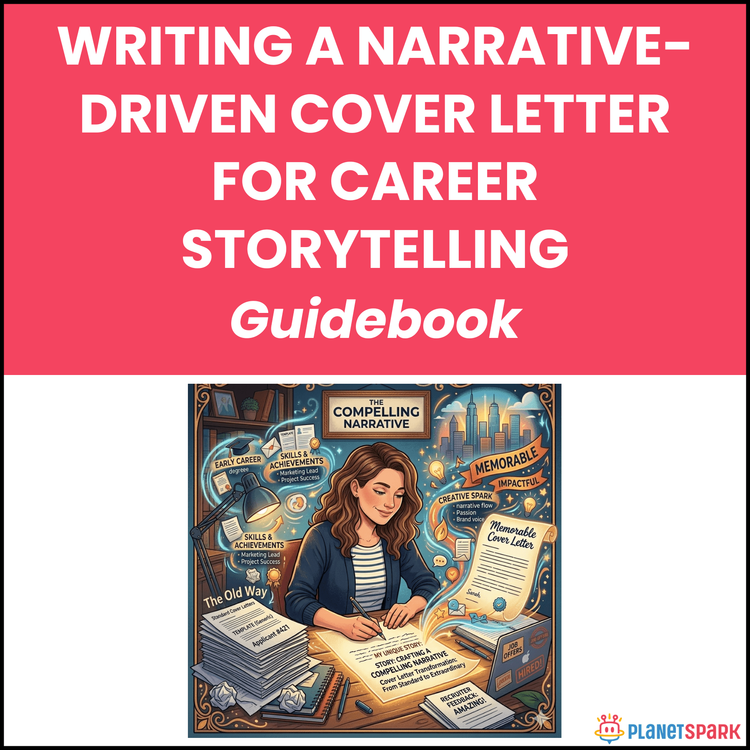
Writing a Narrative-Driven Cover Letter for Career Storytelling
How to Write a Narrative-Driven Cover Letter That Gets Interviews
Most cover letters fail before they’re even finished reading.
Not because candidates lack experience—but because their cover letters sound like recycled resumes. Lists of responsibilities. Generic openings. Polite but forgettable language. Hiring managers skim them, close the tab, and move on.
The uncomfortable truth? A cover letter is not a summary of your past—it’s a story about your future.
This is exactly where the resource “Writing a Narrative-Driven Cover Letter for Career Storytelling” steps in. It teaches you how to stop writing safe, generic cover letters—and start crafting compelling narratives that make hiring managers want to meet you.
Who Is This Resource For?
This guidebook is designed for working professionals who want to stand out in competitive job markets, especially:
- Career switchers struggling to connect non-linear experiences
- Early to mid-career professionals looking to move up or pivot
- Consultants and managers who need stronger personal positioning
- Job seekers tired of sending applications without responses
- Professionals unsure how to “tell their story” effectively
If you’ve ever felt like your experience doesn’t “translate” well on paper, this resource is built for you.
What Does This Resource Contain?
This is not just a theory-heavy guide—it’s a practical, structured system you can apply immediately.
Inside, you’ll find:
- The 4 Common Cover Letter Mistakes
Helps you identify why most cover letters fail (e.g., CV rehash, generic openings, skill dumping)
- The SPARK Narrative Framework
A proprietary storytelling structure:
- Setup (your professional identity)
- Pivot Point (why this role, now)
- Application of Proof (your evidence)
- Relevance Bridge (connection to company)
- Kinetic Close (strong, forward-looking ending)
- Step-by-Step Writing Breakdown
Each part of the cover letter is explained with examples and rewrites
- Proof Point Builder Template
A structured way to turn your work into measurable, story-based achievements
- Story Audit Worksheet
A pre-writing tool to clarify your career narrative before drafting
- Fill-in Cover Letter Template
A ready-to-use structure to build your first narrative cover letter
- Real Case Studies
Including career changers and mid-career professionals successfully reframing their profiles
- Pre-Send Quality Checklist
Ensures your letter is specific, relevant, and impactful
- 7-Day Action Plan
A practical roadmap to go from blank page to a complete cover letter
Summary of the Resource
In simple terms, this guide teaches you how to transform your cover letter from a list of experiences into a compelling career story.
Instead of answering “What have you done?”, it helps you answer:
“Why does your journey make you the right person for this role right now?”
It replaces generic writing with structured storytelling—and gives you tools to apply it immediately.
How Will This Resource Be Useful?
This resource delivers real, measurable benefits:
- Clarity: You understand your own career story better
- Confidence: You stop apologizing for gaps or transitions
- Relevance: You learn how to tailor each application effectively
- Differentiation: Your cover letter becomes memorable, not replaceable
- Efficiency: You stop rewriting from scratch every time
- Results: Better responses, more interviews, stronger positioning
One of the most powerful insights from the guide is that even “non-linear” careers can become an advantage—when framed as a narrative instead of a mismatch. :contentReference[oaicite:1]{index=1}
How Should You Use This Resource?
To get the maximum value, don’t just read—apply.
Here’s the recommended approach:
Step 1: Start with the Story Audit
Use the worksheet to clarify your career direction, strengths, and motivations before writing anything.
Step 2: Build Your Narrative Foundation
Define your Setup (who you are professionally) and Pivot Point (why this role matters now).
Step 3: Develop Proof Points
Use the Problem → Action → Result format to create 2–3 strong, measurable examples.
Step 4: Research the Company
Identify specific insights about the company to build a strong Relevance Bridge.
Step 5: Draft Using the Template
Follow the SPARK structure to assemble your full cover letter.
Step 6: Refine and Score
Use the checklist and self-scoring sheet to improve clarity, specificity, and impact.
Step 7: Final Review
Read your letter aloud to ensure it sounds natural, confident, and human.
Action Steps
If you want to apply this immediately, follow this quick checklist:
1. Download and open the resource
2. Complete the Story Audit (15–20 minutes)
3. Write 2 versions of your Pivot Point
4. Create 2 strong proof points with measurable results
5. Research one target company deeply
6. Draft your cover letter using the SPARK template
7. Review it using the Pre-Send Checklist
8. Send your application with confidence
The key is consistency—not perfection.
A strong cover letter is not written in one attempt. It’s refined through clarity and iteration.
Your cover letter is often the only place where your voice, intent, and story come together.
Most professionals treat it like a formality—and that’s exactly why most of them get ignored.
If you approach it as a narrative instead of a document, it becomes one of the most powerful tools in your career toolkit.
This guide doesn’t just help you write better cover letters—it helps you think more clearly about your career direction, communicate your value, and position yourself with confidence.
Use it. Apply it. Revisit it for every application.
Because the professionals who get noticed are not always the most qualified—they’re the ones who tell the most compelling story.
Book your free session today!