
Accent vs Pronunciation: Understanding the Fine Line Between Sound and Speech
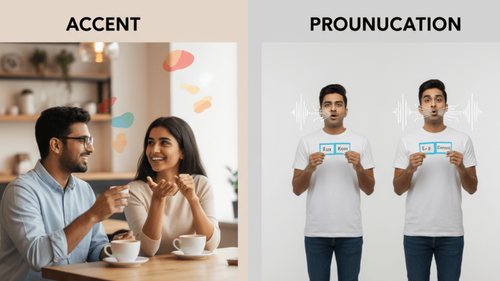

Table of Contents
- Defining Terms: What We Mean by Accent and Pronunciation
- Accent vs Pronunciation: Key Differences
- Why Learners Get Them Mixed Up
- Which Should You Focus On: Pronunciation First, Accent Later
- How Pronunciation and Accent Play Out in Real-World Contexts
- Practical Tips to Improve Pronunciation and Manage Accent
- Case Study: How a Focused Course Makes a Difference
- Why Many Learners Focus Too Much On Accent, and What To Do I
- 10. The Role of Vocabulary, Fluency, and Confidence
- Elevate Your Spoken English with Planet Spark
- Conclusion
Imagine you’re chatting with a friend online. They speak English clearly, you understand every word, but you can tell they grew up somewhere far from the UK or the US. Their rhythm, intonation, or vowel sounds hint at their background. What you’re sensing is accent. Meanwhile, when a word sounds muffled, mis-articulated, or when you ask them to repeat, it’s likely a pronunciation issue. In this blog, we’ll explore “accent vs pronunciation”, dig into how they differ, why each matters, and how you can sharpen both to improve your English speaking, especially for daily conversations, interviews, travel, and more.
Setting the Scene: Why the Distinction Matters
When learners ask about improving their English, they often mix up “having a good accent” with “good pronunciation”. But clarity of speech depends more on pronunciation than accent. According to one writer:
“Your pronunciation is your ability to pronounce words in a way that makes them intelligible to other speakers of the language. … Your accent includes things like your intonation and rhythm of speech.”
Another source adds:
“Pronunciation is the way people produce sound. … Accents are different from pronunciation as it’s based on the speaker’s social or geographic upbringing.”
Why does this matter? If your pronunciation is poor, people may misunderstand you or ask you to repeat. If your accent is strong but you pronounce clearly, you’ll still be understood. So it helps to focus your efforts where they count.
Ready to sharpen your spoken English? Sign up for a free trial class with Planet Spark and start practising live!
Defining Terms: What We Mean by Accent and Pronunciation
Let’s clarify the two terms, side by side.
Pronunciation
Refers to how you produce the sounds of words: vowels, consonants, stress, and rhythm.
It is actionable; you can practice specific sounds and improve them.
Example: pronouncing “think” as /θɪŋk/ rather than /tɪŋk/. If you say tink, you’re mispronouncing.
Accent
Refers to the overall pattern of how you speak a language, often hinting at your background: region, mother-tongue, social group.
It includes features like vowel quality, consonant patterns, intonation, and rhythm.
You may have an accent and still be perfectly understandable.
So in short: Pronunciation = how you say words. Accent = what your speech sounds like (regionally, culturally). The two overlap, but they are not identical.
Accent vs Pronunciation: Key Differences
Let’s break down the major differences under headings.
Purpose and Focus
Pronunciation: Focuses on clarity and correctness of sounds. The goal is understandability.
Accent: Focuses on broader features of speech (rhythm, intonation, mother-tongue influence). The goal might be either maintaining identity or reducing interference if needed.
Changeability
Pronunciation: Relatively easier to change with dedicated practice (mouth movements, sound drills).
Accent: More ingrained, because it ties into your lifelong speech habits, first language influence, and social factors.
Relevance for Communication
Pronunciation: Critical. If you mispronounce too much, the listener may struggle to understand.
Accent: Secondary in terms of understanding. You can have a strong accent and still make yourself clear. But if the accent affects clarity (for example, by heavy interference), it can hinder communication.
Identity Aspect
Pronunciation: Less about identity, more about technique and clarity.
Accent: Strongly linked to identity, culture, and origin. Trying to erase your accent may carry emotional or identity implications. One blog says:
“An accent is part of your identity, whereas pronunciation can be improved through consistent practice.”
Examples
If a learner says “pasketti” instead of “spaghetti”, that’s a pronunciation mistake.
If you hear someone speak English and immediately guess “She sounds Indian” or “He sounds Australian”, that’s accent.
Example from one source: “When we hear Indian English, we are very likely to understand what is being said, … but at the same time, we can tell the speaker’s origins.”
Why Learners Get Them Mixed Up
It’s common for English learners (and even teachers) to use the terms interchangeably. Here are reasons why:
Sound overlaps: Since accent includes pronunciation features, it's easy to see them as the same.
Social pressure: Many learners believe they must “get rid of their accent” to speak “good English, ; when in fact clarity matters more.
Identity vs clarity confusion: Learners may feel their accent marks them as ‘non-native’, which can affect confidence.
Inconsistent terminology: Some resources use “accent” when they mean “pronunciation”, and vice versa. One Reddit user noted:
“There is no difference between ‘accent’ and ‘pronunciation’. Having ‘an accent’ simply means not pronouncing the language in the same way …”
That suggests confusion exists even among learners.
Which Should You Focus On: Pronunciation First, Accent Later?
Given the distinctions, the practical question is: Where should you invest your effort?
Prioritise Pronunciation
Since clear pronunciation makes you understandable, that should be the priority. If you’re constantly misunderstood, focus on how you articulate sounds, stress syllables, link words, and adjust rhythm.
Then Address Accent Features If Needed
If you speak clearly already but your accent is very strong and interfering with clarity, or you wish to target a particular accent (for acting, broadcast, job interviews), then you can work on accent features: intonation, rhythm, specific vowel/consonant shifts.
One blog puts it simply:
“…while having good pronunciation is necessary for being understood, your accent doesn't [necessarily need to change].”
Embrace Your Identity
Your accent is part of your identity. It’s not inherently “bad” to have an accent. If you can speak clearly and confidently, the world is perfectly fine hearing your accent. One writer:
“There is no such thing as having a good or lousy accent … The most important aspect is that you can convey effective communication and make people understand what you will present.”
Practical Approach for Learners
Here’s a simple plan:
Step 1: Record your speech or conversation, and note words you mispronounce.
Step 2: Work on those specific sounds, stress patterns, linking and rhythm.
Step 3: Practice in real-life situations: role-plays, dialogues, conversation practice.
Step 4: Once clear, if desired, choose accent features you may wish to modify (e.g., British vs American vowel sounds) and practise them, but not at the cost of naturalness or confidence.
Want to boost your clear speaking fast? Join Planet Spark’s live spoken English sessions; get instant AI & trainer feedback!
How Pronunciation and Accent Play Out in Real-World Contexts
Let’s look at how this distinction shows up in practical settings: everyday, academic, and professional.
Everyday Conversation
In casual chats, the goal is to be understood and respond naturally. Pronunciation clarity ensures you don’t say “beach” as “bitch” or “ship” as “sheep”. Accent may hint at your background, but as long as you’re clear, you’ll communicate effectively.
Academic/Interview Settings
Here, the expectations go up: You may present ideas, answer questions, and participate in discussions. Pronunciation errors may distract your listener; an overly strong accent may occasionally require repetition or effort from them. Prioritising clarity and steady rhythm helps significantly.
Travel / Service Contexts
If you’re travelling or interacting in a service situation (airport, hotel, customer support), your pronunciation influences how quickly you’re understood. Accent differences may not matter as much; what matters is that your speech flows, and the listener doesn’t have to keep asking “Pardon?”
Multinational Professional Environment
In global teams, colleagues come from varied accents. As a non-native speaker, clear pronunciation ensures you’re not misinterpreted, and smooth rhythm and pacing help large audiences follow you. Accent neutralisation might be requested in some roles (like voice-overs, broadcasting), but not all.
Practical Tips to Improve Pronunciation and Manage Accent
Here are some actionable methods you can use.
Pronunciation Practice
Work on individual sounds that trouble you (e.g., /θ/ vs /t/, /v/ vs /w/).
Use tongue-twisters: For example, “How can a clam cram in a clean cream can?” helps articulation.
Record yourself and compare with native speaker models; listen for stress, rhythm, and pauses.
Focus on linking words: “I want to go” → “I wanta go”.
Focus on syllable stress: Wrong stress can make it hard to understand.
Accent Awareness and Adjustment
Listen to regional accents you admire (e.g., General American, Received Pronunciation) and note the features: vowel length, r-sound, and tone of voice.
Work on rhythm and intonation: Ask whether you rise at the end of a sentence (often in questions) or fall (often in statements).
Be aware of mother-tongue interference: Does your first language cause you to insert extra vowels or consonants?
Practise conversational role-plays in real scenarios (ordering food, interview, travel check-in).
Use feedback (trainers, AI tools) to spot which accent features affect clarity for your listener.
Balanced Approach
Don’t chase a “perfect native accent” unless your goal requires it. Clarity = key.
Keep your accent as part of your identity, but be willing to adjust key features that hamper understanding.
Consistent daily practice beats occasional long sessions.
Try a free trial class at Planet Spark today and get personalised trainer feedback on your pronunciation and accent habits.
Case Study: How a Focused Course Makes a Difference
Let’s imagine a learner, “Arjun”, from Patna. He speaks English with a strong local-Bihari influence. He finds that in job interviews, he gets asked to repeat himself. He decides to enrol for a spoken English course focused on both pronunciation and clarity rather than accent perfection.
His Path
Week 1–2: Trainer helps him identify his tricky sounds: /ʃ/ vs /s/, /v/ vs /w/, word-stress errors.
Week 3–4: He practices role-plays: travel check-in, job interview, and describing a project.
Week 5+: He records his sessions and gets instant AI fluency reports: trainer feedback + AI flagging of unclear words.
The Outcome
After 6 weeks, Arjun feels less anxious in conversation; fewer “Pardon?” moments.
His accent remains clearly from Bihar, but his speech flows, is clearly, and he handles interview questions confidently.
He realised he didn’t need to erase his accent; he needed his pronunciation clarity and confidence.
This mirrors what a course at Planet Spark offers: live interactive English conversations, accent-neutralisation & articulation focus, vocabulary in context, role-plays, instant feedback and fluency trackers.
Why Many Learners Focus Too Much On Accent, and What To Do Instead
Here are common misconceptions and how to correct them.
Misconception: “I must sound like a native to be taken seriously.”
Reality: What matters more is being clear, confident, and fluent. Accent alone doesn’t make or break credibility.
Misconception: “If I don’t change my accent now, it’s too late.”
Reality: Pronunciation improvement is always possible; accent can remain part of identity. Don’t aim for erasure; aim for clarity.
Misconception: “Accent correction = perfect native accent.”
Reality: Accent correction in many learning programmes means reducing interference and boosting clarity, not “losing your origin”. One blog points out:
“If someone’s accent is native-like, then when they make errors you will see them as uneducated or unintelligent … whereas if you have a slight accent but speak incredibly well, you will seem intelligent and educated.”
What to do instead:
- Focus on pronunciation drills from Day 1.
- Keep conversations flowing: live interactive practice beats passive video watching.
- Seek feedback (trainers, AI) to spot where clarity breaks down.
- Use context: situational dialogues (travel, interview, everyday chat) help embed pronunciation and rhythm.
- Track progress: seeing yourself improve boosts confidence.
10. The Role of Vocabulary, Fluency, and Confidence
Improving pronunciation and managing accent doesn’t happen in isolation. They link with vocabulary, fluency, and confidence.
Rich vocabulary allows you to speak comfortably rather than pausing or stumbling, which improves your fluency and helps you pronounce with ease.
Fluency (flow of speech) means you don’t pause too often, which helps articulation and rhythm.
Confidence means you speak without fear of being “judged” for your accent, so you focus on clarity, not self-consciousness.
At Planet Spark, the Spoken English programme aims to build this full stack:
- Live, interactive English conversations daily around real-life situations (school, home, travel, interviews)
- Focus modules on accent neutralisation & clear articulation
- Vocabulary taught contextually with word-groups, collocations, and phrases integrated into dialogues
- Situational dialogues & role-plays (ordering food, giving a speech, handling interviews)
- Instant feedback & AI fluency reports
- Speaking, confidence trackers, and visible progress for parents and children
Don’t wait. Enrol with Planet Spark now or join a free trial class to experience the full spoken English transformation.
Elevate Your Spoken English with Planet Spark
Let’s zoom in on what makes Planet Spark’s spoken English course stand out and how it ties into your goal of mastering both accent vs pronunciation.
Why choose Planet Spark’s Spoken English programme?
- Daily live interactive sessions: unlike passive video courses, you speak every day.
- Accent neutralisation & clear articulation modules: dedicated practice to reduce mother-tongue influence and improve phonetics and pronunciation.
- Lexical resource enhancement: vocabulary is not taught in isolation but integrated into dialogues, collocations and everyday phrases.
- Situational dialogues & role-plays: real-world scenarios build practical fluency; kids practice ordering food, giving speeches, handling interviews, asking for help, and explaining concepts.
- Instant feedback & AI fluency reports: kids receive corrective feedback right away on pronunciation, grammar, and fluency.
- Speaking confidence trackers: parents can monitor visible progress, and children stay motivated as they advance.
How this addresses accent vs pronunciation:
The programme prioritises clarity of pronunciation (so you’re understood) while also guiding students on managing accent features (if needed), but without forcing “native accent” as the only goal.
Through live dialogue and role-play, students improve both how they articulate and how they present themselves in English conversation, making their speech more effective, e; even with their own accent.
The vocabulary and fluency tracks ensure that pronunciation improvements don’t only happen in drills, but in meaningful conversation.
Quick benefits you’ll observe:
- Fewer instances of “Please say that again.”
- More confidence in speaking spontaneously in English.
- Easier handling of interviews, presentations, and travel communication.
- Parents see measurable improvement, and children feel more fluent.
How to get started:
Sign up for the free trial class – experience live conversation and feedback.
Take the diagnostic session: assess current pronunciation and fluent speech.
Choose your membership or track (especially for kids) and attend daily live interactive sessions.
Practice outside class – role-play with family/friends or practise dialogue recordings.
Check your fluency tracker at regular intervals and celebrate the progress.
If you’re serious about improving your spoken English, be it for school, job, travel, or personal growth, Planet Spark’s Spoken English course gives you a structured path where you’ll work on pronunciation clarity and build your ability to speak confidently. The fine line between accent vs pronunciation gets addressed not theoretically, but practically and interactively.
Conclusion
Mastering spoken English means recognising the fine line between accent vs pronunciation. Pronunciation gives you the power to be understood, while accent shapes how your speech sounds and reflects your identity. If you focus on clear articulation, correct sounds, and smooth rhythm first, you’ll already elevate your communication. Adjusting accent features can come next, if you choose to, but your clarity will carry you far.
Take this moment to invest in your spoken English. Join a live programme that gives you daily conversation practice, feedback, and a structured path. At Planet Spark, you’ll not only sharpen pronunciation and manage accent features; you’ll build confidence and practical fluency in real-life contexts.
Don’t wait. Sign up for your free trial class now and start speaking English more clearly, confidently and fluently today.