
Commonly Confused Words in English | Meanings & Examples


Table of Contents
- What Are Commonly Confused Words?
- Why Do Students Get Confused?
- Commonly Confused Words in English
- Top 10 Basic Commonly Confused Words in English with Example
- Commonly Confused Words Worksheet
- Fun Activity: “Confused No More!”
- Commonly Confused Words Exercises
- Confused Words Sentences Practice
- Commonly Confused Words — Worksheet with Answers
- Commonly Confused Words — Quiz Time!
- British Council Style — Learn Confused Words the Smart Way
- Parent’s Corner — How to Help Your Child
Have you ever written “their” instead of “there”? Or said “accept” when you really meant “except”? Don’t worry, it happens to everyone! These are known as commonly confused words words that may sound the same, look similar, or have close meanings, but are actually quite different. Understanding the difference between them is important because using the wrong word can completely change the meaning of your sentence.
In this blog, we’ll explore what these words mean, why they often confuse us, and how you can easily remember the correct ones. You’ll find fun examples, simple tricks, and engaging worksheets to help you practice at home. So, get ready to learn with PlanetSpark’s easy and exciting guide to mastering confusing words and becoming a more confident communicator!
What Are Commonly Confused Words?
Definition of Commonly Confused Words
Commonly confused words are pairs or groups of words that look or sound alike but have different meanings and spellings.
Example:
- “Buy” and “By” sound the same, but mean totally different things!
- Buy = to purchase something.
- By = to show who did something or where something is located.
Turn Hesitation into Confidence with PlanetSpark
Join a Free Trial Class now and see the difference in just one session!
Why Do Students Get Confused?
| Reason | Example | Tip to Remember |
| They sound the same (homophones) | “Sea” and “See” | Picture the ocean for “Sea” and your eyes for “See”. |
| They look similar | “Affect” and “Effect” | “Affect” is a verb (action), “Effect” is a noun (result). |
| They mean almost the same | “Say” and “Tell” | You “say” words, but you “tell” stories. |
| They are used wrongly in daily talk | “Less” and “Fewer” | “Less” for uncountable things (water), “Fewer” for countable (apples). |
Commonly Confused Words in English
Here are some of the most common pairs that confuse learners. Read, repeat, and practice them aloud!
Commonly Confused Word Pairs with Meaning and Examples
| Word 1 | Word 2 | Meanings | Sentence Examples |
| Accept | Except | Accept = to agree or receive; Except = not including | I accept your gift. / Everyone is invited except Sam. |
| Their | There | Their = belonging to them; There = a place | It’s their car. / Please go there. |
| Then | Than | Then = time; Than = comparison | We went home then slept. / She is taller than me. |
| Affect | Effect | Affect = to influence; Effect = result | The rain affected the game. / The effect was cancellation. |
| Lose | Loose | Lose = to misplace; Loose = not tight | Don’t lose your pencil. / My shoes are loose. |
| Piece | Peace | Piece = part of something; Peace = calmness | I want a piece of cake. / The world needs peace. |
| Write | Right | Write = to form words; Right = correct/direction | Please write neatly. / You are right! |
| Weather | Whether | Weather = climate; Whether = if | The weather is sunny. / I don’t know whether to go. |
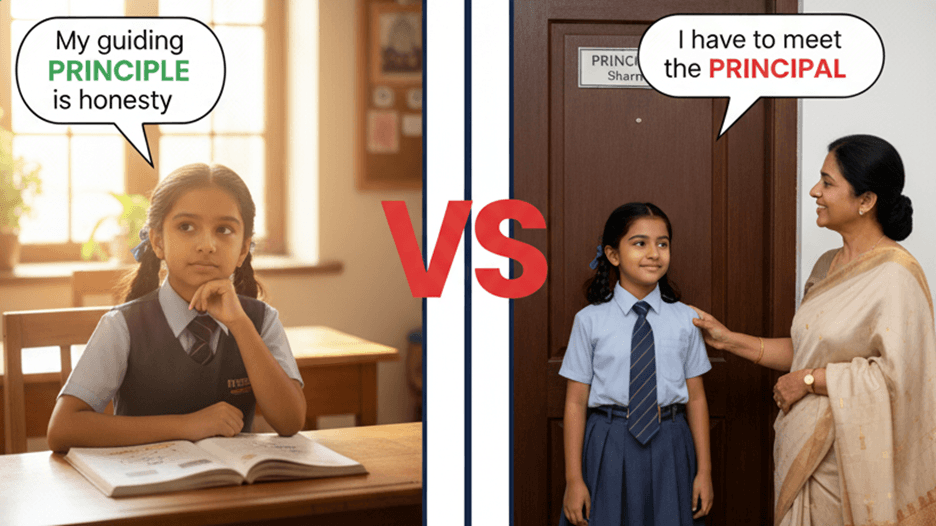
| Principal | Principle | Principal = school head; Principle = rule/value | Our principal is kind. / Honesty is a good principle. |
| Stationary | Stationery | Stationary = not moving; Stationery = writing items | The car was stationary. / I bought new stationery. |
Ready for better clarity? Dive into our full guide on homophones and homonyms, with plenty of examples, tips, and worksheets — only on PlanetSpark.
Click to read more and master these tricky word pairs today!
Top 10 Basic Commonly Confused Words in English with Examples
Here’s a mini list of 10 confusing word pairs. Print or save it for regular practice!
| Sr. | Word Pair | Example Sentence |
| 1 | Aloud / Allowed | She read the poem aloud, but phones are not allowed. |
| 2 | Brake / Break | Don’t break the toy! / Press the brake to stop. |
| 3 | Desert / Dessert | The desert is dry. / I love chocolate dessert. |
| 4 | Complement / Compliment | That hat complements your dress! / Thanks for the compliment! |
| 5 | Its / It’s | It’s raining today. / The cat licked its paw. |
| 6 | Hear / Here | Can you hear me? / Come here! |
| 7 | Mail / Male | I got your mail. / That bird is a male. |
| 8 | Pair / Pear | I bought a pair of shoes. / I ate a pear. |
| 9 | Quiet / Quite | Be quiet! / It’s quite nice today. |
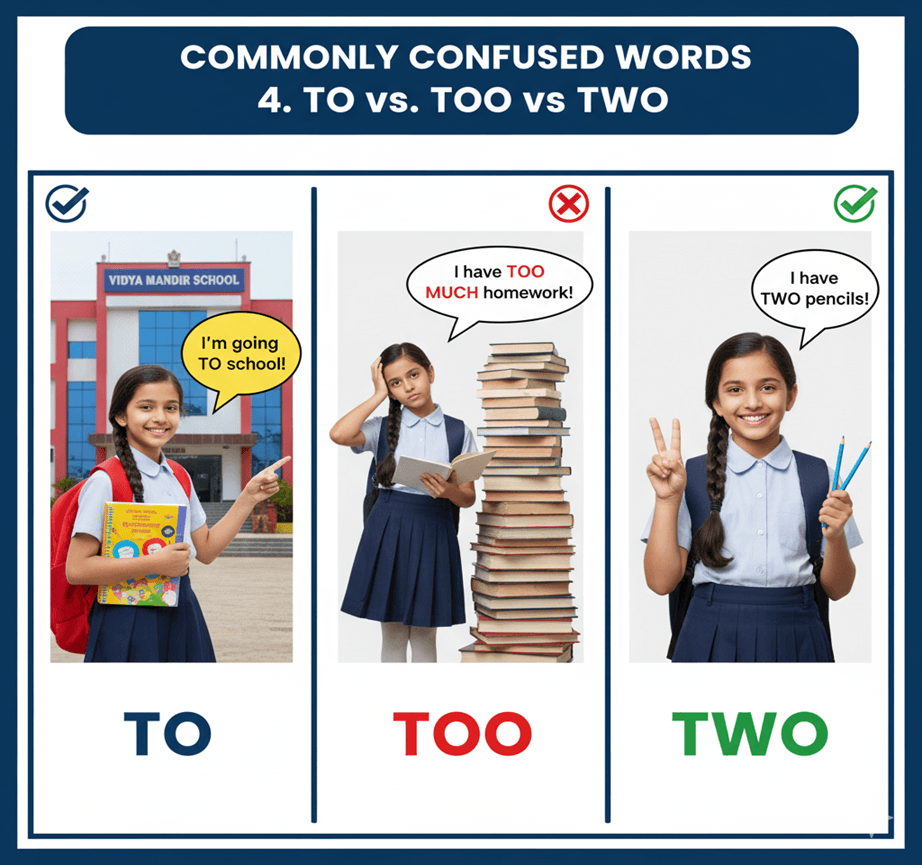
| 10 | Two / Too | I have two apples too. |
Every great communicator starts with the right guidance! At PlanetSpark, your child learns to speak fluently, express ideas clearly, and build confidence.
Book a Free Demo Class today and experience how one-on-one expert coaching transforms your child’s communication skills.
Commonly Confused Words Worksheet
Here’s a fun worksheet to test your learning!
Fill in the Blanks
Fill in each blank with the correct word from the brackets.
- I can’t ______ (hear / here) you.
- Please give me a ______ (piece / peace) of chocolate.
- My shoes are too ______ (loose / lose).
- The cat is licking ______ (its / it’s) paw.
- We’ll go to the park and ______ (then / than) eat lunch.
Answers:
(hear, piece, loose, its, then)
Match the Words with Their Meanings
| Word | Meaning |
| Principal | Head of a school |
| Stationery | Pens, pencils, paper |
| Affect | To change something |
| Desert | Dry area |
| Dessert | Sweet dish after meals |
Fun Activity: “Confused No More!”
Here’s a game you can play with your parents or friends:
How to play:
- Take flashcards. Write one confused word pair on each card (e.g., to / too, right / write).
- One person reads a sentence aloud but skips the word.
- The other person must fill in the correct word.
- 1 point for every correct answer!
Example:
- “I have ___ much homework.” → Too!
Commonly Confused Words Exercises
Choose the Correct Word
- My friend will (meet / meat) me after school.
- Please (wear / where) your uniform.
- The bird spread its (wings / win).
- You’re (to / too / two) kind!
- Let’s (sea / see) a movie today.
Answers:
( meet, wear, wings, too, see )
Confused Words Sentences Practice
Try writing 5 original sentences using these pairs:
- There / Their
- Weather / Whether
- Accept / Except
- Affect / Effect
- Piece / Peace
💡 Tip: Say each word aloud while writing it helps you remember which is which!

Commonly Confused Words — Worksheet with Answers
Parents! Here’s a printable table you can use for weekly practice at home.
| Week | Words to Practice | Activity | Parent Check |
| 1 | There / Their / They’re | Use all three in sentences | ✅ |
| 2 | Affect / Effect | Make a mini poster explaining both | ✅ |
| 3 | Your / You’re | Write a comic strip using both | ✅ |
| 4 | Its / It’s | Create a flashcard set | ✅ |
| 5 | Then / Than | Write a short paragraph using both | ✅ |
Commonly Confused Words — Quiz Time!
Let’s test your knowledge! Choose the right answer:
1. I don’t know ______ to go.
a) weather b) whether
Answer: b) whether
2. The teacher asked us to be ______.
a) quite b) quiet
Answer: b) quiet
3. Please don’t ______ your books.
a) lose b) loose
Answer: a) lose
4. The movie had a strong ______ on me.
a) affect b) effect
Answer: b) effect
5. My ______ gave me a compliment.
a) principle b) principal
Answer: b) principal
British Council Style — Learn Confused Words the Smart Way
The British Council recommends learning confusing words by understanding context and using them in real-life sentences.
Here’s a simple trick used by PlanetSpark trainers:
“Don’t just memorize — visualize!”
When you connect a word to a picture, action, or story, you’ll never forget it again.
Example:
- “Desert” → Think of hot sand.
- “Dessert” → Think of yummy ice cream!
Parent’s Corner — How to Help Your Child
Parents, here are a few easy ways to help your child master confusing words at home:
Encourage them to read storybooks aloud daily.
Create word flashcards for weekly practice.
Reward them for spotting confusing words in their homework!
Join PlanetSpark’s Public Speaking and Grammar courses to boost vocabulary naturally.
At PlanetSpark, our 1:1 live classes help children learn through games, storytelling, and real-time speaking activities making confusing words easy and fun to remember!
Communication is the key to success and every child deserves to master it. With PlanetSpark’s engaging curriculum, 1:1 trainers, and real-world speaking activities, your child will learn to speak, write, and present with impact.
Book a Complimentary Class today and give your child the confidence to shine anywhere, anytime!
Key Takeaways
| Key Point | What to Remember |
| Commonly confused words are tricky but easy to master with practice. | ✔️ |
| Read, speak, and write regularly to use them correctly. | ✔️ |
| Use fun worksheets, quizzes, and games to stay motivated. | ✔️ |
| PlanetSpark offers expert-led English programs to improve grammar and vocabulary. | ✔️ |
Words are like magic the better you know them, the more powerfully you can speak and write!
So next time you’re confused between “your” and “you’re”, or “there” and “their”, remember: practice makes perfect!
About PlanetSpark – English Grammar
PlanetSpark helps children build a strong grammar foundation through personalised, interactive learning that makes English simple, fun, and practical. Our sessions go beyond memorising rules — we help kids understand, apply, and express grammar confidently in writing and speech.
1. Personal Grammar Coaches for Every Learner
Each child learns 1:1 with a certified grammar expert who adapts lessons to their pace, style, and comfort level — ensuring real understanding instead of rote learning.
2. Learn by Doing, Not Memorising
Our Concept-to-Application approach takes kids from rule to real use through examples, sentence building, paragraph writing, and live feedback making grammar come alive.
3. Smart AI Feedback for Instant Improvement
With SparkX AI, learners get real-time insights on grammar accuracy, sentence clarity, and writing strength turning every practice into measurable progress.
4. Fun, Gamified Grammar Practice
From word puzzles and grammar races to story-based learning and quizzes, every session is designed to make tricky topics like commonly confused words exciting and easy to remember.
5. From Grammar to Great Communication
Children move from learning grammar rules to using them naturally in speaking and writing building confidence, fluency, and clarity that reflect in every word they use.
Frequently Asked Questions
Commonly confused words are pairs or groups of words that sound or look alike but have different meanings. For example, “their” and “there” or “accept” and “except.” These words often confuse learners while speaking or writing in English.
Students often get confused because some words sound the same (like sea and see), or look almost alike (like affect and effect). The best way to learn them is through regular reading, writing practice, and fun exercises like those at PlanetSpark.
Parents can help by creating flashcards, reading aloud together, and practicing worksheets daily. You can also enroll your child in PlanetSpark’s grammar and public speaking classes, where trained educators make English fun and easy to understand.
Parents can help by creating flashcards, reading aloud together, and practicing worksheets daily. You can also enroll your child in PlanetSpark’s grammar and public speaking classes, where trained educators make English fun and easy to understand.
You can practice commonly confused words at home through fun activities like word flashcards, matching games, or short quizzes. Try writing sentences using both words in a pair, such as “there” and “their.” You can also download worksheets or join PlanetSpark’s interactive grammar classes to make learning engaging and effective.