
Critical Reading: Meaning, Examples, Technique, Benefits
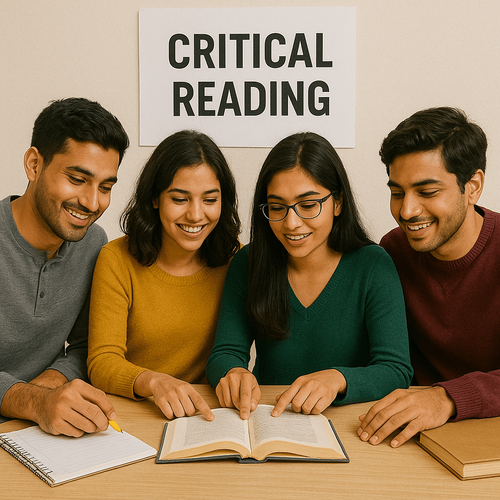

In a world flooded with information, critical reading is the skill that helps you think, not just read. It means analysing, questioning, and evaluating what you read to uncover meaning, bias, and logic. Instead of accepting words at face value, you engage actively with ideas, making reading a tool for understanding, reasoning, and independent thought in learning and everyday life.
What is Critical Reading?
Critical reading is the process of going beyond simply understanding the words on a page, it’s about analysing, questioning, and evaluating what you read to form a thoughtful judgment. Instead of accepting information at face value, a critical reader digs deeper to understand the author’s purpose, argument, evidence, and assumptions behind the text.
At its core, critical reading is an active and reflective process. It requires you to engage with the text, not just to know what the author is saying, but how and why they are saying it. You become a participant in the reading process, constantly asking:
- “What is the author trying to prove?”
- “Is the argument supported by credible evidence?”
- “Are there any biases or gaps in reasoning?”
For example, imagine reading an article about the benefits of social media. A non-critical reader might accept the claims at face value. But a critical reader would question:
- Who wrote it, a researcher, a marketer, or an influencer?
- What data supports the claim that social media “improves productivity”?
- What perspectives are missing, mental health impacts, privacy issues, or time spent online?
By doing this, the reader not only understands the text but also evaluates its reliability and fairness.

Why is Critical Reading Important?
Critical reading is more than a study skill; it’s a lifelong tool for smarter thinking. It helps you question ideas, evaluate facts, and draw logical conclusions. By engaging deeply with text, you sharpen comprehension, boost analytical power, and make informed judgments, skills that enhance learning, communication, and decision-making across all areas of life.
Helps You Make Informed Decisions
Critical reading trains you to evaluate evidence, detect bias, and separate facts from opinions. It prevents you from accepting information blindly and helps you form conclusions based on logic, not emotion.
Example:
If you read an article claiming a new diet “guarantees weight loss,” a critical reader would check the source, sample size, and whether scientific studies back the claim, instead of believing it instantly. This approach helps you make well-reasoned, fact-based decisions in daily life.
Builds Stronger Comprehension and Retention
When you read critically, you don’t just memorise words, you understand meanings, patterns, and relationships. By questioning and summarising as you go, you engage your brain more deeply, improving both comprehension and memory.
Example:
While reading a chapter on climate change, a critical reader identifies the main argument, notes examples of human impact, and connects it to prior knowledge. This active engagement helps retain information longer and recall it accurately later.
Develops Analytical and Logical Thinking
Critical reading boosts your ability to analyse arguments, spot inconsistencies, and evaluate reasoning. You learn to distinguish between valid logic and emotional persuasion, making your thought process sharper and more structured.
Example:
If a political article uses emotional language instead of evidence, a critical reader spots the logical fallacy, such as appealing to fear, and questions the reliability of the claim. This develops logical thinking that applies beyond reading, into real-world problem-solving.
Improves Writing and Communication Skills
Reading critically improves your understanding of how ideas are structured, supported, and communicated effectively. You observe how good writers use evidence, transitions, and tone, skills that reflect in your own writing and speaking.
Example:
A student analysing a well-argued editorial learns how the writer builds persuasion using facts and examples. This helps them write essays or reports that are clear, cohesive, and convincing.
Essential for Academic and Professional Success
In both academics and professional life, success depends on your ability to understand, evaluate, and synthesise information. Critical reading ensures that your decisions, arguments, and conclusions are accurate and well-grounded.
Example:
A manager reading a market report uses critical reading to question data sources, check trends, and identify assumptions before making business decisions. Similarly, students apply it to analyse research papers and develop strong academic arguments.
Also Read, How to Achieve Clear Communication
Key Features of a Critical Reader
A critical reader doesn’t just absorb information, they interact with it, question it, and evaluate its credibility. Instead of passively accepting what’s written, they think independently, look for evidence, and connect ideas to a broader context. This mindset turns reading into an active, reflective process that strengthens understanding and judgment. Below are the key traits that define a true critical reader.
1. Curious and Inquisitive
A critical reader constantly asks questions, Why did the author say this? What’s the evidence? What’s being left out? This curiosity drives deeper exploration and prevents surface-level understanding.
Example:
When reading an article on “Artificial Intelligence in Education,” a curious reader doesn’t just note benefits. They also ask, What challenges exist? How reliable are these claims? This questioning leads to a more balanced view of the topic.
2. Analytical and Observant
Critical readers break down complex ideas into smaller parts and examine how each element supports the author’s argument. They pay attention to tone, structure, examples, and the logic connecting them.
Example:
In a persuasive essay, a critical reader analyses whether the author uses facts, statistics, or emotional appeals. By doing so, they identify if the argument is based on evidence or manipulation.
3. Open-Minded but Skeptical
Being a critical reader means keeping an open mind while still maintaining healthy skepticism. You consider different perspectives, even those you disagree with, but you don’t accept them without proof.
Example:
When reading about alternative medicine, an open-minded reader listens to both sides, testimonials and scientific evidence, before forming a conclusion. This balance between openness and scepticism ensures fair, unbiased judgment.
4. Logical and Evidence-Oriented
Critical readers rely on reasoning and proof rather than emotions or opinions. They examine how the author supports claims, whether through research, expert testimony, or logical argumentation.
Example:
If a news report claims “remote work boosts productivity,” a logical reader looks for data or studies backing that statement instead of relying on anecdotal experiences.
5. Reflective and Self-Aware
A critical reader constantly reflects on their own beliefs, biases, and prior knowledge while reading. They understand that interpretation is shaped by perspective, so they stay aware of how their experiences may influence understanding.
Example:
While reading about cultural traditions, a reflective reader might realise their judgment comes from limited exposure and take time to learn more before concluding. This self-awareness deepens empathy and comprehension.
6. Purposeful and Goal-Driven
Critical reading is intentional, the reader knows why they’re reading and what they’re trying to find. This purpose helps them filter irrelevant information and focus on meaningful insights.
Example:
When reading a research article, a goal-driven reader focuses on methodology, results, and implications, instead of reading every paragraph in detail. This saves time and improves clarity.
Work on Your Reading Skills, Join Planet Spark Demo Class Today
Stages of Critical Reading
Critical reading is not a single act, it’s a three-stage process that moves from preparation to reflection. Each stage helps you engage more deeply with the text, ensuring that you don’t just read but truly understand and evaluate what’s written. Let’s explore the three main stages: Pre-Reading, During Reading, and Post-Reading, with clear steps and examples.
Pre-Reading, Setting a Purpose
Before diving into a text, a critical reader always starts with a clear purpose. Pre-reading helps you prepare mentally, activate prior knowledge, and set expectations. It’s about understanding what you’re reading and why you’re reading it.
Key actions in this stage:
- Skim the title, introduction, and subheadings to get a sense of the topic.
- Ask questions like: “What do I already know about this?” and “What might the author’s perspective be?”
- Identify the type of text, is it persuasive, informative, or analytical?
Example:
Before reading an article titled “The Future of Renewable Energy,” you might predict that it will discuss solar, wind, or sustainability trends. By identifying your goal, for example, understanding how policy affects renewable energy, you know what to focus on while reading.
Pre-reading creates a roadmap that helps you read with direction and curiosity, not confusion.
During Reading, Active Analysis
This is where critical engagement truly happens. During reading, you interact with the text by questioning, annotating, and analysing how ideas are presented. Instead of just absorbing words, you evaluate the logic, evidence, and tone of the writing.
Key actions in this stage:
- Highlight or underline key arguments, data, or contrasting viewpoints.
- Ask yourself: “Is the author’s reasoning sound?” “What assumptions are being made?”
- Notice tone and bias, is the author objective, persuasive, or emotional?
- Connect ideas within the text and relate them to your own knowledge.
Example:
While reading a research-based article on online learning, a critical reader examines whether the data truly support the author’s claim that it “improves performance.” They check sample size, research validity, and look for missing perspectives (like social interaction or accessibility issues).
Active analysis transforms reading from a passive task into an intellectual dialogue between the reader and the author.
Post-Reading, Reflection and Evaluation
Once you finish reading, the critical process continues. This stage focuses on reflection, synthesis, and judgment, understanding what the text means and how credible it is. You analyse not just what was said, but how effectively it was communicated.
Key actions in this stage:
- Summarise the main argument in your own words.
- Ask: “Was the author convincing?” “What evidence was strong or weak?”
- Reflect on how the reading changes or challenges your own thinking.
- Compare it with other sources or viewpoints for balance.
Example:
After reading an essay on social media’s influence on mental health, you might conclude that while the author presented valid research, their argument overlooked the role of content moderation or cultural differences. This reflection helps you form a more nuanced, personal conclusion.
Post-reading ensures that what you’ve read becomes knowledge you can apply, question, and build upon, not just information to memorise.
Read Here, Power of Tone and Expression
Strategies to Develop Critical Reading Skills
Becoming a critical reader doesn’t happen overnight, it’s a skill built through practice, curiosity, and reflection. The goal isn’t just to understand what a text says, but to explore how and why it says it. These proven strategies will help you actively engage with any piece of writing, evaluate its credibility, and develop deeper insight and judgment.
Ask Questions While You Read
The foundation of critical reading lies in asking the right questions. Every time you read, think of it as a conversation with the author, one where you challenge, clarify, and probe deeper.
Ask yourself:
- Who is the author and what is their purpose?
- What evidence supports the main argument?
- Are there assumptions or hidden biases?
- What counterarguments are missing?
Example:
If you’re reading an article about remote work productivity, question whether the author’s claim applies to all industries or just specific cases. By interrogating the text, you turn passive reading into active analysis, sharpening both comprehension and critical thinking.
The Author’s Argument and Evidence
Every piece of writing is built around an argument, an idea the author wants to prove, supported by evidence. Critical readers look beyond surface details to identify these components and evaluate how well they connect.
How to do this:
- Identify the main claim or thesis.
- List the supporting points or examples.
- Check if the evidence logically backs the argument.
Example:
In an article arguing that technology improves education, the author’s claim may sound convincing, but a critical reader checks if the evidence includes data, case studies, or expert sources rather than just opinions. Recognising the structure of argument and proof helps you spot weak logic and incomplete reasoning.
Recognise Bias and Perspective
Every author writes from a particular point of view, shaped by culture, beliefs, or experiences. Critical readers detect these biases and assess how they influence the argument. Recognising bias doesn’t mean dismissing the text; it means understanding its context and limitations.
How to detect bias:
- Look for emotionally charged or one-sided language.
- Ask: “Whose voice is missing?”
- Notice if alternative views are fairly represented.
Example:
An article promoting electric cars may highlight environmental benefits but ignore battery waste concerns. A critical reader recognises this selective presentation and understands that the text supports a specific agenda.
Evaluate the Quality of Evidence
Strong arguments rely on credible, relevant, and sufficient evidence. Critical readers don’t just accept statistics or quotes, they verify their sources and assess their reliability.
Check for:
- Credible sources (academic, peer-reviewed, or verifiable).
- Up-to-date information.
- Balanced representation of facts.
- Logical consistency between claim and proof.
Example:
If a health article cites “recent studies,” a critical reader might question which studies, who conducted them, and whether the results are generalisable. This ensures that beliefs are built on fact, not persuasion.
Boost Your Child’s Reading Confidence, Book a Planet Spark Demo Class Now
Make Connections Between Ideas
Critical readers connect what they read to other texts, experiences, or real-world situations. These connections deepen understanding and help identify patterns, contradictions, and broader implications.
Ways to connect:
- Compare the text with another source on the same topic.
- Relate new ideas to your prior knowledge.
- Ask: “How does this fit into the bigger picture?”
Example:
After reading an essay on renewable energy, you might recall a news report about policy challenges. By connecting both, you gain a more well-rounded understanding, seeing how theory and practice intersect.
Summarise and Reflect After Reading
Once you’ve finished reading, summarise the key ideas in your own words and reflect on what you’ve learned. This final step transforms passive reading into lasting comprehension. Reflection helps you evaluate the text’s strength, relevance, and impact on your thinking.
How to reflect:
- Write a short summary of the main argument.
- Identify what was convincing or weak.
- Note how the reading changed or reinforced your opinion.
Example:
After reading a research article on digital learning tools, you might summarise that while they increase accessibility, they also require better teacher training. Reflecting like this strengthens retention and builds independent judgment.
How Planet Spark Helps in Improving Reading Skills?
PlanetSpark helps children strengthen reading skills through structured lessons, engaging activities, and personalised coaching. With expert mentors and interactive learning formats, kids develop stronger comprehension, vocabulary, and reading confidence. The platform ensures children understand what they read—not just decode it—through practice-based learning.
- 1:1 Personal Coaching by Expert Mentors: Mentors offer personalised guidance, helping children understand texts clearly and develop accuracy, confidence, and deeper comprehension.
- Step-by-Step Lessons: Lessons simplify concepts like context, tone, main ideas, and supporting details, enabling children to process information effectively.
- Engaging Games and Activities: Reading-based games, quizzes, and storytelling sessions make learning enjoyable while reinforcing comprehension naturally.
- Critical Reading Skill Development: Children learn to analyse texts, identify key arguments, understand perspectives, and distinguish facts from opinions, core skills for higher-level reading.
- Focus on Logical Thinking and Inference: PlanetSpark trains students to draw conclusions, make inferences, and connect ideas across paragraphs, helping them think beyond surface-level reading.
Strengthen Reading & Comprehension Skills, Enrol for a Free Planet Spark Demo Today
Conclusion
Critical reading isn’t just about understanding words, it’s about thinking beyond them. It empowers you to question ideas, analyse evidence, and form your own perspective rather than accepting everything at face value. By practising active questioning, identifying bias, and reflecting deeply, you become not just a better reader, but a sharper thinker and communicator.
Ready to sharpen your reading and communication skills? Join PlanetSpark and learn how to read, think, and speak with confidence through expert-led, engaging programs that turn every learner into a powerful communicator.
Frequently Asked Questions
The goal of critical reading is to go beyond understanding words, it’s to analyse, question, and evaluate what the author says. It helps you form your own opinion instead of accepting everything as true.
Normal reading focuses on what the text says.Critical reading focuses on why and how it says it, by examining tone, logic, and evidence to judge reliability.
Critical reading strengthens your analytical and logical thinking. It teaches you to identify strong arguments, spot weak reasoning, and make balanced judgments in everyday life.
Start small, read short articles or blogs, highlight key points, and ask questions like “Is this fact or opinion?” or “What’s the evidence?”. Reflect on what you agree or disagree with and why.
With so much information online, critical reading helps you separate truth from bias. It builds awareness, sharpens judgment, and makes you a confident, independent thinker.