
E Sound Words for Kids | Easy Examples & Phonics Practice


Table of Contents
- What Are E Sound Words?
- Short E Sound Words
- Sentences Using Short E Sound Words
- Long E Sound Words
- Why Sound Recognition Matters in Reading
- Common Spelling Patterns for Long E Sound
- Silent E and Its Role in Sound
- E Sound Word Families
- Comparing Short E and Long E Words
- E Sound in Multisyllable Words
- Common Errors Children Make with E Sounds
- Using E Sound Words in Reading
- Using E Sound Words in Writing
- Using E Sound Words in Speaking
- Using E Sounds in Everyday Conversations
- Reading Aloud for Confidence
- Common Pronunciation Problems with E Sounds
- Using E Sound Words in Storytelling
- Games to Make E Sound Practice Fun
- Table: Practice Methods at a Glance
- Checkpoint: Self Assessment
- Parent Support for Practice
- Teacher Support in Classrooms
- About PlanetSpark : Spoken English
English begins with sounds, and the “E” sound is one of the most important ones children learn early. Found in everyday words like bed, pen, tree, and me, this sound helps kids read clearly, spell correctly, and speak with confidence. Understanding E sound words makes reading easier and more enjoyable.
At PlanetSpark, children learn E sound words through personalised 1:1 live classes with expert trainers. Using phonics-based methods and speaking practice, we help children improve pronunciation, reading fluency, and overall communication building confidence that lasts beyond the classroom.
What Are E Sound Words?
E sound words are words that contain the letter “E” and produce an “E” sound when spoken. This sound can change depending on the word.
The “E” sound can be:
Short E sound
Long E sound
Understanding the difference between these sounds helps children read correctly and avoid confusion while speaking.
“Book a Free Demo Class” and help your child master sounds, reading, and speaking with confidence.
Why Are E Sound Words Important for Children?
Learning E sound words helps children:
Read smoothly and clearly
Spell words correctly
Improve pronunciation
Build strong phonics skills
Speak with confidence
Children in Classes 5 and 6 often read longer sentences and paragraphs. Knowing sound patterns helps them read faster and understand better.
Types of E Sounds in English
There are mainly two types of E sounds that children should learn.
Short E sound
Long E sound
Each sound appears in different types of words.
Short E Sound Words
The short E sound is soft and quick. It sounds like “eh”.
Examples of short E sound words :
Bed
Pen
Red
Net
Hen
In these words, the “E” sound is short and sharp
Simple Explanation of Short E Sound
The short E sound is usually found in short words and closed syllables where the vowel is followed by consonants.
Example:
Bed
The “e” makes a short “eh” sound.
Short E Sound Word List
Word | Sound
Bed | eh
Pen | eh
Leg | eh
Men | eh
Ten | eh

Sentences Using Short E Sound Words
The cat sat on the bed.
I have a red pen.
Ten men ran fast.
Reading sentences aloud helps children recognise the sound easily.
Activity: Find the Short E Sound
Activity Name: Sound Spotter
Instructions:
Read a short paragraph.
Circle words with the short E sound.
Example words to find:
Bed, pen, net, leg
This improves listening and reading skills.
Common Mistakes with Short E Sound
Children may confuse short E with:
Short I sound
Short A sound
Example:
Pen vs Pin
Practicing pronunciation helps reduce confusion.
Book a Free Demo Class Today
Discover how guided learning builds strong language skills.
Long E Sound Words
The long E sound says its name “ee”.
Examples of long E sound words:
Me
Tree
See
Feet
Green
These words have a clear, stretched “ee” sound.
Simple Explanation of Long E Sound
The long E sound usually appears when:
The word ends with “e”
The word has “ee” or “ea”
The “e” is pronounced clearly
Example:
Tree
The “ee” makes a long “ee” sound.
Long E Sound Word List
Word | Sound Pattern
Me | e
Tree | ee
See | ee
Leaf | ea
Green | ee
Sentences Using Long E Sound Words
I can see the tree.
The leaf is green.
Please give this book to me.
These sentences help children hear the long E sound clearly.
Activity: Match the Sound
Activity Name: Short or Long?
Instructions:
Write two columns: Short E and Long E.
Sort the words correctly.
Words:
Bed, see, pen, tree, red, me
This helps children identify sound differences.

Checkpoint: Quick Understanding Test
Ask children:
Does bed have a short or long E sound?
Does tree have a short or long E sound?
Correct answers:
Bed – Short E
Tree – Long E
Why Sound Recognition Matters in Reading
When children recognise E sounds:
They read faster
They understand words better
They pronounce words correctly
They avoid guessing words
Sound recognition builds confidence in reading aloud.
Parent Tip for Practicing E Sounds at Home
Parents can:
Read aloud with children
Correct gently when needed
Play sound games
Encourage repetition
Daily practice improves fluency.
Teacher Tip for Classroom Learning
Teachers can:
Use word charts
Conduct sound drills
Encourage reading aloud
Praise effort
This creates a positive learning environment.
Common Spelling Patterns for Long E Sound
The long E sound can be spelled in many ways. Learning these patterns helps children read unfamiliar words easily.
E Sound Spelling Patterns
Spelling Pattern | Examples
ee | see, tree, feet
ea | leaf, read, seat
e | me, be, he
y | happy, funny
ie | field, piece
These patterns all produce the same “ee” sound.
Understanding the EE Pattern
The “ee” pattern is the most common spelling for the long E sound.
Examples:
See
Bee
Free
Green
Sentence examples:
I can see a green tree.
The bee is flying.
Understanding the EA Pattern
The “ea” pattern can produce the long E sound in many words.
Examples:
Leaf
Read
Clean
Seat
Sentence examples:
Please clean your seat.
I read a book under the tree.
Important Note About EA Words
The “ea” pattern does not always sound like long E.
Example:
Bread (short E sound)
Children should practice reading these words carefully.
Silent E and Its Role in Sound
Sometimes, the letter “e” at the end of a word changes the vowel sound before it. This is called the silent E rule.
Examples:
Pet → Pete
Met → Mete
Not → Note
The silent E makes the vowel say its name.
Table: Words With and Without Silent E
Without E | With Silent E
Pet | Pete
Met | Mete
Pin | Pine
Cap | Cape
Activity: Add the Silent E
Activity Name: Magic E
Instructions:
Write a word.
Add “e” at the end.
Read the new word.
Example:
Tap → Tape
This activity helps children understand sound changes.
E Sound Word Families
Word families are groups of words that share the same ending sound.
Common Short E Word Families
Word Family | Examples
-et | pet, net, wet
-en | pen, hen, ten
-ed | bed, red, fed
Common Long E Word Families
Word Family | Examples
-eet | feet, meet
-eed | seed, feed
-een | green, seen
Why Word Families Help Children
Word families help children:
Learn spelling faster
Recognise patterns
Improve reading speed
Build vocabulary
Comparing Short E and Long E Words
Short E Word | Long E Word
Bed | Bead
Pen | Peen
Met | Meet
Red | Read
Children should listen carefully to the sound difference.
Help Your Child Read Clearly and Confidently
Strong phonics skills build lifelong learning success.
Activity: Sound Sorting Game
Activity Name: Sound Sort
Instructions:
Make two columns: Short E and Long E.
Sort given words into the correct column.
Words:
Bed, meet, pen, tree, red, green
E Sound in Multisyllable Words
Long E sounds also appear in longer words.
Examples:
Teacher
Even
Repeat
Complete
Sentence example:
The teacher asked me to repeat the word.
Pronunciation Tip for Multisyllable Words
Children should:
Break the word into parts
Listen for the E sound
Read slowly and clearly
Common Errors Children Make with E Sounds
Mistake | Correction
Mixing short and long E | Practice listening
Wrong pronunciation | Read aloud
Spelling confusion | Learn patterns
Mistakes are part of learning and improve with practice.
Activity: Read and Underline
Activity Name: Sound Finder
Instructions:
Read a paragraph.
Underline all words with long E sound.
This improves reading awareness.
Checkpoint: Quick Sound Check
Ask children:
Does bread have a long or short E sound?
Does feet have a long or short E sound?
Correct answers:
Bread – Short E
Feet – Long E
Parent Tip for Sound Practice
Parents can:
Play word games
Read bedtime stories aloud
Correct gently
Encourage daily practice
Teacher Tip for Classroom Activities
Teachers can:
Use sound charts
Practice word families
Conduct reading circles
Encourage repetition
Why Practice Is Important for Mastering E Sounds
Learning about E sounds is only the first step. Children need regular practice to use these sounds confidently while reading, writing, and speaking. Practice helps children recognise patterns quickly and pronounce words correctly without hesitation.
When children practise E sound words regularly, they:
Read more fluently
Spell words correctly
Speak clearly
Gain confidence while reading aloud
Using E Sound Words in Reading
Reading helps children hear and understand E sounds in real sentences. When children read aloud, they learn how sounds flow naturally in speech.
Tips for Reading E Sound Words Correctly
Children should:
Read slowly at first
Listen to each vowel sound
Notice spelling patterns
Repeat difficult words
Parents and teachers should encourage reading aloud instead of silent reading during practice.
Reading Practice Paragraph
Read the paragraph aloud and listen for E sounds.
The green tree stands near the red fence.
I can see ten birds sitting on the branch.
They rest on the tree and feel free.
Children should underline all E sound words while reading.
Activity: Sound Highlight Reading
Activity Name: Read and Mark
Instructions:
Read a short passage.
Underline short E words.
Circle long E words.
This activity builds sound recognition and attention.
Support Your Child’s Language Development Early
Sound-based learning improves reading and speaking.
Using E Sound Words in Writing
Writing helps children remember correct spellings and sound patterns. When children write E sound words in sentences, they understand how sounds work in context.
Writing Tips for Children
Children should:
Say the word aloud before writing
Think about the sound
Choose the correct spelling pattern
Check spelling after writing
Sentence Writing Practice
Ask children to write sentences using given words.
Words:
Bed, tree, green, pen, see
Sample sentences:
I sleep on my bed every night.
I can see a green tree.
I write with a blue pen.
Writing sentences strengthens spelling and sound understanding.
Activity: Fill in the Blanks
Activity Name: Choose the Right E
Instructions:
Fill in the blanks with correct E sound words.
I can ___ the bird. (see / set)
The ___ is green. (tree / tray)
The cat sat on the ___. (bed / bad)
Correct answers:
see
tree
bed
Using E Sound Words in Speaking
Speaking practice helps children pronounce E sounds clearly and confidently. It also improves communication skills.
Speaking Tips for Clear E Sounds
Children should:
Open their mouth properly
Speak slowly
Stretch long E sounds
Keep short E sounds quick
Activity: Sound Stretch Game
Activity Name: Stretch the Sound
Instructions:
Say a short E word quickly.
Say a long E word slowly.
Example:
Bed (quick)
Tree (slow)
This helps children feel the difference between sounds.
Give Your Child Structured Phonics Practice
Daily sound practice leads to confident readers.
Using E Sounds in Everyday Conversations
Children use E sound words daily without noticing. Becoming aware of these sounds improves clarity.
Examples in daily speech:
Please help me.
I feel happy today.
Let us meet after school.
Encouraging children to listen to their own speech helps improve pronunciation.
Reading Aloud for Confidence
Reading aloud builds confidence and fluency.
Benefits of reading aloud:
Improves pronunciation
Builds vocabulary
Reduces hesitation
Strengthens listening skills
Children should read aloud for at least 10 minutes daily.
Activity: Family Reading Time
Activity Name: Read Together
Instructions:
Child reads aloud.
Parent listens patiently.
Correct gently if needed.
This builds confidence and bonding.
Common Pronunciation Problems with E Sounds
Problem | Solution
Mixing short and long E | Practice minimal pairs
Skipping E sounds | Slow reading
Wrong stress | Read aloud regularly
Example of minimal pairs:
Bed – Bead
Met – Meet
Using E Sound Words in Storytelling
Storytelling is a fun way to practise sounds.
Activity: E Sound Story
Activity Name: Sound Story
Instructions:
Write a short story using at least 5 E sound words.
Read it aloud.
Sample words:
Tree, bed, see, green, pen
This improves creativity and sound use.
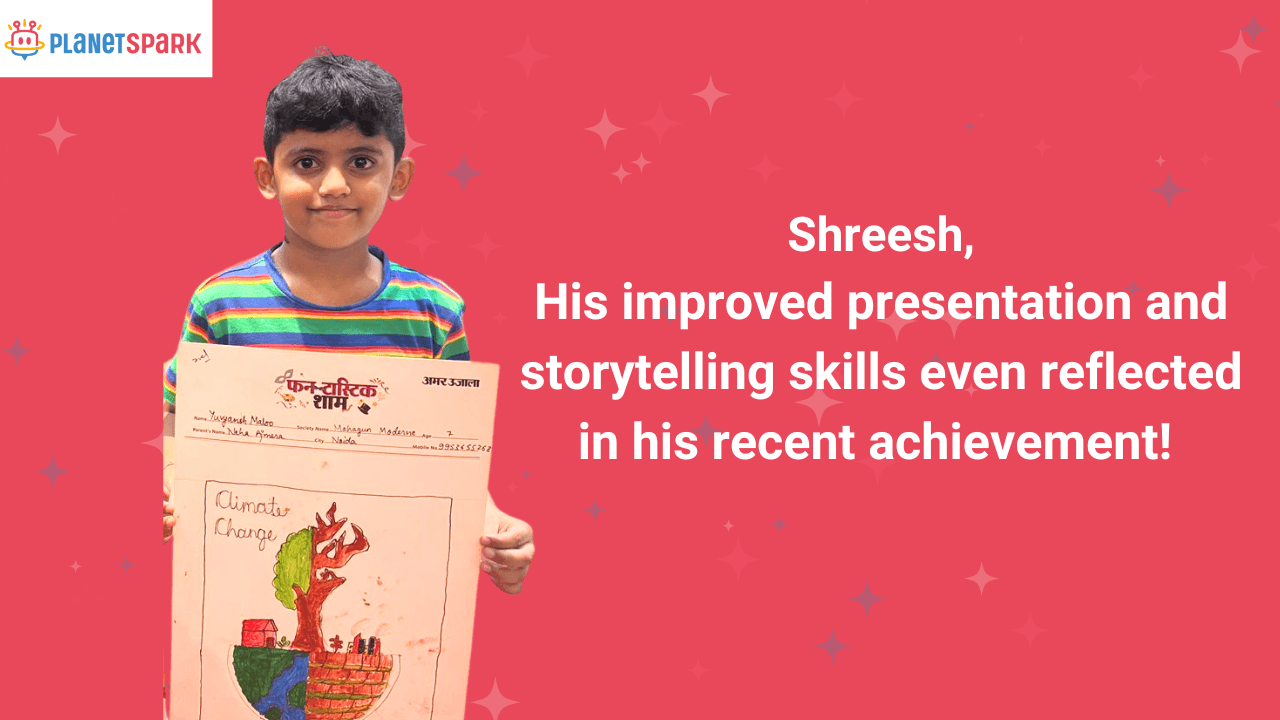
Success Story: Yuvyansh (Age 6)
PlanetSpark helped Yuvyansh build confidence and express his ideas more creatively. With improved storytelling and presentation skills, he proudly won second place in the Junior Category of the ‘Climate Change’ drawing competition organised by the Amar Ujala team a true reflection of his growing communication skills.
Games to Make E Sound Practice Fun
Game 1: Word Match
Match short E words with pictures.
Game 2: Sound Bingo
Listen to words and mark short or long E.
Game 3: Sound Race
Say as many E sound words as possible in one minute.
Games make learning enjoyable.
Table: Practice Methods at a Glance
Skill | Practice Method
Reading | Read aloud daily
Writing | Sentence practice
Speaking | Sound stretching
Listening | Sound identification
Checkpoint: Self Assessment
Ask children:
Can I hear the E sound clearly?
Can I spell E sound words correctly?
Can I say short and long E differently?
If yes, progress is strong.
Parent Support for Practice
Parents can:
Encourage reading aloud
Play sound games
Praise effort
Be patient
Positive support builds confidence.
Teacher Support in Classrooms
Teachers can:
Conduct phonics drills
Use sound charts
Encourage storytelling
Give regular feedback

About PlanetSpark : Spoken English
PlanetSpark helps children speak English fluently, clearly, and confidently through engaging 1:1 live classes. Our Spoken English Program strengthens pronunciation, fluency, vocabulary, and conversational skills enabling kids to express themselves confidently in school and everyday life.
1. 1:1 Expert Spoken English Coaching
Every child learns with a certified spoken English trainer who personalises sessions based on the child’s pace, level, and learning style ensuring clear speech and steady improvement.
2. Personalised Learning Path
A customised curriculum builds grammar, vocabulary, listening skills, and sentence formation step by step guiding learners from basic speaking to fluent communication.
3. AI-Powered Pronunciation & Fluency Feedback
With SparkX video analysis and AI-led speaking practice, students receive instant feedback on pronunciation, clarity, tone, and pacing turning practice into measurable progress.
4. Interactive & Gamified Learning
Fun tools like Word Wisdom, Listen & Spell, Fluency Quests, and daily challenges make English practice exciting and consistent, helping kids learn through play.
5. Confidence for Real Conversations
Through storytelling, roleplays, and daily conversation practice, children gain the confidence to speak naturally and clearly anytime, anywhere.
Frequently Asked Questions
E sound words are words that contain the letter “E” and produce an E sound when spoken.
Short E sounds are quick and soft, while long E sounds say the name of the letter.
They help children improve reading, spelling, pronunciation, and speaking skills.
Parents can read aloud with children, play sound games, and encourage daily practice.
No. E sounds also appear in longer words like teacher and repeat.