
English Language Learning: Complete Guide and Speaking Strategies


Learning the English language is one of the most valuable skills in today’s global world. Whether someone wants to advance in a career, score well in exams, travel confidently, or communicate with people across cultures, English becomes the common bridge. But despite years of studying grammar and textbooks, many learners still struggle with speaking fluently, expressing ideas, or understanding conversations at natural speed.
In this blog, you will find practical insights, proven techniques, helpful examples, and structured tips to improve your English language learning journey. All the strategies shared here align with modern, real-world communication practices used by advanced learning platforms like PlanetSpark’s Spoken English Course.
What English Language Learning Truly Means Today?
English learning is no longer about memorizing grammar rules or translating sentences word-by-word. Today, effective learning focuses on:
• Using English actively instead of passively
• Building natural communication skills
• Understanding context, tone, intention, and fluency
• Developing listening, speaking, reading, and writing abilities together
• Practicing in real-life situations
Most learners fail because they learn English like a school subjec not as a life skill. True mastery comes when English becomes a tool, not a topic. PlanetSpark’s spoken English approach follows this exact principle: immersive speaking practice, real-time conversation, and experiential learning.
Tips and Strategies for Effective English Language Learning
Below are deeply explained, practical tips that help learners develop strong English communication skills.
1. Build vocabulary through usage, not memorization
Learning new words is essential, but the way you learn them matters more. Many students memorize a list of difficult words but cannot use them in conversations. Instead, focus on learning words in context.
Example:
Instead of memorizing the word “meticulous,” learn it in a phrase:
“She is meticulous about her work.”
This allows you to understand meaning, tone, and usage.
Create sentences, speak them aloud, or use them in daily conversations. Repetition builds long-term memory.
2. Practice English speaking every single day
Speaking is a muscle the more you use it, the stronger it becomes. Many learners avoid speaking because they fear making mistakes, but avoiding practice slows learning. Speak for at least 10–15 minutes a day.
Ways to practice daily:
• Speak in front of a mirror
• Record your voice
• Describe your day in English
• Talk about what you learned
• Practice spontaneous responses
PlanetSpark classes use guided conversations where learners speak for more than 70 percent of the session, helping them practice naturally.
3. Listen to English actively, not passively
Listening is the foundation of speaking. If you can understand the rhythm, accent, pauses, and natural expressions of English speakers, your own speaking becomes stronger.
Active listening means:
• Trying to understand tone
• Noticing word stress
• Paying attention to real-life conversations
• Listening to podcasts, interviews, or stories
Example:
When someone says, “Do you wanna grab a coffee?”, you learn informal contractions naturally. This cannot be learned from textbooks alone.
4. Learn grammar intuitively instead of memorizing rules
Grammar makes communication clear, but memorizing rules makes speaking unnatural. Learn grammar through patterns and usage.
Example:
Instead of learning the rule for present perfect, observe:
“I have finished my work.”
“I have seen that movie.”
“I have never tried sushi.”
Patterns help your brain absorb rules automatically. This method is used widely in modern spoken English training systems like PlanetSpark.
If you want to boost your confidence and speak fluent English through live practice, explore PlanetSpark’s Spoken English Course designed for children, teens, and adults. It focuses on 100 percent speaking-based learning with personalised feedback.
5. Think in English to avoid translation delays
The biggest barrier to fluency is translating thoughts from your mother tongue into English. This causes long pauses, awkward phrasing, and confusion.
Start small:
• Think about simple activities in English (“I am cooking lunch.” “I need to finish this work.”).
• Describe objects around you in English.
• Try to form quick mental responses in English.
This builds automatic thinking one of the deepest skills in language learning.
6. Use real-life situations to practice speaking
Language improves when used in meaningful situations. Instead of practicing isolated phrases, use English in:
• Ordering food
• Asking for directions
• Introducing yourself
• Making simple requests
• Explaining your opinion
PlanetSpark classes simulate real-life situations to prepare learners for actual conversations.
7. Learn pronunciation by mastering sound placement
Pronunciation is not about sounding foreign; it is about clarity. Many learners mispronounce words because they do not focus on how sounds are formed.
Example:
The “th” sound in “think” or “this” requires the tongue to come slightly between the teeth.
Learning this placement improves clarity instantly.
Practicing minimal pairs (ship/sheep, cat/cut, pin/pan) helps differentiate sounds.
8. Build fluency through connected speech
Native speakers rarely pronounce each word separately. They link sounds naturally.
Example:
“I want to go” becomes “I wanna go.”
“Did you eat?” becomes “Didja eat?”
Understanding connected speech improves listening and fluency.
9. Use storytelling to improve expression
Storytelling builds clarity, vocabulary, and structure. Tell short stories about your childhood, school life, work experiences, or imaginary scenarios. This strengthens your narrative skills and builds language flow.
Story example practice:
“Yesterday I went to the market. I noticed something interesting…”
This helps you speak continuously without pausing.
10. Read regularly to build language sense
Reading improves sentence structure, vocabulary, and comprehension. But read material that matches your level news, articles, fiction, biographies, or even children’s books.
Focus on:
• Understanding context
• Observing sentence patterns
• Noting natural expressions
Reading for 10–15 minutes daily improves your language tone and vocabulary retention
11. Practice writing to organize thoughts
Writing helps you structure ideas before speaking. Start with short paragraphs your daily routine, opinions, goals, or summaries of what you read.
Over time, increase complexity:
• Write 150-word opinions
• Create short stories
• Write emails or messages in English
The more you write, the more confident you become while speaking.
To speak confidently and fluently in structured, real-life situations, join PlanetSpark’s Spoken English Program where every session focuses on practical speaking improvement.
12. Engage in conversational drills
Conversational drills improve speed and confidence. They involve repeated practice of certain sentence structures.
Examples:
• “Can you please help me with…?”
• “I would like to know more about…”
• “In my opinion…”
Repeating these lines in different contexts builds fluency and prepares you for real communication.
13. Expand vocabulary through word families
Learning word families helps you expand vocabulary faster.
Example with the root “act”:
Act – Action – Active – Activity – Activation – Actor – Actual – Actually
This multiplies your vocabulary with less effort.
14. Break fear and hesitation through guided speaking practice
Most learners hesitate because of fear of mistakes or judgment. The only solution is structured, guided speaking practice where you get feedback.
PlanetSpark classes offer:
• Live conversations
• Feedback from communication experts
• Real-time fluency corrections
• Confidence-building speaking activities
This transforms fearful speakers into confident communicators.
15. Use technology as a learning companion
Use digital tools podcasts, YouTube channels, audiobooks, reading apps, and conversation apps to improve your exposure. Technology makes learning convenient and allows you to practise anytime. But choose resources wisely. Learn from credible and structured platforms, not random content.
PlanetSpark combines online tech tools with expert-led live classes for maximum impact.
16. Build confidence through real-time performance tracking
Track your speaking progress by:
• Recording your voice
• Tracking speed, clarity, and grammar
• Noting improvements weekly
• Identifying patterns of mistakes
PlanetSpark provides AI-powered fluency reports to highlight strengths and guide learners on what needs improvement.
17. Practice with partners or groups
Join conversation circles, group discussions, or English practice groups. When you speak with others, you learn:
• interaction
• turn-taking
• active listening
• quick thinking
• conversational flow
This creates confidence and natural fluency.
18. Focus on articulation and clarity
Articulation refers to how clearly you pronounce words. Slow down slightly, emphasize sounds correctly, and avoid mumbling.
Practice with tongue twisters:
• “She sells seashells by the seashore.”
• “Red lorry, yellow lorry.”
This sharpens your speaking clarity.
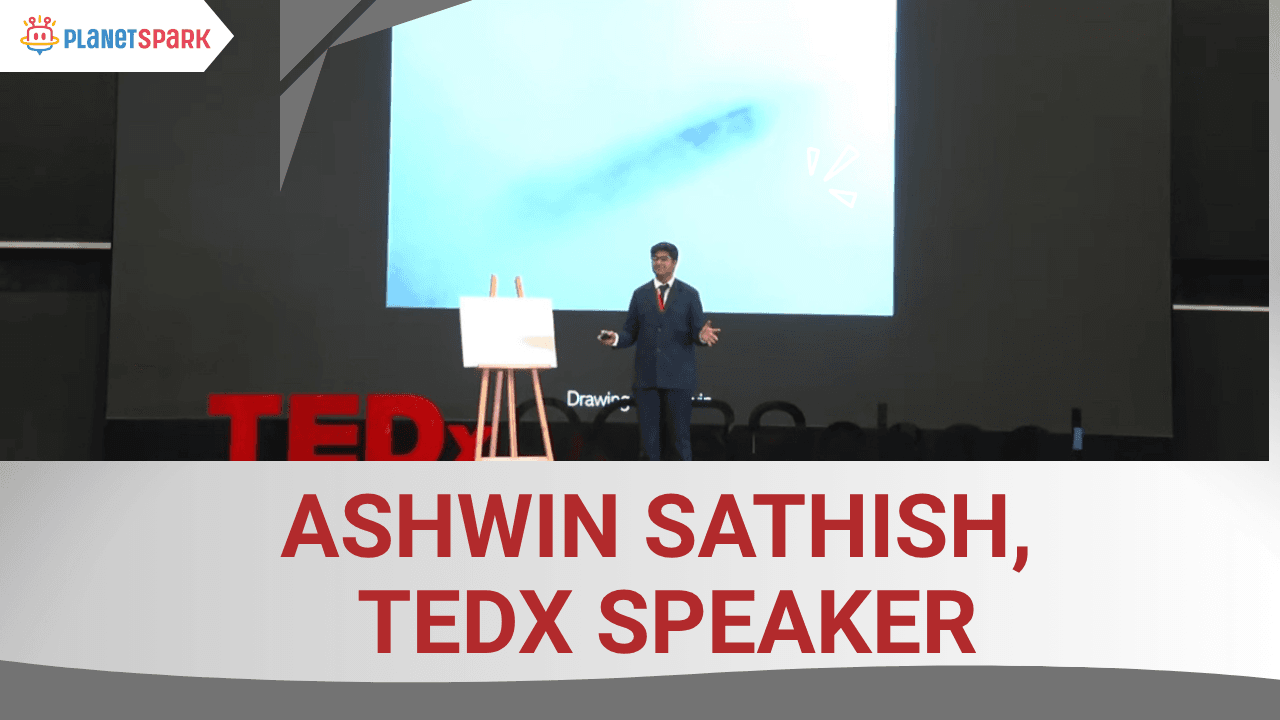
Ashwin Sathish, Grade 8 from New Delhi, stood tall as a TEDx Speaker, sparking conversations that truly matter. From classroom confidence to commanding a global stage, his journey reflects the power of voice, vision, and courage.
19. Learn through imitation (shadowing technique)
Shadowing means listening to a sentence and repeating it immediately, copying tone, rhythm, and pronunciation.
Example:
Listen to a podcast line and repeat exactly like the speaker.
This builds natural fluency faster than most traditional methods.
Why English Speaking Is the Most Important Skill?
Among all skills reading, writing, listening, and grammar speaking is the one people need the most in real-world situations. Speaking well helps you:
• Express thoughts confidently
• Communicate with clarity
• Build a strong personality
• Perform better in group discussions
• Crack interviews and presentations
• Interact socially without hesitation
Most learners can understand English but cannot speak it smoothly. The gap lies in structured speaking practice a core feature of PlanetSpark’s learning model.
Why Choose PlanetSpark For Learning English Language?
PlanetSpark delivers a modern English-speaking experience built on interactive, real-time learning. Here’s what sets it apart:
- Live, practice-driven sessions: Classes focus on speaking practice for most of the session. Learners get real-time interactions, discussions, and feedback.
- Expert communication trainers: Certified trainers guide learners with personalized corrections, helping them improve step-by-step.
- AI-based fluency tracking: Learners receive automatic reports on grammar accuracy, speaking speed, clarity, and confidence.
- Activity-based learning model: Role plays, debates, storytelling, interviews, and conversational drills create natural skill development.
- Tailored modules for all ages: Whether someone is a beginner or wants advanced communication skills, the curriculum adapts to individual needs.
Book a free demo class now!
Conclusion
English language learning is a lifelong skill that opens doors to academic success, career growth, global opportunities, and personal confidence. With the right strategies daily speaking, active listening, immersive vocabulary building, grammar through patterns, technology-based practice, and structured real-life conversations any learner can become fluent.
However, true fluency requires consistent practice and expert guidance. Platforms like PlanetSpark bring a modern, practice-first approach with live speaking sessions, personalised feedback, AI-powered reports, and real-world communication training.
Frequently Asked Questions
The best method is daily speaking practice supported by feedback. Combine listening, vocabulary building, and real-life conversations to see results. A structured program like PlanetSpark accelerates progress with guided speaking.
It depends on your current level and practice. With PlanetSpark’s 1:1 coaching and AI support, learners often see progress in a few weeks.
Hesitation comes from fear of mistakes, limited vocabulary, and lack of practice. Overcoming this requires guided speaking sessions, confidence-building exercises, and real-time corrections.
Yes, adults can learn English effectively with the right approach. Adult learners benefit from practical, conversation-based training that focuses on real-life usage instead of textbook learning.
Use mirror speaking, voice recording, listening tools, and online platforms to build confidence. Join structured programs like PlanetSpark to practice with expert trainers and peers in real conversations.