
Etymology Meaning Explained: Grow Vocabulary & Word Power with PlanetSpark


Have you ever wondered where words come from or why they mean what they do? Understanding etymology meaning helps children unlock the stories hidden inside words. Instead of memorising vocabulary, children learn how words are formed, how they change over time, and how meanings evolve. This makes learning new words easier, deeper, and more enjoyable.
In this blog, we explain etymology meaning in simple terms and show how learning etymology helps children build strong vocabulary and word power.
Etymology Meaning Explained in Detail
To fully understand etymology meaning, it helps to look beyond simple definitions and explore how words are formed and evolve over time.
Etymology is the study of the origin and history of words. It explains:
- Which language a word comes from
- What the word originally meant
- How its spelling, sound, or meaning has changed
In simple terms, etymology answers the question: Where did this word come from?
Help your child master word meanings and creative writing.
Book a free PlanetSpark demo today.
Simple Explanation for Kids
For children, etymology meaning can be explained as learning the story of a word.
Just like people have histories, words also have histories. Many English words come from languages like Latin, Greek, French, and German. Over time, these words changed slightly to become the words we use today.
Example to Understand Etymology Meaning
Let us take the word school:
- It comes from a Greek word scholē
- Scholē originally meant free time or leisure
- Over time, the meaning changed to a place of learning
This shows how word meanings can change as language grows.
Breaking a Word into Parts
Understanding etymology meaning often involves breaking words into smaller parts called roots, prefixes, and suffixes.
Example: The word "unhappy"
- Un means not
- Happy means joyful
So, unhappy means not joyful.
Another example:
The word "transport"
- Trans means across
- Port means carry
So, transport means to carry something across.
Why This Matters for Vocabulary Learning
When children understand etymology meaning, they do not need to memorise every new word. Instead, they learn patterns.
For example:
- Bio means life (biology, biography)
- Chron means time (chronology, chronicle)
- Tele means far (telephone, television)
One root can help children understand many words.
Why Is Learning Etymology Important for Kids?
Learning etymology meaning plays a powerful role in a child’s overall language development. It does much more than teach new words. It helps children understand how language works, builds confidence, and makes vocabulary learning meaningful instead of mechanical.
1. Builds Strong and Lasting Vocabulary
When children memorise words, they often forget them quickly. Etymology helps vocabulary stay longer because children understand why a word means what it does.
For example, once a child knows that spect means to see, they can understand words like spectator, inspect, and spectacle more easily.
This creates long-term vocabulary growth instead of short-term learning.
2. Helps Children Guess Meanings of New Words
One of the biggest benefits of learning etymology is that children become independent learners.
While reading, they can break unfamiliar words into parts and make intelligent guesses instead of skipping the word or feeling confused.
This improves:
- Reading confidence
- Reading speed
- Reading comprehension
3. Improves Spelling and Word Recognition
Many spelling mistakes happen because children do not understand how words are formed.
Learning word roots, prefixes, and suffixes helps children recognise spelling patterns. They understand why words are spelled a certain way, which reduces confusion and errors.
4. Strengthens Writing Skills
Children who understand etymology meaning choose words more accurately while writing.
Instead of using simple or repeated words, they learn to:
- Select precise vocabulary
- Avoid incorrect word usage
- Express ideas clearly
This leads to stronger essays, stories, and descriptive writing.
5. Boosts Speaking and Communication Skills
Etymology also improves spoken language. When children know word meanings deeply, they speak with more confidence and clarity.
They can explain ideas better, participate actively in discussions, and use new words correctly in conversations.
6. Supports Academic Success Across Subjects
Etymology is not limited to English. Many academic subjects use complex vocabulary built from Greek and Latin roots.
Understanding etymology helps children in:
- Science (biology, astronomy, geology)
- Social studies and history
- Competitive exams and aptitude tests
7. Encourages Curiosity and Love for Language
Learning etymology turns words into stories. Children become curious about language and enjoy discovering how words are connected.
This curiosity builds a positive attitude towards reading, writing, and learning.
8. Prepares Children for Advanced Language Skills
A strong foundation in etymology prepares children for:
- Advanced vocabulary
- Literature analysis
- Critical reading skills
It makes higher-level language learning easier and more enjoyable.
In short, learning etymology helps children think smarter, read better, write stronger, and communicate with confidence.
Turn vocabulary learning into confident writing and speaking.
Book a free demo now.
How Etymology Builds Vocabulary and Word Power
Learning etymology helps children see patterns in language.
For example:
- Bio means life, as in biology and biography
- Auto means self, as in autobiography
- Chron means time, as in chronology
Once children learn these roots, one root can unlock many new words. This boosts vocabulary quickly and naturally.
How Etymology Improves Writing and Speaking
Understanding etymology meaning has a direct and powerful impact on how children write and speak. When children know where words come from and what their parts mean, they stop using language blindly and start using it with purpose and confidence.
Helps Children Choose the Right Words While Writing
Many children struggle to find the right words to express their ideas. Etymology gives them clarity.
When children understand word roots, they can:
- Pick words that match their exact meaning
- Avoid using incorrect or confusing words
- Expand sentences with accurate vocabulary
For example, knowing that scrib means write helps children understand words like describe, manuscript, and subscribe, making their writing more precise.
Makes Writing More Clear and Expressive
Children often repeat simple words such as good, bad, or nice. Learning etymology helps them move beyond repetition.
They begin to understand word families and choose better alternatives, which makes:
- Essays more detailed
- Stories more engaging
- Descriptions more vivid
This improves overall writing quality.
Improves Sentence Structure and Flow
As children learn how words are formed, they also become more aware of how sentences work.
They start forming sentences that flow naturally instead of sounding broken or unclear. This helps in both creative writing and academic writing.
Builds Confidence in Speaking
When children know the exact meaning of words, they speak with greater confidence.
They hesitate less, explain ideas clearly, and feel comfortable using new vocabulary during conversations, presentations, and class discussions.
Improves Pronunciation and Word Usage
Understanding word origins often explains why certain words are pronounced in a particular way.
This helps children:
- Pronounce words correctly
- Use words in the right context
- Avoid common speaking mistakes
Strengthens Communication in Debates and Speeches
Children who understand etymology meaning perform better in speeches and debates.
They can explain ideas clearly, support points with accurate vocabulary, and sound more confident and convincing while speaking.
Encourages Thoughtful and Confident Expression
Instead of memorising lines, children learn to express their own thoughts.
This leads to:
- Original ideas
- Clear explanations
- Strong communication skills
In short, etymology helps children become better writers and confident speakers by giving them a deeper understanding of language.
Success Story: How Eshaan Became a Published Author Through Word Power
At just 12 years old, Eshaan, who began his learning journey at PlanetSpark at age 7, achieved an incredible milestone. He officially became a published author, transforming a simple classroom writing activity into a captivating storybook.
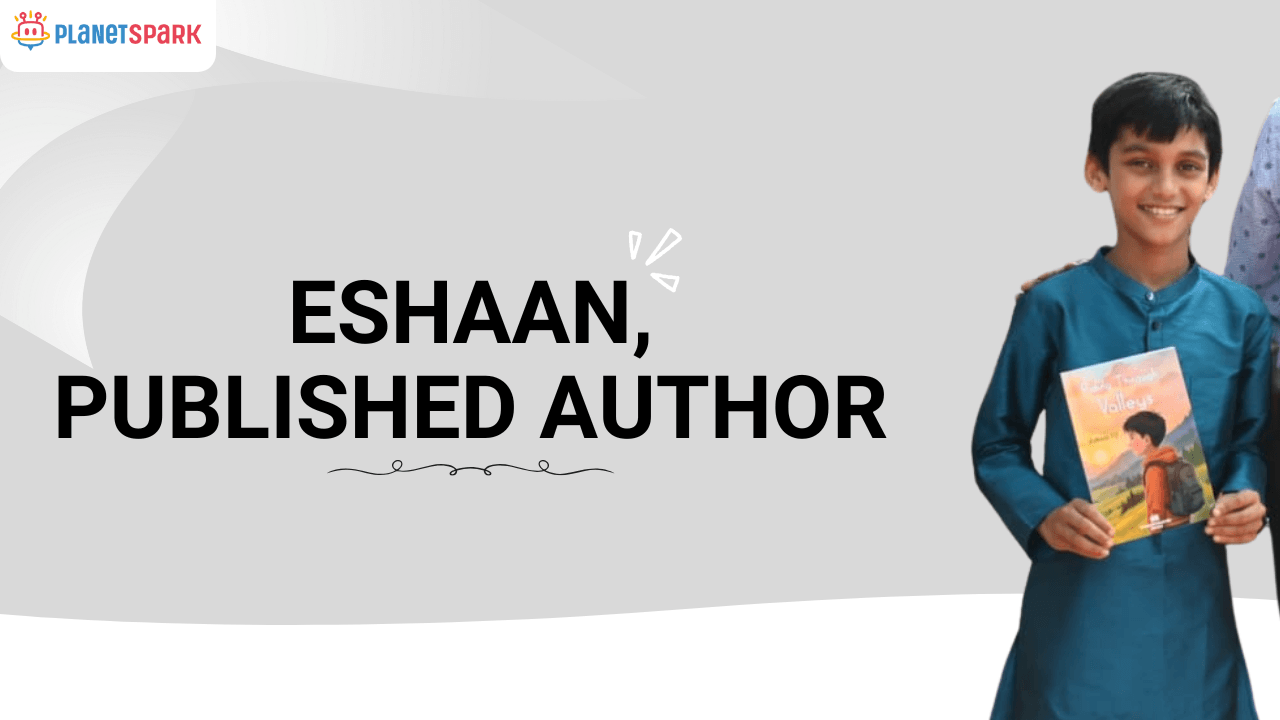
What set Eshaan apart was his growing understanding of etymology meaning and how words are built. Instead of memorising vocabulary, he learned to explore word roots, prefixes, and origins. This helped him choose stronger words, build richer descriptions, and write with clarity and confidence.
During guided writing sessions, Eshaan learned how understanding where words come from could shape how stories are told. He began experimenting with precise vocabulary, meaningful word choices, and expressive language. His sentences became more engaging, and his storytelling more powerful.
With regular practice, feedback, and structured creative writing support at PlanetSpark, Eshaan’s classroom assignment slowly evolved into a polished manuscript. What started as a learning exercise soon became a complete storybook that reflected his imagination, communication skills, and growing command over language.
How PlanetSpark Helps Children Learn Etymology
PlanetSpark helps children understand etymology meaning through a simple, structured, and practice-based approach.
Key ways PlanetSpark supports etymology learning:
- Root-based vocabulary learning: Children learn common Greek and Latin roots, prefixes, and suffixes instead of memorising word lists.
- Learning through context: Word origins are taught using stories, examples, and real-life usage, making meanings easier to remember.
- Creative writing application: Children apply etymology knowledge while writing stories, essays, and descriptive paragraphs.
- Speaking practice: New words are reinforced through conversations, presentations, and storytelling activities.
- Personalised feedback: Expert trainers guide children on correct word usage, stronger vocabulary choices, and clearer expression.
- Confidence building: Regular practice helps children use new words naturally in both writing and speaking.
By combining vocabulary learning with writing and speaking practice, PlanetSpark turns etymology into a practical skill that strengthens communication and creative expression.
Conclusion
Understanding etymology meaning helps children go beyond memorising words. It teaches them how language works, why words mean what they do, and how to use them confidently. When kids learn word origins, they read with better understanding, write with clarity, and speak with accuracy.
Etymology also builds long-term vocabulary and stronger communication skills. It supports creative writing, improves expression, and boosts confidence in both academic and everyday situations. Most importantly, it helps children enjoy learning words instead of feeling overwhelmed by them.
FAQs on Etymology Meaning
1. What is the etymology meaning?
Etymology meaning refers to the study of the origin of words and how their meanings have developed over time. It helps children understand why words mean what they do.
2. How does learning etymology help children improve vocabulary?
Learning etymology helps children remember words better by understanding their roots, prefixes, and origins. This makes vocabulary learning deeper and long-lasting.
3. At what age should kids start learning etymology?
Children can start learning basic etymology concepts from ages 6–7, once they begin reading independently and asking questions about word meanings.
4. How does etymology improve writing skills?
Etymology improves writing by helping children choose accurate words, avoid repetition, and create clearer and more expressive sentences in essays and stories.
5. Does learning etymology help in speaking skills?
Yes, understanding etymology helps children speak with confidence. They pronounce words better and use them correctly during conversations, speeches, and presentations.