
Guide on How to Recognise & Use Snowclones in English
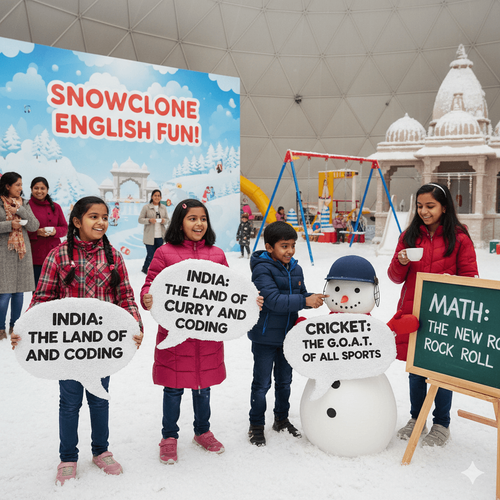

Table of Contents
- What Are Snowclones?
- Common Snowclone Examples You Already Know
- How to Recognise Snowclones in English?
- Popular Snowclone Templates for Students
- How to Use Snowclones in Your Writing and Speaking
- Where You'll Find Snowclones
- Creating Your Own Snowclones
- Common Mistakes to Avoid When Using Snowclones
- Fun Snowclone Activities for Students
- Begin Your Snowclone Adventure with PlanetSpark
Have you ever heard someone say "Orange is the New Black" or "Math is the new superpower"? These catchy phrases are called snowclones, and they're everywhere in the English language! Understanding snowclones can make you a better writer, speaker, and communicator.
At PlanetSpark, we teach students how to master creative language patterns like snowclones through our engaging communication and English courses. Learning these fun language tricks helps you express yourself more creatively and understand modern English better!
What Are Snowclones?
A snowclone is a clichéd phrase in which one or more words can be substituted to express a similar idea in a different context, often to humorous or sarcastic effect. Think of it as a fill-in-the-blank template that people use over and over again with different words! The procedure is simple and common: take a familiar quotation, title, proverb, or saying, and fit it to a new context by substituting for one or more of its words.
For example, Shakespeare's famous line "To be or not to be" has been transformed into countless variations like "To eat or not to eat," "To study or not to study," and so on. These playful adaptations keep the original rhythm and structure while creating entirely new meanings that fit different situations.
The term "snowclone" itself has an interesting origin. It was coined by American linguists Geoffrey K. Pullum and Glen Whitman through a series of short columns published via Language Log. The name is actually a clever blend of "snow cone" and "clone," inspired by the popular phrase pattern: "If Eskimos have N words for snow, X surely have M words for Y." Just like a snow cone comes in different flavors but has the same basic shape, snowclones come in different word combinations but follow the same basic pattern.
Common Snowclone Examples You Already Know
Let's look at popular snowclones that you've probably heard before:
1. "X is the new Y"
This snowclone provides a way of conveying an increase, change in nature, or change in function. Examples include:
- Pink is the new black
- Coding is the new literacy
- Green is the new gold
- Reading is the new cool
2. "To X or not to X"
Based on Shakespeare's famous line from Hamlet, this snowclone helps you create dramatic questions:
- To study or not to study
- To tweet or not to tweet
- To play or not to play
3. "The mother of all X"
This hyperbole refers to something as the greatest of its kind. Examples:
- The mother of all exams
- The mother of all science projects
- The mother of all pizza parties
4. "X and Y and Z, oh my!"
From "The Wizard of Oz" (Lions and tigers and bears, oh my!):
- Tests and projects and homework, oh my!
- Pizza and burgers and fries, oh my!
- Math and science and history, oh my!
Improve Your English Skills with PlanetSpark!
Enroll today and transform how you communicate!
How to Recognise Snowclones in English?
Recognizing snowclones is like being a language detective, and once you know what to look for, you'll start spotting them everywhere! The first clue is familiar rhythm; when you hear a phrase that sounds like something you've encountered before, even with different words, you're probably dealing with a snowclone. Your brain recognizes the pattern because it's stored in your memory from previous encounters with the original phrase or other variations.
The second clue involves imagining blank spaces. If you can picture replacing certain words while keeping the overall structure intact, that's a strong indicator you've found a snowclone. For instance, when you hear "Pizza is the new burger," you immediately understand the template could work with any two items: "X is the new Y."
Pattern Recognition Tips:
- Listen for familiar phrases with new words: If a phrase sounds familiar but uses different words, it's likely a snowclone
- Look for X, Y, Z placeholders: Snowclones have slots where words can be swapped
- Check for pop culture references: Many snowclones come from movies, songs, books, or famous quotes
- Notice repetitive structures: Snowclones follow predictable patterns
Practice Activity:
Can you identify the snowclone templates in these examples?
- "Got homework?" (from "Got milk?")
- "I'm not a scientist, but I play one in the school play" (from TV ads)
- "What happens in the classroom stays in the classroom" (from "What happens in Vegas...")
Popular Snowclone Templates for Students
Here are versatile templates you can use:
1. "X for fun and profit"
- Reading for fun and grades
- Science experiments for fun and learning
2. "In space, no one can hear you X"
- In the library, no one can hear you whisper
- In my room, no one can hear me practice
3. "X: It's not just for Y anymore"
- Math: It's not just for nerds anymore
- Vegetables: It's not just for rabbits anymore
4. "I [heart] X"
- I [heart] books
- I [heart] weekends
5. "All your X are belong to us"
This meme originated from poor English translations in a video game and went viral:
- All your homework are belong to us
- All your snacks are belong to us
How to Use Snowclones in Your Writing and Speaking
Now that you know what snowclones are and how to recognize them, let's explore how you can use them creatively in your own communication! When it comes to creative writing, snowclones can add humor and familiarity to your stories. They help readers connect with your writing because the patterns feel recognizable and comfortable. Try taking traditional proverbs and creating your own versions. For example, transform "A bird in the hand is worth two in the bush" into "A book in your bag is worth two in the library."
For school presentations, using snowclones can make your points more memorable and engaging. When discussing environmental issues, you might say "Recycling is the new cool" or "Pollution is the mother of all problems." These familiar patterns help your audience quickly grasp your message while adding a touch of creativity that makes your presentation stand out from others.
Snowclones also make excellent headlines and social media captions because they're catchy and easy to remember. During the COVID-19 pandemic, we saw an explosion of new snowclones emerge, showing how adaptable these patterns are to current events and trending topics. Whether you're writing a blog post, creating an Instagram caption, or crafting a catchy title for your school project, snowclones give you a ready-made structure that already works.
Become a Confident Communicator!
Try PlanetSpark's interactive classes for free!
Where You'll Find Snowclones
Snowclones were originally identified and discussed online as "phrases for lazy writers" or "journalistic clichés," but they've become much more than that! They've evolved into powerful communication tools that help journalists, writers, and everyday people express complex ideas quickly and memorably. Snowclones have helped journalists disguise dramatic changes in a palatable and easy-to-comprehend template that readers instantly understand.
You'll find snowclones everywhere in popular culture. Movie titles frequently use snowclone patterns to create catchy, memorable names that reference other famous works. Book authors love playing with familiar phrases to create titles that are both fresh and recognizable. Advertisers and marketers use snowclones extensively because they make ads more memorable. When you hear a familiar pattern with a twist, it catches your attention and sticks in your mind.
News headlines are perhaps the most common home for snowclones. Journalists use them to grab attention and convey information quickly. During any major event or trend, you'll see hundreds of headlines using the same basic snowclone templates with different specific words, allowing readers to quickly understand the story's context and significance.
Snowclones vs. Regular Clichés
While snowclones and clichés are related, they're not exactly the same.
Snowclones are similar to the fill-in-the-blank game of Mad Libs, where certain words may be replaced to produce new variations with altered meanings.
Creating Your Own Snowclones
Ready to create your own? Follow these steps:
Step 1: Choose a Famous Phrase
Pick something everyone knows:
- Movie quotes
- Song lyrics
- Proverbs
- Advertising slogans
Step 2: Identify Replaceable Words
Find which words can be swapped:
- "A bird in the hand is worth two in the bush"
- Replaceable: bird, hand, bush
Step 3: Create New Versions
Make it relevant to your life:
- "A book in my bag is worth two in the library"
- "A snack in my pocket is worth two in the cafeteria"
Step 4: Check If It Works
Your snowclone should:
- Be recognizable as the original
- Make sense in the new context
- Sound natural and fun
Common Mistakes to Avoid When Using Snowclones
While snowclones are fun, avoid these pitfalls:
Don't Overuse Them: Using too many snowclones makes your writing seem unoriginal. Mix them with your own unique expressions.
Make Sure They're Recognizable: If people don't recognize the original phrase, your snowclone won't work. Stick to well-known templates.
Keep Context Appropriate: Use snowclones that fit your audience and situation. What works on social media might not work in a formal essay.
Avoid Confusing Combinations: Your snowclone should make sense. "Pizza is the new pencil" doesn't work because there's no logical connection.
Fun Snowclone Activities for Students
Practice makes perfect! Try these activities:
Activity 1: Snowclone Scavenger Hunt
Find 10 snowclones in:
- Song titles on streaming platforms
- YouTube video names
- Social media posts
- News headlines
Activity 2: Create a Snowclone Story
Write a short story using at least 5 different snowclones. Make them fit naturally into the narrative.
Activity 3: Snowclone Poetry
Create poems using snowclone templates: "To read or not to read,
That is the question before bed.
Books are the new treasure,
Reading is pure pleasure!"
Activity 4: Class Snowclone Competition
Challenge your classmates to create the cleverest snowclone about your favorite subject!
Begin Your Snowclone Adventure with PlanetSpark
Snowclones are more than just linguistic curiosities; they're windows into how language evolves, adapts, and stays relevant across generations and cultures. The linguistic phenomenon of "a multi-use, customizable, instantly recognizable, time-worn, quoted or misquoted phrase or sentence that can be used in an entirely open array of different variants" was originally described by linguist Geoffrey K. Pullum in 2003, and since then, it's become an essential part of understanding modern communication.
By learning to recognize and use snowclones, you're developing valuable communication skills that will serve you throughout your life. Whether you're writing creative stories, giving persuasive presentations, crafting social media posts, or simply having conversations with friends and family, understanding these language patterns makes you a more versatile, creative, and effective communicator. Snowclones help you connect with your audience by using familiar structures while expressing fresh, original ideas.
Remember that snowclones are everywhere once you start looking for them! Challenge yourself to spot at least three snowclones this week in books, websites, conversations, or advertisements. Then try creating your own variations to share with classmates or post on social media. The more you practice recognizing and using snowclones, the more natural they'll become in your own communication style.
Language learning should be fun, engaging, and practical, exactly what PlanetSpark delivers. Join our community of young learners who are mastering not just snowclones but all aspects of effective communication. With personalized attention, interactive learning methods, and a curriculum designed specifically for kids aged 4-14, PlanetSpark is your partner in developing the language skills that will open doors throughout your academic career and beyond. Book your free demo class today and discover how exciting language learning can truly be!
Frequently Asked Questions
Snowclones are reusable phrase templates where certain words can be substituted to create new meanings. Examples include “X is the new Y” or “To X or not to X.” These patterns help writers add humor, creativity, and familiarity to their communication.
Clichés are fixed expressions repeated without change, while snowclones are flexible templates you can modify. A cliché is “Break a leg,” while a snowclone is “X is the new Y,” which can be adapted using different words.
Students can use snowclones to create catchy headlines, humorous lines, memorable presentations, and creative stories. Using familiar templates helps readers connect quickly while keeping the message fun and engaging.
Snowclones work well in media because they are recognizable and catchy. They help headlines, ads, and titles grab attention instantly. The familiar structure makes new information easier to process and remember.
Pick a famous phrase, identify which words can be replaced, and substitute them with new ones that fit your context. For example, change “To be or not to be” into “To read or not to read.” Make sure your version stays meaningful and recognizable.