
IELTS Reading Practice Explained: Build Strong Reading Skills and Academic Comprehension
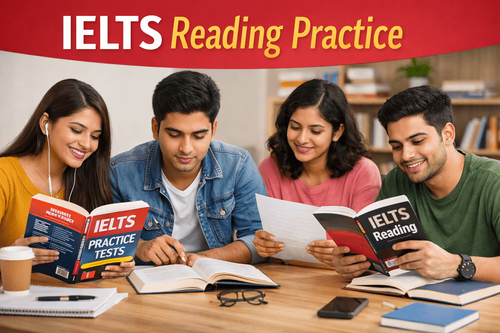

Table of Contents
- Understanding the IELTS Reading Module
- Why IELTS Reading Practice Is Essential
- Role of Practice Tests and Mock Tests
- Importance of Practising With Answers
- Academic vs General Reading Practice
- How IELTS Reading Practice Builds Academic Comprehension
- Effective IELTS Reading Practice Strategies
- IELTS Reading Practice Resources
- Academic vs General Reading Practice: What Should You Focus
- How Often Should You Practice IELTS Reading?
- How Planet Spark Helps in Acing IELTS Reading?
Preparing for the Reading module is one of the most decisive factors in achieving a high IELTS band score. Whether you are targeting Academic or General Training, IELTS Reading Practice plays a crucial role in improving accuracy, speed, and comprehension. This guide explains how structured practice strengthens reading skills, familiarises you with exam patterns, and builds the academic understanding required for success in the International English Language Testing System (IELTS).
Understanding the IELTS Reading Module
The IELTS Reading test is designed to assess how well you understand written English across different contexts. The test format varies slightly between IELTS academic reading practice and IELTS general reading practice, but both measure similar core skills: comprehension, interpretation, and information retrieval.
In the Academic version, passages are taken from journals, research articles, and analytical texts.
These are often dense, information-rich, and concept-driven. In contrast, the General Training version focuses more on everyday reading material such as advertisements, workplace notices, manuals, and descriptive articles. Regardless of the version, regular IELTS reading preparation is essential to become comfortable with long passages and unfamiliar topics.
Practising consistently helps candidates adjust to the 60-minute time limit, where they must answer 40 questions without extra reading time. This is why candidates who rely only on reading ability—but not exam-oriented practice—often struggle.

Why IELTS Reading Practice Is Essential
Many test-takers underestimate the importance of structured practice and focus only on vocabulary or grammar. However, IELTS Reading Practice goes far beyond basic language knowledge. It trains you to:
- Read quickly without losing meaning
- Identify key ideas rather than every detail
- Recognise paraphrasing and synonym usage
- Handle multiple question types confidently
Working through IELTS reading practice questions regularly allows you to understand how examiners design traps and distractors. Over time, you begin to predict answers more accurately and avoid common mistakes such as overthinking or misinterpreting information.
Boost your IELTS Reading band with expert guidance
Book a free Planet Spark demo class today.
Role of Practice Tests and Mock Tests
A major component of effective preparation is attempting full-length practice papers. An IELTS reading practice test simulates real exam pressure and tests your stamina. Unlike short exercises, full tests help you learn time management and prioritisation.
Similarly, an IELTS reading mock test is useful for measuring progress. Mock tests highlight patterns in your errors—whether you struggle with matching headings, True/False/Not Given questions, or sentence completion tasks. Analysing these mistakes is where real improvement happens.
Candidates who consistently use mock tests tend to perform better because they are mentally prepared for the exam structure and pacing. They are less likely to panic when facing difficult passages.
Importance of Practising With Answers
One of the biggest advantages of using IELTS reading practice with answers is self-evaluation. Answers allow you not only to check whether you were right or wrong but also to understand why an answer is correct.
When reviewing answers, focus on:
- Keywords in the question and passage
- How ideas are paraphrased
- Why other options are incorrect
This habit significantly improves analytical reading and prevents repeated mistakes. Simply completing tests without reviewing answers carefully limits improvement.
Academic vs General Reading Practice
Choosing the correct preparation material is critical. IELTS academic reading practice requires exposure to formal language, complex sentence structures, and abstract topics such as science, history, and social issues. Reading academic articles and research-based content helps develop this skill.
On the other hand, IELTS general reading practice demands familiarity with practical texts used in daily life. Speed and clarity matter more here, as questions are usually straightforward but time-bound.
Using the wrong type of material can affect your preparation quality, so always align your reading practice with the test format you have registered for.
Struggling with IELTS Reading speed and accuracy?
Join a PlanetSpark demo class and learn proven reading strategies.
How IELTS Reading Practice Builds Academic Comprehension
Academic comprehension is not just about understanding words—it is about processing ideas. Regular IELTS reading practice helps you:
- Follow arguments across long paragraphs
- Understand cause–effect relationships
- Interpret data, opinions, and conclusions
- Improve concentration over extended reading tasks
These skills are valuable not only for the exam but also for university studies, professional certifications, and international work environments where reading large volumes of English content is routine.
Effective IELTS Reading Practice Strategies
Strong scores in the Reading module come from strategic IELTS Reading Practice, not random reading. Candidates who approach practice with clear techniques for time, vocabulary, and accuracy improve much faster across both IELTS academic reading practice and IELTS general reading practice.
Time Management Techniques
Section-wise time allocation
The reading test has three passages and 40 questions to be completed in 60 minutes. A practical approach during an IELTS reading practice test is to spend about 15–18 minutes per passage, keeping the final few minutes for review. Many candidates waste time on the
first passage and feel rushed later, which lowers accuracy.
When to skip and return
If a question is taking too long, skip it and move ahead. During IELTS reading mock test practice, train yourself to mark difficult questions and return later. This ensures easy marks are secured first.
Vocabulary-Building Through Context
Guessing meaning without a dictionary. IELTS does not test rare vocabulary directly; it tests your ability to understand meaning from context. Regular IELTS Reading Practice teaches you to use surrounding sentences, examples, and contrasts to infer meanings naturally.
Word families and synonyms
IELTS rarely repeats words exactly. Practising IELTS reading practice questions builds awareness of synonyms and word families—for example, increase, growth, rise, or expansion. This skill is critical for matching questions with passage information.
Avoiding Common Mistakes
Overthinking answers
The correct answer is always supported by the text. Over-analyzing beyond the passage often leads to errors.
Ignoring word limits
In completion tasks, exceeding the word limit makes the answer incorrect—even if the idea is right. This is why IELTS reading practice with answers is essential.
Reading too slowly
Reading every word carefully reduces your chance of finishing the test. Practice trains you to read strategically, not thoroughly.
Daily Reading Habits for IELTS Success
Daily exposure builds consistency. Reading news articles, academic blogs, and research journals for 20–30 minutes strengthens comprehension and stamina, directly supporting your IELTS reading preparation.

IELTS Reading Practice Resources
Choosing the right resources determines how effective your preparation will be.
Free Online Practice Tests
Advantages
Free IELTS reading practice test platforms help candidates familiarise themselves with question formats, timing, and difficulty levels. They are useful for early-stage preparation.
Limitations
Many free tests lack detailed explanations, which limits learning unless paired with proper review.
Practice PDFs and Sample Papers
Practice PDFs are ideal for focused preparation. They allow offline study and repeated revision.
How to use them effectively
Attempt questions under timed conditions, then review answers carefully. Use IELTS reading practice with answers to understand paraphrasing and eliminate weak areas.
Mock Tests vs Topic-Based Practice
An IELTS reading mock test should be used weekly to assess progress and build exam stamina. This is ideal for improving specific weaknesses like True/False/Not Given or matching headings. Use it between mock tests for faster improvement.
Self-Evaluation and Progress Tracking
Track errors, note repeated mistakes, and observe patterns. Progress improves when practice is paired with analysis, not just repetition.
Academic vs General Reading Practice: What Should You Focus On?
Choosing the right focus depends on your test type under the International English Language Testing System.
- For IELTS academic reading practice, prioritise complex texts, research-based articles, and opinion-driven passages. These require deeper comprehension and interpretation skills.
- For IELTS general reading practice, focus on speed, clarity, and everyday texts such as notices, workplace documents, and instructions. Questions are more direct but time pressure is higher.
- Adjust strategies accordingly—academic candidates should practise inference and tone-based questions, while general candidates should emphasise scanning and locating information quickly.
How Often Should You Practice IELTS Reading?
Consistency is more important than long, irregular study sessions. Ideally, practise reading 5–6 days a week.
A balanced weekly plan includes:
- 3–4 days of IELTS reading practice questions
- 1–2 full IELTS reading practice test or mock tests
- Daily short reading from external sources
Spend 45–60 minutes per session, while balancing reading with writing, listening, and speaking modules. Within 4–6 weeks of disciplined practice, most candidates see measurable improvement in speed, accuracy, and confidence.
Turn IELTS Reading practice into real results.
Attend a PlanetSpark demo class and start your journey to a higher band score.
How Planet Spark Helps in Acing IELTS Reading?
PlanetSpark helps students and young adults strengthen their IELTS Reading performance by building core reading skills, academic comprehension, and exam confidence.
- The platform focuses on helping learners understand complex texts, identify key ideas, and manage time effectively—skills that are essential for achieving a high IELTS Reading band score.
- Through personalised guidance, trained mentors help learners understand IELTS Reading question patterns and what examiners expect in answers.
- Instead of random practice, students work on targeted skills such as skimming, scanning, recognising paraphrases, and handling different question types accurately.
- PlanetSpark follows a step-by-step learning approach: understanding the IELTS Reading test format → learning practical reading strategies → practising exam-style passages and questions → improving performance through detailed feedback.
- Students practise IELTS Reading through activities like passage analysis, keyword identification, True/False/Not Given practice, and timed reading exercises. These tasks improve reading speed, accuracy, and comprehension.
Conclusion
IELTS Reading success depends on consistent, strategic practice and the right guidance. By applying proven techniques, choosing suitable resources, and analysing mistakes, you can steadily improve speed, accuracy, and comprehension. To accelerate your progress, expert support makes a real difference. Book a personalised demo with PlanetSpark today and learn targeted IELTS reading strategies with structured practice, expert feedback, and confidence-building guidance designed to help you achieve your desired band score faster.
Frequently Asked Questions
Practice regularly using IELTS reading passages, focus on skimming and scanning, and review your answers to understand mistakes.
Spending 30–60 minutes a day on focused IELTS reading practice is enough to see steady improvement.
Yes. Practice tests help you understand the exam format, manage time, and build confidence before the real test.
No. You should read strategically by skimming for ideas and scanning for keywords instead of reading word by word.
Yes. Academic reading passages are longer and more complex, while general reading focuses on everyday and workplace texts.