
Jolly Phonics Sounds A to Z for Kids: The Complete Parent and Teacher Guide
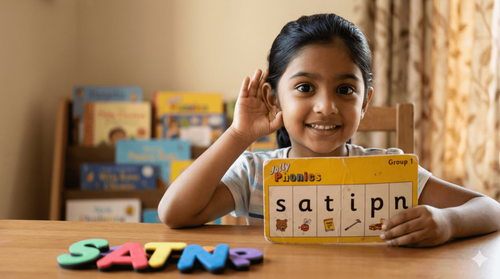

Table of Contents
- What Are Jolly Phonics Sounds A to Z and Why Do They Matter?
- PlanetSpark Complete Jolly Phonics Sounds List: All 42 Sound
- How PlanetSpark Teach Phonics to Kids Using the Jolly Phonic
- Phonics Sounds A to Z for Kids: Common Mistakes and How to F
- PlanetSpark Teaches Moving From Letters to Reading Real Word
- Phonics Activities for Kids: Making Jolly Phonics Fun at Hom
- PlanetSpark Spoken English and Communication Skills Classes
- Every Reader Starts With a Single Sound
Your child is starting to read. You've heard about phonics. Someone mentions Jolly Phonics and suddenly there's a whole system to understand, 42 sounds, actions, songs, blending rules, and a specific teaching order that isn't even alphabetical. It's a lot to take in when you just want to help your child sound out their first words.
Here's the good news: jolly phonics sounds a to z is genuinely one of the most effective early reading systems ever developed. It's structured, multisensory, and designed specifically for how young children actually learn. This blog breaks down exactly what the Jolly Phonics sounds list covers, how each sound works, how to teach phonics to kids at home, and what comes after the basics. Whether you're a parent, a teacher, or both, this is your practical starting point.
What Are Jolly Phonics Sounds A to Z and Why Do They Matter?
Jolly Phonics sounds a to z teaches children 42 letter sounds using actions, songs, and stories, giving them a multisensory foundation for reading and writing from the start.
Most people assume phonics just means learning the alphabet. It's actually deeper than that. The jolly phonics sounds a to z system covers 42 sounds, not 26, because English has far more sounds than letters. Every vowel has multiple sounds. Consonants blend in ways that create entirely new phonemes. A child who only knows letter names and not letter sounds will struggle to decode real words on a page.
That's the core problem Jolly Phonics solves. Developed by Sue Lloyd in the 1990s and refined through decades of classroom use, the Jolly Phonics system teaches each sound through a specific action, a story, and a song. The "s" sound comes with a snake action. The "a" sound involves pretending an ant is crawling up your arm. These aren't just cute additions. They're multisensory anchors that help children store and retrieve sounds far more reliably than rote repetition alone.
The jolly phonics alphabet sounds are taught in a specific order designed for maximum early reading success, not alphabetical order. The first group includes s, a, t, i, p, and n, because those six sounds let children build and read dozens of real words almost immediately. "Sat," "nip," "tan," "pin." That early success matters enormously for motivation.
Research consistently shows that children taught through systematic phonics outperform those taught through whole-language or look-and-say methods in reading accuracy and comprehension. Jolly Phonics is one of the most widely used structured phonics programs globally, used in schools across the UK, India, the US, and beyond. Understanding how it works puts you in a much stronger position to support your child at home.
PlanetSpark's Early Childhood Learning and Communication Skills classes are built on exactly this kind of structured phonics foundation, helping children develop sound awareness, blending confidence, and a genuine love of language from their earliest learning years.
Want expert guidance on teaching phonics to your child? Explore PlanetSpark's Early Childhood Learning classes today.
PlanetSpark Complete Jolly Phonics Sounds List: All 42 Sounds Explained
The jolly phonics sounds list covers 42 phonemes grouped into seven sets, each introducing sounds that combine immediately into decodable words for early readers.
This is the part most parents want and most guides bury. Here is the complete Jolly Phonics sounds list, organized by group, with examples and a note on the action for each.
- Group 1: s, a, t, i, p, n These are the foundation sounds. "s" as in "sun" (snake action), "a" as in "ant" (ant crawling action), "t" as in "tap" (turning a tap action), "i" as in "insect" (wriggling fingers), "p" as in "pet" (blowing action), "n" as in "net" (nose action). With just these six jolly phonics alphabet sounds, children can read and write words like "sat," "nap," "tin," and "sip."
- Group 2: ck, e, h, r, m, d Here the jolly phonics sounds list introduces the "ck" digraph early. Children learn that two letters can make one sound. "e" as in "egg," "h" as in "hat," "r" as in "rabbit," "m" as in "mango," "d" as in "drum."
- Group 3: g, o, u, l, f, b Short vowels "o" and "u" enter here. "g" as in "girl," "l" as in "leg," "f" as in "fish," "b" as in "bat." Children start building three-letter words with more complexity.
- Group 4: ai, j, oa, ie, ee, or This is where digraphs and long vowel sounds begin in the jolly phonics alphabet sounds sequence. "ai" as in "rain," "oa" as in "boat," "ee" as in "feet." These open up an enormous range of words.
- Group 5: z, w, ng, v, oo, oo Two sounds are represented by "oo" here. The short "oo" in "book" and the long "oo" in "moon." This distinction is one of the trickiest in phonics sounds for beginners and worth spending extra time on.
- Group 6: y, x, ch, sh, th, th Two sounds for "th" as well. The voiced "th" in "this" and the unvoiced "th" in "think." "ch" as in "chin," "sh" as in "shell."
- Group 7: qu, ou, oi, ue, er, ar The final group completes the core 42 sounds. "ou" as in "out," "oi" as in "oil," "ar" as in "car."
Knowing this full jolly phonics sounds list helps you understand exactly where your child is in the system and what comes next. PlanetSpark's structured phonics curriculum follows this progression precisely, ensuring no sound gets skipped and every child builds on solid foundations before moving forward.
How PlanetSpark Teach Phonics to Kids Using the Jolly Phonics Method
Teaching jolly phonics sounds a to z at home works best through daily 10-minute sessions combining sound cards, actions, blending practice, and simple decodable books.
Here's where a lot of well-meaning parents go wrong. They try to teach too much too fast. Phonics sounds for beginners need repetition, not speed. The Jolly Phonics method works precisely because it's slow and multisensory, not because it's comprehensive.
Start With the Actions: Before your child reads anything, teach the action for each sound. Do the snake wiggle for "s." Do the ant crawl for "a." These physical movements activate different parts of the brain and make retrieval far more reliable during reading. Spend one to two days on each new sound before introducing the next.
Use Sound Cards Daily: Jolly Phonics comes with flashcards for each phoneme. Hold one up. Your child says the sound and does the action. Keep sessions to 10 minutes maximum for young learners. Short and consistent beats long and occasional every single time.
Introduce Blending Early: Once your child knows the first six jolly phonics alphabet sounds, start blending immediately. Say each sound slowly: "s...a...t." Then push them together: "sat." This is called phonics blending sounds and it's the core reading skill the whole system builds toward. Don't wait until all 42 sounds are learned. Start blending with what they know.
Read Decodable Books Together: Jolly Phonics publishes decodable readers matched to each group of sounds. These books only use words made from sounds already taught. This matters because it gives children the experience of actually reading real text early, which builds both skill and confidence simultaneously.
Make It Multisensory: Write sounds in sand trays. Use magnetic letters. Trace sounds in the air. The more physical channels involved in learning, the stronger the memory trace. Phonics activities for kids work best when they involve the whole body, not just the eyes and ears.
PlanetSpark's live phonics classes bring exactly this multisensory approach into structured sessions led by expert early childhood educators, giving children a richer learning experience than worksheet-based practice alone can provide.
Phonics Sounds A to Z for Kids: Common Mistakes and How to Fix Them
The most common errors in teaching phonics sounds a to z for kids include adding "uh" to consonants, skipping digraphs, and rushing blending before sounds are secure.
Parents often make three specific mistakes when teaching jolly phonics sounds a to z at home, and knowing them in advance saves weeks of confusion.
Adding "uh" to Consonant Sounds: This is the most common one. Parents say "buh" for "b," "duh" for "d," "fuh" for "f." The correct sound is a clean, short consonant with no trailing vowel. "b" should sound almost like a soft pop of the lips. "f" is a breath of air through the teeth. When children add "uh" to every consonant, blending breaks down. "s-uh-a-uh-t-uh" never blends into "sat" no matter how many times you try.
Skipping Digraphs: Some parents skip the digraph sounds like "sh," "ch," "th," and "ng" because they feel more advanced. But these sounds appear in hundreds of common early words. A child who doesn't have "sh" in their phonics sounds a to z toolkit will struggle to decode "shop," "ship," and "she" indefinitely.
Rushing Blending Before Sounds Are Secure: Blending only works when individual sounds are automatic. If your child has to think hard about what sound "p" makes, they can't simultaneously hold three sounds in memory and blend them. Sounds need to be overlearned before blending practice begins. This means drilling the jolly phonics sounds list until each sound is instant, not just recognized.
Inconsistent Practice: Ten minutes daily is dramatically more effective than an hour twice a week for phonics learning. Young children's phonics learning relies on spaced repetition. Daily exposure keeps sounds fresh and builds cumulative fluency.
PlanetSpark's teachers are specifically trained to spot and correct these errors in real time, giving children personalized feedback that prevents small mistakes from becoming deeply ingrained habits that are much harder to fix later.
PlanetSpark Teaches Moving From Letters to Reading Real Words
Phonics blending sounds is the process of pushing individually learned phonics sounds a to z together smoothly to decode whole words, and it's the most important early reading skill to develop.
Blending is the bridge between knowing sounds and actually reading. A child can know all 42 jolly phonics sounds a to z perfectly and still struggle to read if blending isn't explicitly taught and practiced.
The key insight is that blending is a skill separate from sound knowledge. It requires holding multiple sounds in working memory simultaneously while merging them into a recognizable word. For many children this doesn't happen automatically. It needs direct instruction and patient practice.
Start With CVC Words: Consonant-vowel-consonant words like "cat," "dog," "sit," and "hop" are the starting point for phonics blending sounds practice. They're simple enough to decode with just the first two groups of jolly phonics alphabet sounds.
Use Continuous Blending: Instead of saying sounds separately and then merging, teach your child to blend continuously. "Ssssaaaat." Stretch each sound slightly and let them run into each other rather than blending in stages. Many children find this easier and it produces more fluent reading more quickly.
Blend Before Reading Books: Before opening a decodable reader, go through three to five standalone words using phonics blending sounds practice. Warm up the blending skill before applying it to text. Think of it like stretching before exercise.
Celebrate Every Success: A four-year-old successfully blending "pin" for the first time is a genuine cognitive achievement. Treat it like one. Positive reinforcement during phonics activities for kids isn't just nice. It's neurologically important. Dopamine responses to success strengthen memory consolidation.
PlanetSpark's phonics sessions include structured blending practice at every stage, with expert teachers who know exactly when to scaffold support and when to let a child work through a word independently so confidence and skill build together.
Phonics Activities for Kids: Making Jolly Phonics Fun at Home
The best phonics activities for kids combine jolly phonics alphabet sounds with movement, games, and creative play to build lasting phonics learning through enjoyment rather than drill.
Learning phonics sounds a to z for kids works best when it doesn't feel like work. The Jolly Phonics system is already built around this principle, but there's a lot parents can do to extend that playfulness into daily home practice.
Sound Hunts: Call out a jolly phonics sound and challenge your child to find five objects in the room that start with it. "s" finds sock, sofa, spoon, sink, and stairs. This builds phonics sounds for beginners through real-world vocabulary connections that worksheets simply don't create.
Action Flashcard Games: Lay out five to ten sound cards face down. Your child picks one, says the sound, does the action, and keeps the card if correct. Make it into a collection game. Children will ask to play again, which means more repetition without it feeling like practice.
Sound Sorting: Give your child a pile of picture cards. Sort them by their starting sound. This develops phonemic awareness alongside jolly phonics alphabet sounds recognition, which research shows is one of the strongest predictors of later reading success.
Magnetic Letter Building: Put out magnetic letters on the fridge. Call out a three-letter word. Your child builds it using what they know from the jolly phonics sounds list. Adjust difficulty based on which groups they've covered.
Jolly Phonics Songs: The official Jolly Phonics songs are freely available on YouTube. Play them during breakfast or in the car. Passive exposure to phonics sounds through music reinforces learning without any formal effort, and children often start singing the sounds spontaneously throughout their day.
PlanetSpark's early childhood educators design engaging phonics activities for kids that blend structured learning with genuine play, creating sessions children look forward to rather than resist.
Book a free demo class and watch your child's excitement for phonics learning grow from the very first session.
PlanetSpark Spoken English and Communication Skills Classes
Help Your Child Speak English Clearly and Confidently
If your child is learning English, developing strong speaking skills from an early age makes a measurable difference. While phonics builds the foundation, guided spoken English practice helps children use those sounds in real conversations with clarity and confidence.
PlanetSpark’s Spoken English and Communication Skills classes are designed for young learners aged three to eight who need structured support in pronunciation, fluency, and everyday communication. These sessions go beyond basic learning by helping children speak correctly, express ideas clearly, and build confidence in real-life situations.
What makes PlanetSpark different:
- Live, interactive classes focused on spoken English practice
- Certified trainers specializing in early language and communication skills
- Structured learning covering pronunciation, vocabulary, and sentence formation
- Personalized feedback to improve clarity, fluency, and confidence
- Activity-based sessions including role plays, conversations, and storytelling
- Small group classes for better participation and attention
- Curriculum designed to build real-world speaking ability from an early age
Whether your child is just starting with basic sounds or ready to speak in full sentences, PlanetSpark’s expert trainers help them progress step by step with clear guidance and consistent practice.
Every Reader Starts With a Single Sound
Your Child's Reading Journey Begins Right Here
Learning jolly phonics sounds a to z isn't just about reading. It's about giving your child the tools to decode the written world independently, confidently, and with genuine joy.
Keep the sessions short. Keep them consistent. Celebrate every sound your child masters, every word they blend, every sentence they read for the first time. Those moments compound into something remarkable. A child who reads confidently reads everything. And a child who reads everything can learn anything.
That journey starts with the jolly phonics sounds list. You've already taken the first step.
Frequently Asked Questions
Jolly Phonics teaches 42 sounds in seven groups starting with s, a, t, i, p, n rather than alphabetical order because these sounds build the earliest decodable words for young readers immediately.
The complete jolly phonics sounds list contains 42 phonemes, covering all the sounds in the English language including digraphs like "sh," "ch," and "th" that go beyond the basic 26 alphabet letters.
Most children begin jolly phonics sounds a to z learning between ages three and five, though readiness varies. Signs of readiness include interest in books, ability to follow simple instructions, and awareness that words are made of separate sounds.
Sound hunts, action flashcard games, magnetic letter building, sound sorting with picture cards, and listening to jolly phonics songs daily are all highly effective phonics activities for kids that make learning feel playful rather than pressured.
The jolly phonics alphabet sounds are grouped so that children can start blending and reading real words almost immediately. Teaching alphabetically would delay this because letters like q, x, and z appear rarely in early words.