
Jolly Phonics Learning with PlanetSpark for Early Reading Skills
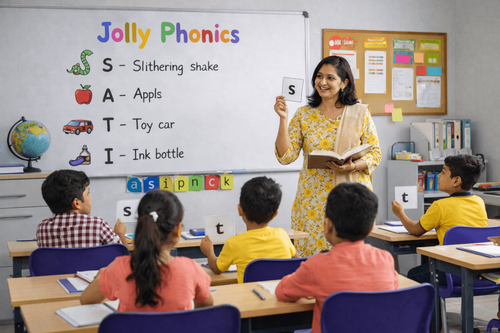

Table of Contents
- How Jolly Phonics Sounds Build Reading and Speaking Confiden
- Understanding Jolly Phonics Tricky Words and Their Role in F
- How Jolly Phonics Supports Early Reading Skills Step by Step
- Why Phonics Learning Must Go Beyond Books
- PlanetSpark Spoken English Course: Turning Phonics into Comm
- How PlanetSpark Aligns with Jolly Phonics Learning Goals
- The Long-Term Benefits of Combining Jolly Phonics with Spoke
- A Confident Start to Lifelong English Mastery
Jolly phonics is a structured, multisensory approach to teaching children how sounds work in the English language. Instead of memorising letters in isolation, children learn how individual sounds combine to form words. This sound-based learning builds a strong foundation for reading, writing, spelling, and pronunciation.
Jolly phonics focuses on five key skills: learning letter sounds, letter formation, blending sounds for reading, identifying sounds in words for writing, and mastering tricky words. These skills work together to make reading logical rather than memorised.
When children understand jolly phonics sounds, they decode words independently instead of guessing. This leads to better fluency, stronger pronunciation, and improved confidence in spoken English. Phonics-based learning also supports accent clarity, which is essential for global communication.
How Jolly Phonics Sounds Build Reading and Speaking Confidence
Jolly phonics sounds form the backbone of early literacy. Each sound is taught with actions, repetition, and usage in words, helping children remember and apply them naturally.
Children who master jolly phonics sounds:
Recognise sound patterns quickly
Blend sounds smoothly while reading
Pronounce words accurately
Speak with better clarity and rhythm
Sound awareness directly influences spoken English confidence. When children know how a word is formed phonetically, they pronounce it correctly while speaking. This is why phonics is not just a reading tool but a speaking skill.
At PlanetSpark, phonics learning is reinforced through live English conversations, ensuring children use jolly phonics sounds while speaking, not just while reading.
Understanding Jolly Phonics Tricky Words and Their Role in Fluency
Jolly phonics tricky words are high-frequency words that do not follow regular phonics rules and therefore cannot be sounded out using standard decoding techniques. Words like said, was, the, have, and you appear repeatedly in everyday reading and conversation, making their instant recognition essential for fluency.
Because these words break phonics patterns, children must learn them through repeated exposure, contextual usage, and correct pronunciation practice. If tricky words are not mastered early, they create reading and speaking roadblocks that interrupt language development.
Without strong command over jolly phonics tricky words, children often:
Pause or hesitate while reading, breaking confidence and comprehension
Lose sentence rhythm and flow, making reading sound unnatural
Mispronounce commonly used words, affecting clarity in speech
Struggle with spoken fluency, especially in spontaneous conversations
PlanetSpark addresses this challenge by embedding jolly phonics tricky words into real-life speaking situations rather than isolated drills. Children practise these words while introducing themselves, answering questions, storytelling, and role-playing everyday scenarios. This contextual repetition helps tricky words shift from short-term memory to natural speech patterns.
When children use tricky words correctly in daily conversation, reading becomes smoother, speaking becomes more confident, and overall fluency improves organically, without memorisation pressure.
How Jolly Phonics Supports Early Reading Skills Step by Step
Jolly Phonics follows a carefully structured, cumulative approach that takes children from recognising basic sounds to reading full sentences with confidence. Each stage builds on the previous one, ensuring that no foundational skill is skipped. Instead of encouraging memorisation, the method develops logical decoding ability, which supports long-term reading success.
Here is a deeper look at how each stage works and why it matters.
1. Sound Recognition - Building the Foundation of Reading
The first step focuses on teaching children the sounds of letters rather than their alphabet names. For example, children learn the sound "s" instead of saying "ess."
This distinction is crucial because reading depends on sound decoding, not letter naming.
In this stage:
Children are introduced to 42 main letter sounds.
Sounds are taught with actions, stories, and visual cues to make learning multi-sensory.
Children begin to associate a sound directly with its written symbol.
Why this works:
When children recognise sounds instantly, they can approach unfamiliar words with confidence. Instead of guessing or relying on pictures, they use sound knowledge to decode logically. This strengthens phonemic awareness, which is the core skill required for early reading success.
2. Blending - Turning Sounds into Words
Once children can identify individual sounds, they are taught how to blend them together to form words.
For example:
c - a - t becomes cat
m - a - p becomes map
Blending trains the brain to smoothly combine separate sounds into meaningful words.
In this stage:
Children practise reading simple consonant vowel consonant words.
They are encouraged to say the sounds quickly and slide them together.
Gradually, longer and more complex words are introduced.
Why this works:
Blending eliminates dependency on memorising whole words. Children gain the power to read new words independently. This creates reading confidence because the child understands that every word can be decoded step by step.
3. Segmenting - Strengthening Spelling and Pronunciation
Segmenting is the reverse of blending. Instead of joining sounds to read, children break spoken words into individual sounds.
For example:
dog becomes d - o - g
ship becomes sh - i - p
In this stage:
Children listen carefully to spoken words.
They identify and separate each sound.
They use this skill while writing and spelling.
Why this works:
Segmenting builds strong spelling accuracy. When children understand how words are constructed phonetically, they can write confidently without random guessing. It also improves pronunciation because they become aware of each sound within a word.
4. Tricky Word Mastery - Handling Exceptions
Not all English words follow phonetic rules. Words like "said," "was," or "the" cannot be fully decoded using regular sound blending.
These are called tricky words.
In this stage:
High-frequency tricky words are introduced gradually.
Children learn to recognise them instantly.
These words are practised in meaningful sentences.
Why this works:
Instant recognition prevents hesitation while reading. When children do not pause at common words, their reading becomes smoother and more natural. This supports sentence-level fluency and better comprehension.
5. Reading Fluency - From Decoding to Confident Reading
As sound recognition, blending, segmenting, and tricky word mastery become automatic, children transition into fluent readers.
In this stage:
Reading speed improves naturally.
Accuracy increases.
Expression and voice modulation develop.
Comprehension strengthens because less mental energy is spent decoding.
Why this works:
Fluency allows children to focus on meaning rather than mechanics. They begin to understand stories, ask questions, and enjoy reading. Confidence grows not only in reading but also in spoken English and classroom participation.
The Overall Impact on Early Reading
The strength of Jolly Phonics lies in its structured progression. Each skill is taught explicitly, practised repeatedly, and reinforced through engaging activities. Children move from:
Recognising sounds
To blending words
To spelling independently
To reading full sentences fluently
This systematic pathway ensures that early reading skills are built on strong foundations rather than shortcuts. As a result, children develop independence, accuracy, and long-term confidence in literacy.
PlanetSpark enhances each step through guided speaking practice, making phonics learning practical and result-driven.
Why Phonics Learning Must Go Beyond Books
Traditional phonics learning often stops at worksheets and reading exercises. However, real language mastery happens when children speak what they read.
PlanetSpark ensures that:
Phonics sounds are used in spoken sentences
Reading vocabulary converts into spoken vocabulary
Children gain pronunciation accuracy
Confidence grows through daily interaction
This is why PlanetSpark is not just another learning platform, it is an immersive speaking environment where phonics becomes a communication skill.
PlanetSpark Spoken English Course: Turning Phonics into Communication Skills
PlanetSpark’s Spoken English Course is designed to complement jolly phonics learning by transforming sound knowledge into real-world speaking ability.
Live, Interactive English Conversations
Daily live classes reinforce jolly phonics sounds through conversation-based learning, ensuring children retain and apply phonics naturally.
Accent Neutralization and Pronunciation Focus
Dedicated pronunciation modules help children articulate sounds clearly, improving global English intelligibility.
Situational Role Plays
From introductions to everyday conversations, children apply phonics-learned words in realistic scenarios.
Instant Feedback and AI Reports
Children receive immediate insights on pronunciation errors, fluency gaps, and articulation improvements.
Speaking Confidence Trackers
Progress is tracked through audio-visual recordings, enabling personalised coaching and measurable growth.
How PlanetSpark Aligns with Jolly Phonics Learning Goals
PlanetSpark supports the core goals of jolly phonics by:
Reinforcing sound clarity through speaking
Improving reading fluency via oral practice
Strengthening tricky word usage in conversation
Building confidence through real-time feedback
This integrated approach ensures children don’t just learn phonics—they use phonics confidently.
The Long-Term Benefits of Combining Jolly Phonics with Spoken English Training
When jolly phonics is paired with spoken English training, children gain:
Strong reading comprehension
Clear pronunciation and accent control
Confident public speaking ability
Better academic and social communication
Lifelong language confidence
PlanetSpark ensures these benefits are achieved through consistent practice, expert guidance, and engaging learning formats.
A Confident Start to Lifelong English Mastery
Jolly phonics lays the foundation, but confident communication completes the journey. When children understand sounds, tricky words, and pronunciation, they develop reading fluency and speaking confidence together. PlanetSpark bridges this gap by turning phonics learning into active spoken English practice. Through live conversations, pronunciation coaching, and personalised feedback, children grow into confident communicators. If you want your child to move beyond basic phonics and develop real-world English confidence, PlanetSpark Spoken English Course provides the structured, engaging, and result-oriented learning environment they need.
Give your child a confident English future with PlanetSpark Spoken English Course.
You may also read :
Frequently Asked Questions
Jolly phonics is a sound-based learning method that teaches children how letters and sounds work together. It helps children read, write, pronounce words correctly, and develop strong early literacy skills.
Jolly phonics sounds improve pronunciation, clarity, and confidence. When children understand sound formation, they speak more fluently and articulate words accurately.
Jolly phonics tricky words are common words that don’t follow phonics rules. Mastering them improves reading fluency and natural speaking flow.
Children can begin jolly phonics learning as early as 3–4 years old, as it builds strong language foundations during critical learning years.
PlanetSpark integrates jolly phonics sounds and tricky words into live spoken English practice, pronunciation coaching, and real-life role plays, helping children apply phonics confidently in everyday communication.