
Phonics Word Families: Easy Examples for Kids and Beginners
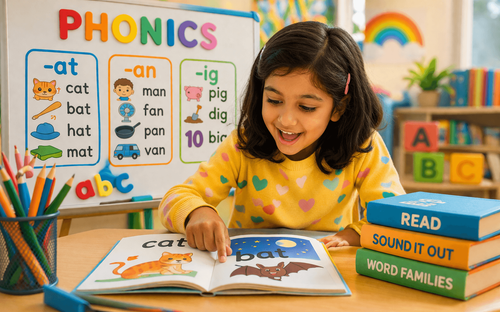

Table of Contents
- What Are Phonics Word Families?
- Why Are Word Families Important for Kids?
- Understanding CVC Word Families for Kids
- Common Phonics Word Families List
- How Word Families Help Kids Learn to Read Faster
- Phonics Word Family Examples for Beginners
- Word Family Words for Beginners (Practice List)
- Difference Between Word Families and Rhyming Words
- Fun Activities to Teach Phonics Word Families
- Long Word Families: Moving Beyond Three-Letter Words
- 3-Letter vs 4-Letter Word Families
- Word Family Worksheets for Kids
- 50+ Phonics Word Family List for Practice
- Word Family Sentences for Reading Practice
- How Parents Can Practice Word Families at Home
- Fun Word Family Games for Classroom Learning
- How Word Families Support Early Writing Skills
- Digital Tools and Apps for Learning Word Families
- Word Families vs Sight Words: What’s the Difference?
- How Word Families Improve Phonemic Awareness
- Tips for Teaching Word Families to Kids
- Common Mistakes Kids Make with Word Families
- Mistakes Parents Make When Teaching Word Families
- How Word Families Improve Reading Fluency
- Daily Practice Routine for Learning Word Families
- Creative Storytelling Using Word Families
- Signs That a Child Is Mastering Word Families
- How PlanetSpark Helps Kids Improve English Communication
- Building Strong Reading Skills with Phonics Word Families
Reading can feel like cracking a secret code for young learners. One small pattern can unlock dozens of new words, and that’s exactly what phonics word families do. Instead of memorizing each word separately, children learn a sound pattern and quickly recognize many similar words. For example, once a child learns –at, they can easily read cat, bat, hat, and mat. This simple method makes reading faster, easier, and more enjoyable for beginners. In this guide, we’ll explore what word families are, why they matter, common examples, CVC word families, and fun activities that help kids build strong early reading skills.
What Are Phonics Word Families?
Phonics word families are groups of words that share the same ending sound and spelling pattern.
These words only differ in their beginning letter or sound, but the ending remains the same.
For example:
–at word family
- cat
- bat
- hat
- mat
- rat
- sat
All these words end with “at”. When children learn the –at pattern, they can easily read many words instead of learning them separately.
This makes reading much simpler for beginners.
Simple Formula
Most phonics word families follow this pattern:
Beginning consonant + word family ending
Example:
b + at = bat
c + at = cat
h + at = hat
Children quickly notice the pattern and begin reading new words confidently.
Why Are Word Families Important for Kids?
Word families play a major role in early reading and phonics learning.
Instead of memorizing hundreds of words, children focus on patterns and sounds.
1. Helps Children Recognize Patterns
When kids learn one pattern like –an, they can read many words:
- man
- fan
- pan
- ran
- can
This improves reading speed and confidence.
2. Improves Phonics Skills
Phonics is all about connecting letters with sounds.
Word families help children practice the same sound repeatedly, which strengthens phonics understanding.
3. Builds Vocabulary
Learning one word family can introduce five or more new words at once.
For example:
–ig family
- pig
- wig
- dig
- big
- fig
This expands vocabulary quickly.
4. Boosts Reading Confidence
When children recognize familiar patterns, reading becomes easier.
This confidence motivates kids to read more books and stories.
5. Makes Learning Fun
Word family activities, rhymes, and games make phonics learning interactive and enjoyable.

Understanding CVC Word Families for Kids
Many phonics word families are CVC words.
CVC stands for:
C – Consonant
V – Vowel
C – Consonant
These are simple three-letter words that follow a basic pattern.
Example:
cat → CVC
dog → CVC
sun → CVC
CVC word families are perfect for beginners because they are easy to decode and pronounce.
Example of a CVC Word Family
–og family
- dog
- log
- fog
- hog
- jog
Children only need to change the first letter while the ending –og stays the same.
Common Phonics Word Families List
Below is a helpful phonics list of common word families that beginners can learn.
–at Word Family
Examples:
- cat
- bat
- hat
- mat
- rat
- sat
- pat
Sentence examples:
- The cat is sleeping.
- He wore a red hat.
–an Word Family
Examples:
- man
- fan
- pan
- can
- ran
- van
Sentence examples:
- The fan is spinning.
- She ran very fast.
–ap Word Family
Examples:
- cap
- map
- nap
- tap
- lap
Sentence examples:
- I found the place on the map.
- The baby took a nap.
–ag Word Family
Examples:
- bag
- tag
- rag
- wag
- lag
Sentence examples:
- I carry books in my bag.
- The dog will wag its tail.
–am Word Family
Examples:
- jam
- ham
- ram
- yam
Sentence examples:
- I like bread with jam.
- The sheep is a ram.
–ig Word Family
Examples:
- pig
- wig
- dig
- big
- fig
Sentence examples:
- The pig is in the farm.
- The hole is big.
–it Word Family
Examples:
- sit
- hit
- bit
- pit
- fit
Sentence examples:
- Please sit here.
- The shoe does not fit.
–op Word Family
Examples:
- mop
- hop
- top
- pop
Sentence examples:
- Clean the floor with a mop.
- The frog can hop.
–ot Word Family
Examples:
- pot
- hot
- dot
- lot
Sentence examples:
- The tea is hot.
- There are a lot of stars.
–ub Word Family
Examples:
- tub
- cub
- rub
- hub
Sentence examples:
- The bear has a cub.
- Wash hands in the tub.

How Word Families Help Kids Learn to Read Faster
Phonics word families make reading easier because children learn patterns instead of isolated words. Once a child recognizes a pattern, they can decode many new words quickly.
For example, if a child knows the –at pattern, they can read:
- cat
- bat
- hat
- mat
- sat
This ability helps children move from slow reading to confident reading.
Word families also improve phonemic awareness, which is the ability to hear and identify sounds in words.
Phonics Word Family Examples for Beginners
Let’s look at how word families help children decode new words easily.
Example 1
If a child knows cat, they can read:
- bat
- hat
- mat
- rat
The ending –at stays the same.
Example 2
If a child knows pig, they can read:
- dig
- wig
- big
- fig
The ending –ig stays the same.
Example 3
If a child knows cap, they can read:
- map
- nap
- tap
- lap
Again, the pattern is repeated.
This pattern recognition is the foundation of fluent reading.
Word Family Words for Beginners (Practice List)
Here is a practice list of easy phonics words for kids.
–ed Family
- bed
- red
- fed
- led
–en Family
- hen
- pen
- ten
- den
–ell Family
- bell
- tell
- sell
- fell
–ick Family
- kick
- pick
- lick
- tick
–ock Family
- rock
- lock
- sock
- clock
These lists are excellent for daily phonics practice.
Difference Between Word Families and Rhyming Words
Many people think word families and rhyming words are the same, but they are slightly different.
Word Families
Word families share the same spelling pattern and sound.
Example:
- cat
- bat
- hat
- mat
All these words end with –at.
Rhyming Words
Rhyming words sound the same at the end but may have different spelling patterns.
Example:
- cat
- hat
- gnat
So, all word family words rhyme, but not all rhyming words belong to the same word family.
Fun Activities to Teach Phonics Word Families
Learning becomes more effective when it is fun and interactive.
Here are some engaging activities for kids.
1. Word Family Houses
Draw a house and write a word family on the roof.
Example:
–at house
Kids add words like:
- cat
- bat
- mat
This activity helps children visualize word patterns.
2. Word Family Flip Cards
Create flip cards with:
Beginning letters on one side
Word family ending on the other
Example:
b + at
c + at
h + at
Kids flip the card to form new words.
3. Rhyming Games
Say a word and ask kids to find rhyming words.
Example:
Teacher: cat
Child: hat, bat, mat
This improves phonics awareness.
4. Fill-in-the-Blank
Example:
_ at
Kids fill the missing letter:
- cat
- hat
- bat
5. Word Family Sorting
Give kids different words and ask them to group them by family.
Example:
Group 1: –at
Group 2: –an
Group 3: –ig
This builds pattern recognition.
Long Word Families: Moving Beyond Three-Letter Words
Once children understand simple CVC word families, they can begin learning longer patterns. These patterns help them read bigger words with confidence.
Long word families often include four or more letters.
For example, the –ake family:
- cake
- bake
- lake
- make
- take
When kids learn the ake pattern, they can easily read several new words without sounding out each letter separately.
This step helps children transition from basic reading to more advanced vocabulary.
3-Letter vs 4-Letter Word Families
Word families can be grouped based on the length of the word pattern.
3-Letter Word Families
These are usually CVC words, which are ideal for beginners.
Examples:
- –at → cat, bat, hat
- –ig → pig, big, dig
- –op → hop, top, mop
These patterns help children understand basic phonics rules.
4-Letter Word Families
These patterns introduce slightly longer words.
Examples:
- –ake → cake, bake, make
- –ight → light, night, sight
- –ell → bell, tell, sell
Learning these patterns helps kids move toward more fluent reading.
Word Family Worksheets for Kids
Worksheets are an excellent way to practice phonics word families.
They provide structured exercises that help children recognize patterns.
Common worksheet activities include:
Fill in the Missing Letter
Example:
_ at
Possible answers:
- cat
- bat
- hat
Circle the Correct Word
Example sentence:
"The cat / cap sat on the mat."
These worksheets help strengthen both reading and spelling skills.
50+ Phonics Word Family List for Practice
Here is a larger phonics list that beginners can practice regularly.
–at Family
cat, bat, hat, mat, sat, pat, rat
–an Family
man, fan, pan, van, can, ran
–ap Family
cap, map, nap, tap, lap
–ag Family
bag, tag, wag, rag, lag
–ig Family
pig, big, dig, wig, fig
–ip Family
lip, sip, tip, dip, rip
–op Family
hop, mop, top, pop, cop
–ot Family
pot, hot, dot, lot
–ub Family
tub, cub, rub, hub
–ug Family
bug, hug, mug, rug
Practicing these words regularly helps children recognize sound patterns quickly.
Word Family Sentences for Reading Practice
Using word families in sentences helps children see how words are used in real reading situations.
–at Family Sentences
- The cat sat on the mat.
- The bat is near the hat.
–an Family Sentences
- The man has a fan.
- The van can carry many bags.
–ig Family Sentences
- The pig is very big.
- The boy will dig a pit.
These simple sentences make reading practice more meaningful and engaging.
How Parents Can Practice Word Families at Home
Parents play a big role in helping children strengthen phonics skills.
Here are simple activities parents can try at home.
Read Together
Choose beginner books that repeat word family patterns.
Example:
"Sam had a cat. The cat sat on a mat."
Use Flashcards
Create flashcards with different word families.
Children can read them daily for quick practice.
Encourage Word Building
Give kids letter tiles and ask them to build new words.
Example:
Using –at, kids can create:
- bat
- rat
- pat
This activity improves spelling and reading.
Fun Word Family Games for Classroom Learning
Games make phonics practice exciting for young learners.
Word Family Bingo
- Create bingo cards with words from different families.
- The teacher calls out a word, and the children mark it on the card.
Word Family Race
- Write word endings on the board.
- Kids race to write as many matching words as possible.
Example:
–an
Possible answers:
- man
- fan
- pan
Rhyming Circle Game
- Students sit in a circle.
- One child says a word like cat, and the next child must say another word from the same family.
How Word Families Support Early Writing Skills
Word families do not only help in reading. They also support early writing development.
When children know patterns, they can write new words confidently.
Example:
If a child knows –an, they can write:
- man
- fan
- pan
- can
This reduces spelling confusion and improves writing fluency.
Digital Tools and Apps for Learning Word Families
Technology can also make phonics practice more engaging.
Many learning apps include interactive word family exercises.
These tools help children:
- hear correct pronunciation
- match words with pictures
- practice reading through games
Interactive learning keeps children motivated and interested in reading practice.
Word Families vs Sight Words: What’s the Difference?
Both word families and sight words are important in early reading, but they serve different purposes.
Word Families
These follow phonics patterns.
Example:
cat, bat, hat
Children sound them out.
Sight Words
Sight words are common words that children memorize by sight.
Example:
- the
- said
- was
Both approaches work together to improve reading skills.
How Word Families Improve Phonemic Awareness
Phonemic awareness is the ability to hear and manipulate sounds in words.
Word families strengthen this skill because children repeatedly hear the same ending sound.
For example:
- cat
- bat
- hat
Children notice that all three words end with the same /at/ sound.
This helps them understand how letters connect to sounds, which is a key step in learning to read.
Tips for Teaching Word Families to Kids
Teaching phonics effectively requires patience and creativity.
Here are some helpful tips.
Start with Simple CVC Words
Begin with easy patterns like:
- at
- an
- ap
These are easiest for beginners.
Use Visual Aids
Flashcards, charts, and picture cards help children remember patterns better.
Practice Reading Aloud
Reading word families aloud strengthens pronunciation and fluency.
Encourage Writing
Ask kids to write new words using the same pattern.
Example:
Write five –at words.
Repeat Regularly
Repetition helps children remember patterns naturally.
Also Read
Phonics Classes for Class 6 | Boost Reading & Spelling Skills
Common Mistakes Kids Make with Word Families
While learning phonics, beginners may make some mistakes.
Confusing Similar Sounds
Example:
–at vs –an
cat vs can
Teachers should emphasize pronunciation.
Mixing Word Families
Children might mix endings like:
cat → cap
Regular practice helps correct this.
Guessing Words
- Sometimes kids guess words instead of sounding them out.
- Encourage them to focus on each letter sound.
Mistakes Parents Make When Teaching Word Families
While teaching phonics, some common mistakes can slow down learning.
Teaching Too Many Word Families at Once
- Introducing too many patterns can confuse beginners.
- It is better to start with one family at a time.
Ignoring Pronunciation Practice
- Children need to hear and say the sounds clearly.
- Reading aloud helps strengthen phonics skills.
Skipping Practice
- Word families require regular repetition.
- Short daily practice sessions work better than occasional long lessons.
How Word Families Improve Reading Fluency
Word families play a big role in helping children become fluent readers.
Here’s how:
Faster Word Recognition
Children quickly recognize familiar patterns.
Better Spelling
Knowing word patterns helps children spell words correctly.
Improved Confidence
When reading becomes easier, children feel proud of their progress.
Strong Phonics Foundation
Word families prepare kids for advanced reading skills.
Daily Practice Routine for Learning Word Families
A short daily routine can help children improve quickly.
5-Minute Routine
Step 1: Review one word family
Example: –at
Step 2: Read five words aloud
cat, bat, hat, mat, rat
Step 3: Use two words in sentences
Step 4: Write the words in a notebook
This simple routine helps children remember patterns through reading, speaking, and writing.
Creative Storytelling Using Word Families
Storytelling is a fun way to practice phonics patterns.
Teachers and parents can create short stories using a single word family.
Example using –at family:
"The cat wore a hat and sat on a mat.
Then the rat ran past the cat."
Stories like this help children:
- remember patterns
- enjoy reading
- recognize rhyming sounds
It turns phonics learning into a creative experience.
Signs That a Child Is Mastering Word Families
Parents and teachers can identify progress through simple signs.
Faster Reading
Children begin recognizing patterns instantly.
Improved Spelling
Kids spell familiar word family patterns correctly.
Example:
They spell hat, bat, mat without help.
Better Pronunciation
Children pronounce vowel sounds clearly while reading.
Confidence in Reading
Kids begin reading short sentences independently.
How PlanetSpark Helps Kids Improve English Communication
Live Interactive Conversations
PlanetSpark offers daily live sessions where kids practice English through real-life situations like school conversations, travel, and introductions.
Accent & Pronunciation Training
Special modules focus on phonetics and reducing mother tongue influence (MTI) to help kids speak clearly and confidently.
Vocabulary in Context
Children learn vocabulary through phrases, collocations, and dialogue-based practice instead of memorizing isolated words.
Role Plays & Situational Dialogues
Activities like giving speeches, ordering food, asking questions, and explaining ideas help build practical speaking skills.
Instant Feedback & AI Reports
Kids receive quick corrections on pronunciation, grammar, and fluency through trainer feedback and AI-based reports.
Confidence Progress Tracking
Regular assessments and progress trackers help parents monitor improvement and keep children motivated.

Building Strong Reading Skills with Phonics Word Families
Learning to read becomes easier when children understand phonics word families. Instead of memorizing many words separately, kids learn simple sound patterns that help them read multiple words quickly.
Word families help children recognize sound patterns, strengthen phonics skills, expand vocabulary, and read with greater confidence. Regular practice through fun activities, reading exercises, and writing tasks helps beginners improve steadily. With the right guidance, children can develop strong early literacy skills.
Platforms like PlanetSpark further support this journey by combining phonics learning with interactive speaking activities, helping kids grow into confident readers and effective communicators.
You May Also Like
Frequently Asked Questions
PlanetSpark explains that phonics word families are groups of words that share the same ending sound pattern, such as cat, bat, and hat. Learning these patterns helps children read new words more easily.
PlanetSpark recommends phonics word families because they help children recognize sound patterns quickly. This makes reading easier and improves early phonics and vocabulary skills.
PlanetSpark teaches word family words for beginners through interactive activities, reading exercises, and speaking practice so kids can understand patterns and use them confidently.
PlanetSpark highlights common CVC word families for kids such as -at (cat, bat), -an (man, fan), -op (hop, top), and -ig (pig, dig) to help beginners practice phonics patterns.
PlanetSpark helps kids practice phonics word family examples through games, worksheets, storytelling, and conversation activities that make learning engaging and effective.
Yes, PlanetSpark uses structured phonics lists and word family exercises to help children recognize sounds, build vocabulary, and improve reading fluency.
PlanetSpark makes learning phonics word families fun by combining interactive lessons, speaking practice, and engaging activities that build both reading and communication confidence.