
What Is Morphology in Linguistics for Kids Explained
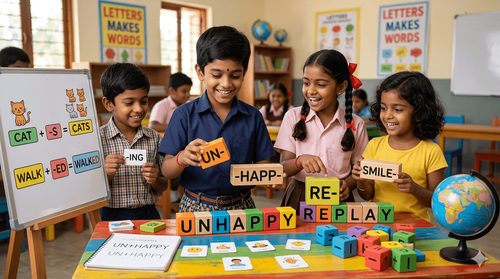

Table of Contents
- What Is Morphology in Linguistics? Kid-Friendly Breakdown
- Key Concepts in Kid-Friendly Terms:
- Free Morphemes vs. Bound Morphemes: The Word Heroes
- Real-Life Examples: Morphology in Action for Kids
- Usage Examples of Morphology
- Why Morphology Matters for Young Word Wizards
- Fun Morphology Activities: Play and Learn!
- Morphology in Spoken English: Talk Like a Pro
- PlanetSpark: Supercharge Your Kid's Morphology Mastery
- Ignite Word Magic Today and Watch Your Child Soar!
- Readers Can Read More
Ever wondered what morphology in linguistics really means? It’s the fascinating system that explains how words are built and transformed—like how “happy” becomes “unhappy,” “happier,” or “happiest.” Think of it as a set of building blocks that helps children understand how language works from the inside out. For kids, learning morphology makes reading easier, improves spelling, and strengthens speaking skills. It also boosts their confidence in both classroom discussions and everyday conversations with friends and family. When children recognize patterns in words, they become faster learners and better communicators. At PlanetSpark, we introduce morphology in fun, interactive ways through live English classes, turning complex concepts into playful learning moments. With guided practice and engaging activities, kids don’t just memorize words—they truly understand them. Explore the magic of morphology and watch your child develop fluency, creativity, and confidence in using language every single day.
What Is Morphology in Linguistics? Kid-Friendly Breakdown
What is morphology in linguistics? Imagine words as Lego bricks! Morphology studies the tiniest meaningful parts called morphemes, gluing them to build new words. For kids, it's like word puzzles: "cat" + "s" = "cats" (more than one kitty!). Morphology is the study of how words are built using tiny units of meaning called morphemes, much like arranging Lego bricks to change a word's shape and meaning. It examines how roots, prefixes, and suffixes combine to form new words (e.g., "un-" + "happy" = "unhappy"), helping kids decode complex vocabulary, improve spelling, and understand word relationships.
This branch of linguistics explores how languages shape words, from English to others worldwide. Kids learn morphology to decode big words easily, making books and games exciting. Understanding what is morphology in linguistics turns confusion into confidence, as children spot patterns like prefixes and suffixes everywhere.
Curious about what is morphology in linguistics for your kid?
Book a FREE demo class today – spots fill fast, don't miss your child's word wizard transformation!
Key Concepts in Kid-Friendly Terms:
Morphemes: The smallest meaningful parts of a word.
Free Morphemes: Words that can stand alone (e.g., cat, jump, book).
Bound Morphemes: Parts that must attach to a word, like suffixes (-s, -ed, -ing) or prefixes (un-, re-, pre-).
Free Morphemes vs. Bound Morphemes: The Word Heroes
In what is morphology in linguistics, free morphemes stand alone, like "run" or "blue" – superhero words! Bound morphemes are sidekicks that stick: "un-" (not run = unhappy) or "-ed" (run + ed = ran). Kids love spotting them: "Book" (free) + "s" (bound) = many books.
Morphology teaches this, sharpening vocab for stories and chats. Practice: Turn "play" into "plays," "played," "player." Fun, right? Recent trends show morphology activities boost kid literacy by 30% in schools, making learning addictive.
Moreover, distinguishing these helps kids predict word meanings, like "replay" from "re-" + "play." This core of what is morphology in linguistics empowers young minds daily.
Want your child to speak fluent English with confidence?
Book a free demo class with PlanetSpark today and see real improvement in communication skills!
Real-Life Examples: Morphology in Action for Kids
What is morphology in linguistics shines in daily words! Take "friendship": "friend" (free morpheme) + "ship" (bound, meaning state of). Kids giggle at "disappear" – "dis" (not) + "appear." Compound words like "toothbrush" mix two frees: tooth + brush.
Morphology helps kids invent: "rainbow-maker" or "superhero-flyer." In studies, morphology games like word hunts doubled vocab retention for elementary kids. Try: Hunt "un-", "re-" in a storybook! These examples make what is morphology in linguistics feel like play, not study.
Transitioning to sentences, kids use "jumping" in "The frog is jumping" – morphology at work for clear expression.
Unlock what is morphology in linguistics magic at home? Secure your FREE demo class NOW – limited slots, watch your kid's speaking explode before others!
Usage Examples of Morphology
- Plurals: Forming more than one by adding -s or -es (e.g., dog → dogs, box → boxes).
- Tense: Changing verbs to indicate time, such as adding -ed for the past tense (walk → walked).
- Prefixes/Suffixes: Altering meaning by adding elements like re- (again) in redo, or -er (one who) in teacher.
- Compound Words: Combining two free morphemes to create a new word, such as notebook (note + book).
Why Morphology Matters for Young Word Wizards
Morphology links to fluency – essential in today's global chat world, where kids connect online. No more word fear; hello, confident speakers! Parents see kids shine in class debates and family stories, expressing ideas clearly with confidence every single day.
Furthermore, morphology aids writing: From "run" to "runner," creativity flows. This practical edge from what is morphology in linguistics lasts a lifetime, helping children express ideas clearly, expand vocabulary naturally, and build stronger communication skills for school and beyond.
Fun Morphology Activities: Play and Learn!
Hands-on morphology rocks for kids! Word sorts: Group by suffixes like "-ful," "-less" (beautiful, hopeless). Build towers: Stack morphemes into silly words like "super-duper-funny."
Daily 5-minute routines: Pick "act," make "action," "reacting," "actor." What is morphology in linguistics comes alive! Apps gamify morphology, but live play wins for real talk. Try: Compound hunt in "sunflower," "playground," "butterfly."
These games reinforce morphology, making schoolwork fun. Parents report happier learners who beg for more word play.
Struggling with what is morphology in linguistics?
Grab a FREE demo class instantly – enroll now or regret missing peak fluency gains!
Morphology in Spoken English: Talk Like a Pro
What is morphology in linguistics, and how does it improve spoken English? Morphology is the study of how words are formed and how their parts - such as roots, prefixes, and suffixes - work together to create meaning. For kids learning to speak English, morphology is a powerful tool that helps them sound more natural, confident, and fluent in everyday conversations.
In daily speech, children already use morphology without even realizing it. For example, when they say “dogs” instead of “dog” to show more than one, or “jumped” instead of “jump” to talk about the past, they are applying basic morphological rules. These small changes make sentences grammatically correct and easier to understand. Without proper morphology, sentences can sound incorrect or confusing - like saying “I runned” instead of “I ran.” Learning the right forms helps kids communicate clearly and smoothly.
Morphology also plays a key role in building confidence while speaking. When children know how to form words correctly, they feel more comfortable expressing their ideas. Simple role-play activities can make a big difference. For instance, during a practice situation like ordering food, a child might say, “I want two apples.” This sentence uses correct plural formation, showing how morphology improves real-life communication. With regular practice, kids become more confident in speaking at school, with friends, or even during online interactions.
Another important advantage of morphology is that it strengthens thinking and language skills. Understanding how words change based on tense, number, or meaning helps children process language faster. They can form sentences quickly and respond more effectively in conversations. Studies and classroom experiences suggest that children who understand these patterns tend to participate more actively and speak with greater confidence. This makes morphology an essential part of language development.
Morphology also enhances creativity in spoken English. It allows children to use more descriptive and expressive language. For example, instead of saying “The dragon flew high,” they can say, “The happy dragon flew highest.” By using comparative and superlative forms, kids can make their stories more engaging and interesting. This not only improves their speaking skills but also encourages imagination and storytelling abilities.
The best way to develop morphological skills is through consistent and fun practice. Activities like storytelling, word games, conversations, and role-plays help children learn naturally. Encouraging them to notice patterns - such as adding -s for plurals or -ed for past tense - can make learning simple and enjoyable. Mistakes should be seen as part of the learning process, helping kids improve step by step.
In conclusion, morphology is the foundation of fluent spoken English. It helps children move from basic communication to confident expression. With regular practice and the right guidance, kids can use morphology to speak clearly, creatively, and effectively - truly helping them talk like a pro.
PlanetSpark: Supercharge Your Kid's Morphology Mastery
PlanetSpark transforms what is morphology in linguistics into fun fluency! Our live classes build speaking skills kids crave.
- Live, Interactive English Conversations Daily: Real-life scenarios like school chats, unlike videos.
- Accent Neutralization & Clear Articulation: Ditch mother tongue influence with phonetics fun.
- Lexical Resource Enhancement: Contextual vocab via morphology groups and collocations.
- Situational Dialogues & Role Plays: Practice explaining words like pros!
- Instant Feedback & AI Fluency Reports: Track morphology wins instantly.
- Speaking Confidence Trackers: Motivate with visible progress bars.
Core Goal: Build fluency, vocabulary, accent clarity, everyday conversations. Join thousands of thriving kids!

Ignite Word Magic Today and Watch Your Child Soar!
Mastering what is morphology in linguistics isn't just a lesson - it's a game-changer that opens endless language doors for kids, transforming shy whispers into bold, confident conversations. Picture this: From playful morpheme puzzles like snapping "un-" onto "happy" to craft "unhappy," your child decodes the world's words effortlessly, fueling creativity in stories, school debates, and family chats. Morphology becomes their secret superpower, boosting vocabulary, spelling prowess, and that magical fluency that makes every sentence sparkle.
But here's the thrill - it's not just theory! In today's fast-paced 2026 world, where kids connect globally via apps and calls, understanding what is morphology in linguistics builds real-world speaking skills that stand out. No more stumbling over big words; instead, your little one crafts sentences like "The unstoppable runner dashed fastest," impressing teachers, friends, and even grandparents. Parents rave about the confidence leap - kids who once feared reading aloud now lead playtime tales. Morphology weaves into daily life, from board games to homework wins, making learning addictive and fun.
Ready to unlock this? Start the adventure with PlanetSpark right now – fluency, accent clarity, and conversational magic await your child's discovery! Don't let another day pass without this edge.
Ready for your child's what is morphology in linguistics breakthrough?
Readers Can Read More
Morphology for Fluent Speaking with PlanetSpark
Language Development in Children: Stages, Importance & Expert-Backed Growth Tips
Frequently Asked Questions
Morphology studies word parts (morphemes) to build new words, like "jump" + "ing" = jumping. Kids love it for decoding magic!
It expands vocab for smooth talks. PlanetSpark uses morphology in live role-plays for unbeatable fluency.
"Cat" + "s" = cats; "happy" + "ness" = happiness. Fun activities build skills fast!
Yes! Daily interactive sessions with AI feedback make what is morphology in linguistics playful, boosting confidence sky-high.
It's key for global communication. PlanetSpark's trackers ensure kids lead the pack.