
Words with Silent Letters: Rules, Examples & Guide
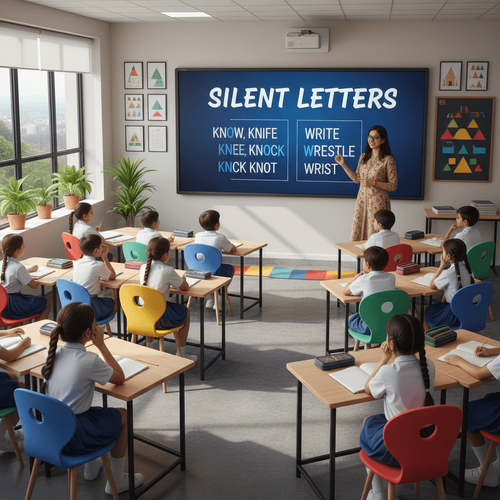

Table of Contents
- Understanding Silent Letters in English
- Common Words with Silent Letters
- Why Learning Silent Letters Matters
- How to Learn Words with Silent Letters Effectively
- Real-Life Examples in Everyday English
- Master Pronunciation and Fluency with PlanetSpark Spoken Eng
- What Makes PlanetSpark the Best Place to Learn Spoken Englis
- Speak with Confidence: Your Words Deserve to Be Heard
Ever wondered why “knight” isn’t pronounced “k-nite” or why we write “honest” but say “onest”? Welcome to the world of words with silent letters , one of the trickiest yet most fascinating parts of English spelling and pronunciation.This blog will help you understand what silent letters are, why they exist, and how learning them can improve your spelling, pronunciation, and spoken fluency. We’ll explore common examples, patterns, and practical learning tips.
Understanding Silent Letters in English
What Are Silent Letters?
A silent letter is a letter that appears in a word but isn’t pronounced. For example:
“K” in knife
“B” in thumb
“W” in write
These letters remain invisible in speech but essential in writing. They influence the structure, meaning, and pronunciation of words , and sometimes even hint at a word’s origin (like Old English, French, or Greek roots).
Silent letters are everywhere in English. In fact, over 60% of English words contain at least one silent letter , that’s why mastering them is crucial for anyone aiming for clear, fluent English communication.
Why Do Silent Letters Exist?
English borrows from many languages , Latin, Greek, French, and German , each with its own pronunciation rules. Over centuries, pronunciations changed, but spellings often stayed the same.
For instance:
“Knight” comes from Old English cniht (meaning servant or warrior). Over time, pronunciation evolved, but spelling didn’t.
“Doubt” still keeps the b from Latin dubitare (to hesitate).
In short, silent letters are the ghosts of English history , relics of old sounds that faded away but left their mark behind.
Common Words with Silent Letters
Let’s explore some of the most common silent letters in English, along with examples to help you remember them.
Silent “K”
The letter K is silent when it appears before N at the beginning of a word.
Examples:
Knife
Knee
Know
Knock
Knight
👉 Tip: Remember the phrase “The knight knew the knife” to recall the rule easily.
Silent “B”
The letter B is often silent after M at the end of a word.
Examples:
Thumb
Climb
Comb
Limb
Bomb
👉 Learning hack: Think of “MB = M only.”
Silent “W”
W is silent before R in many words.
Examples:
Write
Wrong
Wrap
Wreck
Wrist
👉 Remember: “W” waits quietly before “R.”
Silent “H”
H is silent after certain letters or in specific words.
Examples:
Hour
Honest
Ghost
Rhythm
Vehicle
👉 “H” can be a sneaky letter – sometimes voiced, sometimes silent!
Silent “G”
The G becomes silent when followed by N.
Examples:
Sign
Design
Foreign
Gnaw
Reign
👉 Think of “GN” as one sound – n.
Silent “L”
L is often silent after A, O, or U.
Examples:
Calm
Talk
Walk
Should
Salmon
👉 “L” hides behind vowels!
Silent “T”
T is silent in many common English words.
Examples:
Castle
Listen
Often
Whistle
Fasten
👉 Say them slowly to feel the T disappearing.
Silent “P”
The P is silent in many words derived from Greek.
Examples:
Psychology
Pneumonia
Pseudo
Psalm
Receipt
👉 Silent “P” is a prefix phantom.
Silent “C”
The C is silent when it appears before K.
Examples:
Scissors
Muscle
Scene
Fascinate
👉 Think: “C before K or S? It stays quiet!”
Silent “E”
One of the most common silent letters , E at the end of a word , changes pronunciation but isn’t spoken.
Examples:
Hate (vs Hat)
Bite (vs Bit)
Cube (vs Cub)
👉 The silent “E” is called the magic E , it changes the vowel sound before it.
Why Learning Silent Letters Matters
Understanding words with silent letters helps improve:
Spelling accuracy
Pronunciation clarity
Listening comprehension
Speaking confidence
It’s not just about memorization , it’s about sound awareness, an essential skill for effective communication.
How to Learn Words with Silent Letters Effectively
1. Learn Through Phonetics and Practice
Use phonetic transcriptions (like /nɒt/ for knot) to hear how words actually sound. Listening to audiobooks and pronunciation apps helps reinforce this.
2. Read Aloud Daily
Practice reading aloud and focus on how words sound versus how they’re written. You’ll gradually internalize which letters stay silent.
3. Group and Memorize
Group similar silent-letter words together , like all silent “K” or silent “B” words , and practice them as a set.
4. Engage in Spoken English Conversations
Real-time conversations are the fastest way to improve pronunciation and catch silent letters naturally.
Real-Life Examples in Everyday English
Here are some everyday phrases where silent letters appear naturally:
“I know the answer.”
“She climbed the tree.”
“He wrote a poem.”
“Please listen carefully.”
“I should walk home.”
When you pronounce these, notice how your tongue and lips move less , silent letters help make speech smoother and more natural.
Master Pronunciation and Fluency with PlanetSpark Spoken English Course
Live, Interactive English Conversations Daily
PlanetSpark offers live daily sessions where kids engage in real-world conversations – from asking for help to explaining concepts. It’s not passive learning; it’s interactive communication practice.
Accent Neutralization & Clear Articulation
Children learn to reduce mother tongue influence, master phonetics, and pronounce words correctly , including those tricky ones with silent letters!
Lexical Resource Enhancement
Vocabulary is taught through real-life dialogues, helping kids naturally use words like “thumb,” “write,” or “know” correctly.
Instant AI Feedback and Progress Tracking
PlanetSpark’s AI Fluency Reports give instant feedback on pronunciation and grammar, ensuring measurable improvement.
What Makes PlanetSpark the Best Place to Learn Spoken English
1:1 Personal Trainers for Every Child
Every learner gets a dedicated personal trainer who understands their learning pace, personality, and areas of improvement. Trainers guide kids through fluency, storytelling, pronunciation, and public speaking.
Personalized Learning Roadmap
PlanetSpark tailors learning paths for every child , identifying grammar gaps, vocabulary needs, and speaking skills, and designing a roadmap to bridge them.
AI-Led Practice Sessions
AI-based tools simulate real-time speaking activities like storytelling or speech delivery with instant corrections.
Spark Diary & Gamified Learning
Children write creative pieces, play vocabulary games, and enjoy quizzes like “Spell Knockout” and “Grammar Guru Challenge” , making learning fun and consistent.
Clubs & Competitions for Real Exposure
Debate Clubs, Story Writing Circles, and Open Mic Events encourage children to perform and express confidently , a crucial step in mastering English fluency.
Speak with Confidence: Your Words Deserve to Be Heard
Silent letters may seem small, but they carry powerful lessons in pronunciation, spelling, and confidence. When you understand how and when to pronounce them, you take a major leap toward mastering English communication.
Remember , language fluency isn’t about memorizing rules; it’s about expressing ideas clearly and confidently. Whether it’s “knight” or “honest,” every word you master brings you closer to effortless speech.
You may also read:
Frequently Asked Questions
Silent letters are letters that appear in the spelling of a word but are not pronounced when speaking. For example, the “k” in knife and the “b” in thumb are silent. They often reflect historical spellings from Old English, Latin, or French.
English has silent letters because of its mixed linguistic roots. Over time, pronunciation evolved, but many spellings stayed the same. For example, “knight” comes from Old English cniht, where both the “k” and “gh” were once pronounced.
You can master silent letters through phonetic practice, reading aloud, and real-life conversation exercises. Grouping similar words (like all words with silent “K”) also helps. Joining a spoken English course like PlanetSpark’s can make this process faster and more interactive.
Some common examples include:
Silent K: knife, knee, knock
Silent B: thumb, climb, comb
Silent W: write, wrist, wrong
Silent L: talk, calm, should
Silent E: hate, bite, cube
PlanetSpark’s Spoken English Course focuses on live conversation practice, accent neutralization, and AI-led feedback, ensuring kids learn correct pronunciation, including tricky silent letters. With 1:1 trainers and real-world dialogues, it builds lasting speaking confidence.