
How Children Use Storytelling to Process Emotions: A Parent’s Guide
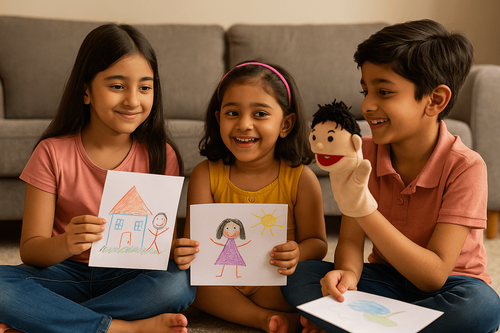

Table of Contents
- Understanding Why Children Express Emotions Through Storytel
- The Psychology Behind Storytelling and Emotional Processing
- How Storytelling Helps Kids Express Feelings Indirectly
- Why Stories Create Emotional Distance and Safety
- How Children Use Storytelling to Understand Their Emotions
- The Role of Imagination in Emotional Processing
- How Storytelling Builds Emotional Vocabulary
- Storytelling Supports Empathy and Perspective-Taking
- How Parents Can Use Storytelling for Emotional Conversations
- Storytelling Activities That Encourage Emotional Processing
- Storytelling Helps Children Build Emotional Regulation Skill
- How Storytelling Shapes Long-Term Mental Well-Being
- How PlanetSpark Helps Children Use Storytelling for Emotiona
- Turning Stories Into Emotional Strength
Children experience emotions intensely, often more deeply than adults realise. Their world is filled with new situations, unfamiliar feelings, developing social skills, and rapidly changing thoughts. Because they lack the vocabulary and cognitive maturity to express complex emotions, they naturally seek alternative ways to communicate their inner world. One of the most powerful tools available to them is storytelling to process emotions.
Storytelling allows children to translate overwhelming feelings into understandable narratives. When children tell stories, they externalize thoughts, understand cause and effect, explore emotional meaning, and create safe emotional distance from difficult experiences.
Understanding Why Children Express Emotions Through Storytelling
Children often lack the language skills to describe fear, embarrassment, sadness, frustration, or confusion directly. Instead of saying “I felt anxious when my teacher called my name,” a child might tell a story about a nervous rabbit or a shaky superhero. This symbolic expression is not avoidance. It is emotional translation.
Psychologists call this narrative emotional processing. When children create stories about characters, animals, imaginary heroes, or fictional situations, they are actually revealing how they feel inside.
Storytelling helps children:
Externalize internal emotions through characters
Describe sensitive feelings indirectly
Build emotional vocabulary
Understand cause and effect
Gain emotional clarity
Reduce emotional intensity
Create meaning from confusing experiences
This is why storytelling children process emotions more easily than through direct conversation.

The Psychology Behind Storytelling and Emotional Processing
Child development research shows that children naturally organize their world through stories. The brain uses narrative patterns to make sense of events, understand motivations, and interpret emotions. When children are upset, overwhelmed, or confused, storytelling becomes a cognitive tool for emotional self-regulation.
Psychologists identify three core mechanisms:
Externalization
Children shift feelings onto characters, reducing emotional pressure.
Structuring
Narratives impose sequence: beginning, conflict, resolution. This helps children order thoughts and feelings.
Reframing
Children can change outcomes in stories, gaining emotional control and resilience.
Thus, storytelling to process emotions works because story structure mirrors emotional processing in the brain.
How Storytelling Helps Kids Express Feelings Indirectly
Some children speak openly about emotions, but many find direct expression overwhelming. Storytelling offers emotional safety because children can express feelings through the stories of others.
They may say:
“The bear was scared of the dark.”
“The robot was sad when nobody listened.”
“The bird didn’t want to go to school.”
These narratives are emotional cues. They reveal emotional patterns, personal fears, or social concerns.
This is exactly how storytelling helps kids express feelings without pressure, shame, or discomfort.
PlanetSpark’s research-backed sessions help children articulate thoughts, feelings, and ideas with clarity.
Book a free class and watch your child grow emotionally and verbally.
Why Stories Create Emotional Distance and Safety
Children are sensitive to judgment. They worry about disappointing adults or being misunderstood. Storytelling acts as emotional buffering. The child is both narrator and observer.
This separation creates psychological safety because:
The child is not “confessing” feelings
The story character absorbs the emotional weight
The child avoids embarrassment
Adults respond to the character, not the child
The child gains control over the narrative outcome
This distance encourages honest emotional exploration.
How Children Use Storytelling to Understand Their Emotions
Children often do not know why they feel the way they do. Storytelling helps reveal emotional causes, triggers, and consequences.
Here is how children storytelling emotions supports internal understanding:
Identification
The child begins noticing emotions through characters.
Clarification
The storyline forces the child to identify what the character feels.
Meaning-making
The child begins to understand why the character feels that way.
Expression
The child finally verbalizes the story, turning emotions into language.
This is one of the deepest benefits of storytelling: it converts emotion into understanding.
The Role of Imagination in Emotional Processing
Imagination allows children to shape emotional possibilities. In stories, children can try out emotional outcomes safely:
Changing endings
Adding helpers
Removing threats
Making themselves powerful
Turning fears into funny moments
Imagination builds emotional flexibility. It also supports resilience by showing children that emotional experiences can be altered, managed, or reinterpreted.
This imaginative mental rehearsal is central to storytelling to process emotions.
PlanetSpark’s expert-guided storytelling and communication activities help children process emotions safely.
Try a free class today and see the difference.
How Storytelling Builds Emotional Vocabulary
Emotional vocabulary is essential for self-regulation. Children cannot regulate what they cannot name. Storytelling exposes children to emotional words like:
worried
excited
lonely
frustrated
disappointed
brave
When children repeatedly hear and use these words in stories, they internalize emotional concepts. Over time, they shift from “I feel weird” to “I feel nervous” or “I feel upset.”
This is why how storytelling helps kids express feelings is strongly linked to long-term emotional intelligence.
Storytelling Supports Empathy and Perspective-Taking
Stories teach children that others feel differently, think differently, and experience the world uniquely. Narrative exposure is one of the strongest drivers of empathy in childhood development.
Through stories, children learn:
to understand how others feel
to put themselves in another’s position
to respect different viewpoints
to recognize emotional cues
Empathy grows when children see the world through a character’s eyes.
How Parents Can Use Storytelling for Emotional Conversations
Parents can use storytelling intentionally to help children process emotions. This does not mean lecturing or moral lessons. It means gentle, supportive conversation.
1. Ask open reflection questions
“Why do you think the character felt sad?”
“What would you tell the character to help them?”
2. Let children lead the narrative
This supports emotional autonomy.
3. Use toys, puppets, or drawings
This lowers emotional pressure even further.
4. Tell stories from your childhood
It normalizes emotional challenges.
5. Repeat the story on different days
Repetition deepens emotional understanding.
When parents facilitate emotional storytelling, children feel heard and supported.
Storytelling Activities That Encourage Emotional Processing
Here are evidence-informed activities parents can use at home:
“Feelings Story Jar”
Write emotions on slips of paper. Children draw one and create a story around that feeling.
“Story Rewrite Game”
Take a familiar story and change the emotional outcome.
“Draw and Tell”
Children draw an emotional moment and narrate the story behind it.
“Puppet Problem-Solving”
Puppets “face” a challenge and your child guides their emotional journey.
“Emotion Path Stories”
Map emotions along a story path: beginning feeling, conflict feeling, resolution feeling.
These activities reinforce storytelling children process emotions in structured, safe ways.
Storytelling Helps Children Build Emotional Regulation Skills
Emotional regulation is not suppressing emotions. It is understanding them, expressing them appropriately, and returning to balance. Storytelling supports these skills by:
Helping children anticipate emotional triggers
Making emotional patterns visible
Providing safe scenarios for emotional practice
Encouraging self-soothing through story creation
Teaching children that emotions change over time
Children learn that emotions are not fixed. They can be understood, expressed, and managed.
How Storytelling Shapes Long-Term Mental Well-Being
Research shows that reflective storytelling builds:
resilience
emotional intelligence
self-awareness
empathy
problem-solving
social understanding
cognitive flexibility
Children who engage in emotional storytelling become emotionally healthier, socially stronger, and cognitively sharper.
This is why storytelling to process emotions is now considered one of the strongest foundations for healthy emotional development.
How PlanetSpark Helps Children Use Storytelling for Emotional Growth
PlanetSpark integrates storytelling into communication learning to help children process emotions safely.
AI Tools
Children receive supportive feedback on clarity, tone, and expression, which helps them articulate emotional narratives confidently.
Gamified Learning
Engaging challenges use storytelling to help children explore emotions and build emotional resilience.
Personalised Curriculums
Each child follows a path tailored to their emotional and communication needs.
Progress Reports
Parents track emotional expression, communication clarity, and storytelling development.
Club-Based Learning Modules
Group storytelling activities help children learn empathy, perspective, and social expression.
PlanetSpark’s interactive sessions guide children to express feelings confidently and constructively.
Book a trial class and support their emotional journey.
Turning Stories Into Emotional Strength
Storytelling is far more than a creative activity for children. It is a deeply instinctive, psychologically powerful method of emotional processing. When children tell stories, they translate overwhelming experiences into understandable narratives. They gain clarity, build emotional vocabulary, strengthen empathy, and learn how to navigate complex feelings with confidence.
By encouraging storytelling to process emotions, parents help children express themselves safely, reflect on emotional experiences, and develop lifelong emotional intelligence. Whether it is through drawings, puppets, improvisational stories, or daily reflection narratives, each storytelling moment helps a child organise thoughts, reduce emotional pressure, and build inner resilience.
Frequently Asked Questions
It helps children externalize feelings, understand emotional meaning, and express them safely through characters.
Yes. When children understand and express emotions through stories, outbursts become less frequent.
Extremely. It allows emotional expression without pressure or embarrassment.
Ages 4 to 14 benefit significantly, though the method can be adapted for teens as well.
You can book directly on the PlanetSpark website by choosing a suitable slot. A communication expert will conduct a personalised trial class.
PlanetSpark supports UPI, cards, net banking, and EMI plans. Payments are processed securely through trusted gateways.