
How to Write Real-Life Experiences Into Stories Effectively

Table of Contents
- Create a Clear Structure for Your True Story
- How to Start a Story About Your Life With Examples
- Choosing the Right Experience to Write About
- Understand the Core Message of Your Story
- Sample Real-Life Experience Story for Students
- Add Emotions — Don’t Just Tell, Show
- Use Dialogue to Make Your Story More Lively
- Paint Your Setting With Simple but Vivid Details
- Stay Honest — Authenticity Is Everything
- Turn Ordinary Moments Into Meaningful Stories
- Make Yourself the Main Character (But Not the Hero)
- Create a Strong Climax
- Write a Meaningful Ending
- Keep Your Language Simple and Clear
- Edit Your Story Like a Professional
- Learn From Real Examples of Personal Story Openings
- Why Real-Life Experiences Make the Best Stories
- Avoid Common Mistakes Students Make
- Practice Makes You a Stronger Writer
- Why PlanetSpark Is the Best Place to Build Exceptional Skill
- Begin Your Power of Writing Your Real-Life Stories With Plan
Writing from your own memories can be powerful, and understanding how to write real-life experiences into stories helps students turn everyday moments into meaningful narratives. This guidance shows you how to choose the right experiences, structure them like engaging stories, and express emotions effectively. With PlanetSpark’s interactive classes and expert mentors, students can build storytelling confidence, polish writing skills, and transform real-life moments into impactful stories.
Create a Clear Structure for Your True Story
A personal story should flow like a movie. The best structure is the classic narrative arc:
1. Introduction
Introduce the situation, setting, and characters. This is where you include how to start a story about your life creatively.
2. Rising Action
Show what problem, challenge, or event occurs.
3. Climax
The most intense or emotional moment of the story.
4. Falling Action
Explain what happened next or how the issue got resolved.
5. Conclusion
End with reflection:
- What did you learn?
- How did you change?
- Why does this experience matter?
This structure keeps your story clear, organised, and engaging.
How to Start a Story About Your Life With Examples
Your opening decides whether a reader stays or leaves. Use hooks that create curiosity or emotion.
Here are some strong ways to begin:
1. Start with a surprising line
“I never thought a simple bus ride would change the way I saw myself.”
2. Start with a moment of action
“I was running as fast as I could, but the school gate was already closing.”
3. Start with dialogue
“‘Are you sure you can do this?’ my coach asked as I tightened my grip on the bat.”
4. Start with an emotion
“My hands were shaking, and I could hear my heart louder than the morning assembly bell.”
5. Start with a flashback
“Whenever I see a paintbrush, I remember the day everything went wrong in art class.”
Such openings make readers curious enough to continue. Use any of these styles depending on your story’s mood.
Choosing the Right Experience to Write About
Not every memory needs to become a story. Pick moments that:
- Taught you a lesson
- Changed your perspective
- Made you feel strong emotions
- You still remember clearly
- Readers can relate to
Examples of student-friendly real-life story ideas:
- Your first day at a new school
- A moment you felt extremely proud
- A failure that taught you something
- A funny family incident
- An unexpected friendship
- A challenge you overcame
- A cultural or festival memory
- A trip where something special happened
Choose a memory that still feels alive inside you. If it makes your heart react, it can make a reader react too.
Watch them write confidently as they explore genres, prompts, and storytelling techniques with PlanetSpark experts.
Understand the Core Message of Your Story
Before writing, pause and ask yourself:
- What is my story really about?
- What lesson or theme does this experience reflect?
Some common themes students use include:
- Courage
- Friendship
- Self-discovery
- Overcoming fear
- Learning from mistakes
- Family bonding
- Growth and maturity
Your theme is the backbone of your story. It guides your writing and gives readers a takeaway.
Sample Real-Life Experience Story for Students
Real-life stories become more powerful when they capture emotions, challenges, and a clear lesson. Here’s a simple, relatable example students can learn from and use as inspiration.
I still remember the morning my teacher announced a surprise speech competition. My heart immediately started racing. Public speaking had always been my biggest fear, and hearing the word “speech” felt like the ground had shifted under my feet.
When my turn came, I walked toward the stage with shaky hands. The microphone looked larger than usual, and for a moment, I wished I could run back to my seat. But then I remembered something my mother always said: “Courage is not the absence of fear, but doing something despite it.” With a deep breath, I began speaking.
At first, my voice trembled. But as I continued, the words flowed more easily. I noticed a few classmates nodding and smiling, and that gave me the strength to continue. By the time I finished, the entire class clapped—some even louder than I expected.
I didn’t win the competition, but that day changed something inside me. I learned that fear loses its power the moment you face it. Now, whenever I need to speak in front of others, I remember that moment—and the courage I discovered in myself.
PlanetSpark teaches children to observe, imagine, and express creatively through proven writing frameworks and activities.
Add Emotions — Don’t Just Tell, Show
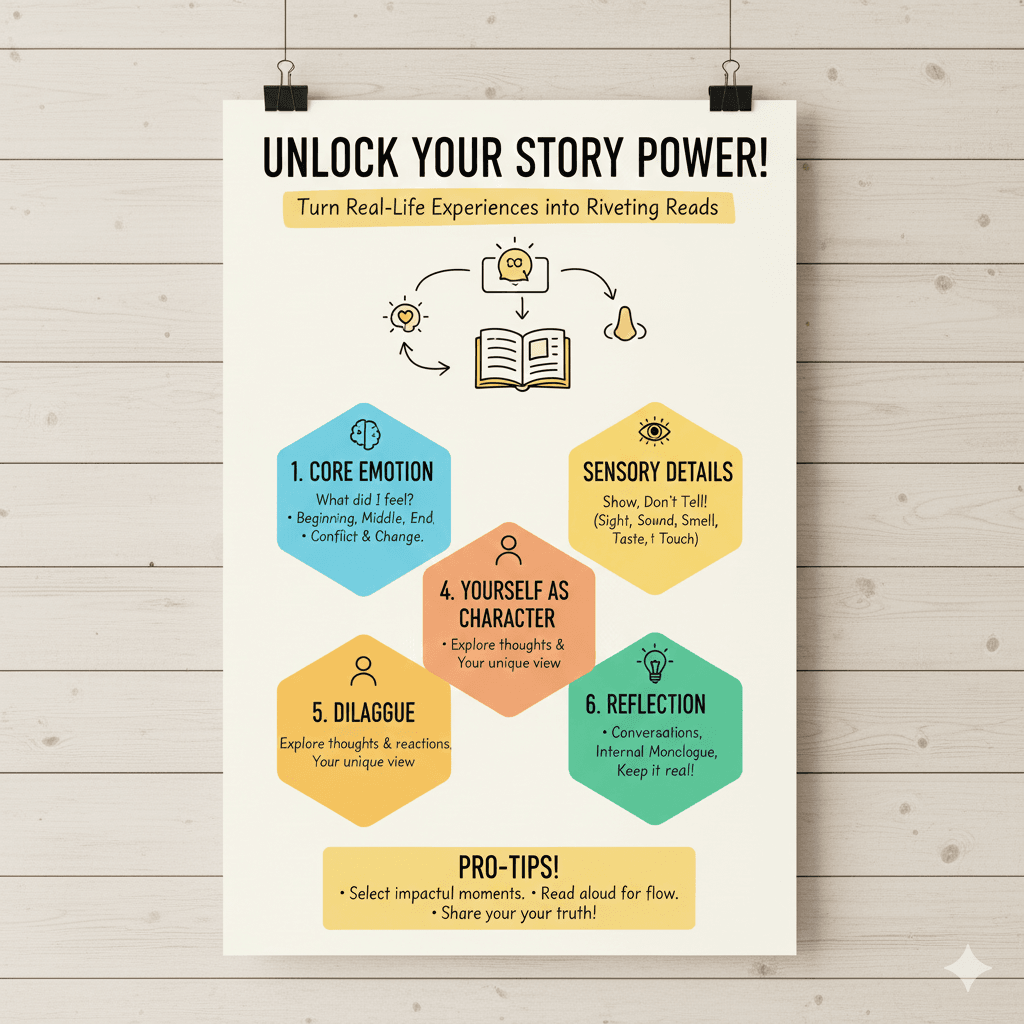
Writing a real-life experience isn’t just reporting facts. You must show emotions through details.
Telling (weak writing):
I was nervous.
Showing (powerful writing):
My stomach felt tight, and my palms were sweaty as I walked toward the stage.
Students often forget that “showing” helps readers feel what you felt. Use:
- Sensory details (sights, sounds, smells)
- Internal thoughts
- Body reactions
- Small actions that reveal emotions
The more you show, the more your story comes alive.
Use Dialogue to Make Your Story More Lively
Dialogues make your personal experience feel real and dynamic. Keep them short and natural.
Example:
“If you fall, just get up,” my father said, placing his hand on my shoulder.
“I’m scared,” I whispered.
“Being scared means you’re about to grow.”
Dialogues help readers hear the characters and understand their relationships.
Paint Your Setting With Simple but Vivid Details
Instead of writing:
I was in the classroom.
Write:
The classroom smelled of chalk dust and freshly printed worksheets. My bench was cold, and sunlight drew golden lines through the window.
Simple imagery like this makes scenes easy to imagine.
Stay Honest — Authenticity Is Everything
When learning how to write a true story about your life, remember:
- You don’t need to exaggerate.
- You don’t need to be dramatic.
- Real emotions are enough.
Be honest:
- If you felt scared, say it.
- If you made a mistake, admit it.
- If someone helped you, describe it.
Readers connect with truth, not perfection.
PlanetSpark’s personalised program strengthens every writing element through fun, interactive learning.
Turn Ordinary Moments Into Meaningful Stories
You don’t need a big tragedy or adventure. Small, everyday memories can become amazing stories if you highlight emotions and lessons.
For example:
- A simple walk to school can become a story about noticing kindness.
- A game you lost can become a story about learning resilience.
- A festival celebration can become a story about cultural bonding.
Look deeper into your memory, where you will find meaning beneath the surface.
Make Yourself the Main Character (But Not the Hero)
Your story should centre around you, but don’t write like you are perfect.
Add imperfections:
- Times you hesitated
- Moments you were confused
- Things you misunderstood
- Mistakes you made
These make your character believable.
Add Conflict (Even Small Ones)
Conflict doesn’t have to be a fight or a big tragedy. It can be:
- Struggling in a competition
- Getting lost
- Facing stage fright
- Arguing with a friend
- Feeling embarrassed
- Not meeting expectations
Conflict keeps the story moving and makes the climax meaningful. Students can click the link to get the picture prompt for inspiration for their writing.
Create a Strong Climax
This is the most emotional or dramatic point.
Examples:
- The moment you stepped on stage
- The second your name was announced
- The instant you realised your mistake
- The event that changed your thinking
Make the climax powerful, detailed, and emotional.
Give students the tools, guidance, and inspiration they need to craft vivid, sensory-rich narratives.
Write a Meaningful Ending
The ending is where you share what you learned.
A strong ending should answer:
- What changed because of this experience?
- What did you understand about yourself or life?
- How do you feel about this memory today?
Endings with reflections make readers think long after the story ends.
Keep Your Language Simple and Clear
Since you are writing about yourself, you don’t need fancy vocabulary. Use:
- Simple sentences
- Conversational tone
- Clear expressions
- Short paragraphs
Your goal is to make the reader feel your journey, not to impress them with big words.
Edit Your Story Like a Professional
After writing your first draft:
- Remove unnecessary details
- Correct grammar and spelling
- Smoothen transitions
- Improve dialogues
- Strengthen emotions
- Check if every part supports your main message
Editing transforms a good story into a great one. Students interested in fun art and writing challenges can click this link.
Learn From Real Examples of Personal Story Openings
Here are a few how to start a story about life examples you can use for inspiration:
Example 1: A Turning Point
I didn’t know that one phone call would change the way I saw my entire life.
Example 2: A Moment of Embarrassment
Everyone in the class was laughing, and I wished I could disappear into my chair.
Example 3: Fear and Growth
My legs were shaking, but I still walked toward the microphone.
Example 4: An Unexpected Twist
What began as a normal Sunday morning ended as the strangest day of my life.
Example 5: A Warm Memory
The smell of fresh jalebis always reminds me of the happiest morning of my childhood.
Use these styles to spark your creativity.
From descriptive paragraphs to full stories, PlanetSpark helps children write with clarity, creativity, and confidence.
Why Real-Life Experiences Make the Best Stories
Real-life experiences feel genuine, relatable, and emotional. Readers love authenticity—when they sense honesty, they connect with your writing instantly.
As a student, writing from your own life helps you:
- Understand yourself better
- Develop strong storytelling skills
- Bring originality and personal voice to your writing
- Express emotions you may not often share
- Build confidence in your thoughts and ideas
Most importantly, nobody else has lived your life. This uniqueness gives your writing a voice that cannot be copied.
Avoid Common Mistakes Students Make
Writing real-life experiences becomes easier when you know what not to do. Avoid these common mistakes to keep your story clear, emotional, and engaging for readers.
- Writing events randomly without structure
- Rushing through important moments
- Adding too many unnecessary details
- Using complicated vocabulary
- Writing like a diary instead of a story
- Forgetting to include emotions
- Not having a clear message or theme
Avoid these to create a polished, powerful story.
Practice Makes You a Stronger Writer
The more you write real-life stories, the better you become. Try writing:
- One story per month
- Short memories in your journal
- Dialogues you remember
- Sensory descriptions of everyday events
Your writing will improve faster than you expect.
Why PlanetSpark Is the Best Place to Build Exceptional Skills
PlanetSpark offers a complete learning ecosystem that helps children become confident, expressive, and imaginative writers. With expert-led classes, AI-powered tools, and engaging activities, students don’t just learn writing—they master the art of storytelling, clarity, structure, and creativity. Here’s how PlanetSpark transforms every child into a skilled young author:
What PlanetSpark Offers for Creative Writing Excellence
- 1:1 Personal Trainers who guide children through grammar, storytelling, vocabulary, and expression
- Personalised Writing Curriculum tailored to your child’s level, goals, and pace
- Spark Diary for daily writing practice that builds consistency and creativity
- Genre-Based Learning covering stories, poems, essays, book reviews, speeches, and more
- Creative Stimulus Activities like story dice, picture prompts, and imagination games
- Real Publishing Opportunities through blogs, e-magazines, anthologies, and showcases
- SparkX AI Video Analysis to refine delivery when presenting written work
- Gamified Tools like SparkBee and quizzes that strengthen grammar, vocabulary, and spelling
PlanetSpark ensures your child not only writes better but thinks sharper, imagines deeper, and communicates with confidence that lasts a lifetime.
Begin Your Power of Writing Your Real-Life Stories With PlanetSpark
Writing real-life experiences into stories is more than a school task—it’s a way to understand yourself better and share your truth with the world. When you learn how to write a true story about your life, you develop confidence, clarity, and creativity. You also discover that your experiences, no matter how small, can inspire, teach, and touch others.
Remember, a great personal story comes from:
- A clear message
- Honest emotions
- Strong structure
- Relatable experiences
- A meaningful ending
Your life is full of stories waiting to be written. Start today, and your words may become the mirror through which readers see a little part of themselves.
Frequently Asked Questions
Choose a moment that taught you something, changed you, or made you feel strong emotions. Pick experiences you remember clearly and that readers can relate to. Meaningful memories always make the strongest stories.
Begin with a hook such as emotion, dialogue, action, or a surprising line. This instantly captures attention and sets the tone. Strong openings help readers connect to your experience from the very first sentence.
Use sensory details, emotions, and dialogues. Show what you felt instead of simply telling facts. Build tension, include a clear conflict, and end with a reflective message. This makes your story believable and memorable.
Use a simple narrative arc: introduction, rising action, climax, falling action, and conclusion. This helps your story flow naturally and ensures your experience is organised, meaningful, and clear for readers.
Yes, PlanetSpark offers interactive classes, expert mentors, and personalised feedback that help students improve creativity, structure, expression, and confidence in writing personal stories and narratives based on real-life experiences.
PlanetSpark trains students to identify meaningful memories, express emotions clearly, use engaging hooks, and structure stories professionally. Their activities and guidance help students confidently transform everyday experiences into impactful, well-written narratives.