
Narrative Voice Techniques for Stronger Student Storytelling


Table of Contents
- What Is Narrative Voice?
- Why Narrative Voice Matters in Storytelling
- Types of Narrative Voice Techniques
- How Students Can Choose the Right Narrative Voice
- Narrative Voice Techniques Examples for Students
- Common Mistakes Students Make With Narrative Voice
- Narrative Voice Techniques in English Literature (Student-Fr
- How Students Can Improve Narrative Voice
- Why PlanetSpark Is the Best Place to Build Exceptional Skill
- Rise to Your Writing Potential with PlanetSpark
Narrative Voice Techniques shape the way a story speaks to its readers, guiding perspective, tone, and emotional impact. This guide breaks down each technique in simple language, offers clear examples for students, and shows how to select the appropriate narrative style for academic writing. With structured practice and expert mentorship, PlanetSpark helps students strengthen their storytelling abilities, refine their voice, and build confidence in every piece they create.
What Is Narrative Voice?
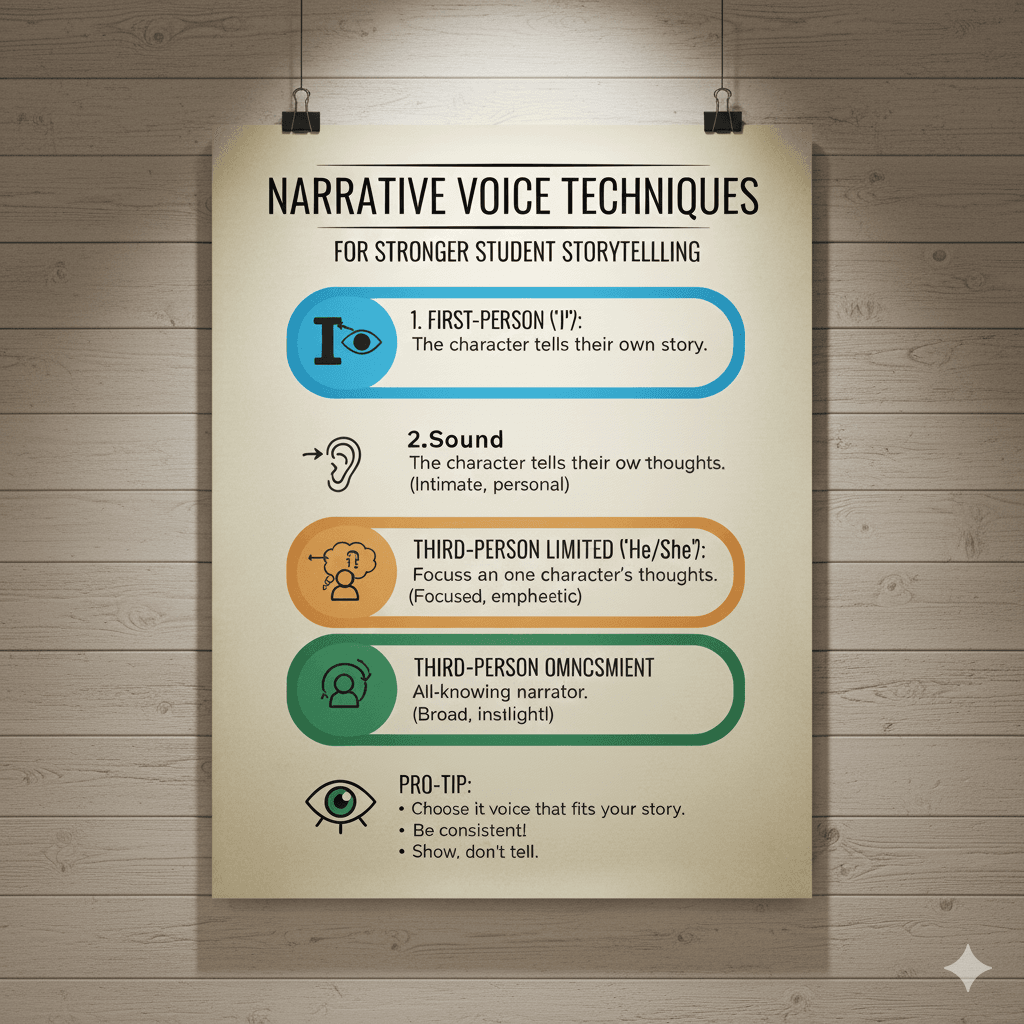
Narrative voice refers to the style and perspective through which a story is narrated. It reflects the narrator’s personality, attitude, reliability, tone, and point of view. When an author chooses a narrative voice, they choose the lens through which readers interpret events.
The narrative voice affects:
- The emotional tone of the story
- The level of intimacy between the reader and the characters
- How much information does the reader receive
- How the reader interprets characters’ motivations
- Whether the narrator is trustworthy or creates suspense
A story narrated by a detached observer feels completely different from one narrated by a character with strong opinions. Similarly, a story told in first person creates intimacy, while an omniscient narrator offers breadth and distance.
Why Narrative Voice Matters in Storytelling
Writers often spend a lot of time building plots, designing settings, or shaping characters. But without a strong narrative voice, the story can fall flat. Narrative voice determines the reader’s experience, shaping how your story feels.
Here are key reasons it matters:
1. Creates Emotional Connection
The narrative voice draws readers into the emotional world of the story. A first-person voice often feels intimate, while a reflective third-person voice provides a broader emotional scope.
2. Shapes Perception and Bias
The narrator influences what the reader believes. A biased narrator can mislead or manipulate the audience, creating suspense or complexity.
3. Builds Tone and Atmosphere
Calm, humorous, dark, whimsical, or reflective are tone that emerges through narrative voice choices.
4. Controls Information Flow
Some narrators reveal everything. Others hide facts, offer unreliable commentary, or share information slowly to build drama.
5. Defines the Story’s Identity
The same plot can be transformed simply by changing the narrative voice. This makes it one of the most powerful elements in a writer’s toolkit.
Understanding these strengths allows writers to use narrative voice strategically rather than accidentally.
Types of Narrative Voice Techniques
Below are the most important and widely used narrative voice techniques in English, along with practical explanations. These categories help you understand how stories position the narrator and how the reader receives the storytelling.
1. First Person Narrative Voice
First-person narration uses “I,” “me,” “we,” and “us.” It comes directly from the perspective of a character in the story.
Characteristics
- The narrator is part of the story
- The voice is personal, intimate, and opinionated
- Information is limited to the narrator’s experience
- Readers connect deeply to the narrator’s thoughts
Uses
- Coming-of-age stories
- Personal memoirs
- Psychological fiction
- Character-driven narratives
Narrative voice techniques examples (first person)
- “I felt the cold wind slice across my cheeks as I stepped onto the abandoned porch.”
- “We believed nothing could go wrong that summer, but we were wrong.”
Why it works
First-person narration creates a strong sense of closeness. Readers feel like they inhabit the narrator’s world.
Watch them write confidently as they explore genres, prompts, and storytelling techniques with PlanetSpark experts.
2. Second Person Narrative Voice
Second-person narration uses “you.”
Characteristics
- The narrator addresses the reader directly
- Creates a sense of active participation
- Often experimental, but powerful when used well
Uses
- Interactive fiction
- Instructions
- Literary fiction needs immersive impact
- Marketing or motivational writing
Narrative voice techniques examples (second person)
- “You step into the dark alley, listening for footsteps behind you.”
- “You realise that every decision is shaping the person you are becoming.”
Why it works
Second-person narration creates urgency, intimacy, and an emotional pull that places the reader inside the story.
3. Third Person Limited Voice
This narrative voice uses “he,” “she,” “they.” The narrator is outside the story but follows one character closely.
Characteristics
- Provides insight into only one character’s thoughts
- Offers a combination of intimacy and distance
- Feels controlled and steady
Uses
- YA fiction
- Mystery novels
- Modern commercial fiction
Narrative voice techniques examples
- “She watched the train disappear and wondered if she would ever see him again.”
Why it works
It balances closeness with narrative flexibility. Writers can explore a character deeply but still maintain an authorial distance.
4. Third Person Omniscient Voice
The narrator knows everything about thoughts, past events, future events, secrets, and conversations happening across locations.
Characteristics
- All-knowing narrator
- Wide perspective
- Multiple characters’ thoughts
- Strong narrative authority
Uses
- Epic novels
- Historical fiction
- Multi-perspective stories
Narrative voice techniques examples
- “Anna believed she had made the right choice, but far away in the valley, her brother was preparing for a confrontation she could not foresee.”
Why it works
This technique allows writers to build large and intricate story worlds.
5. Third Person Objective Voice
Here, the narrator describes only observable actions and dialogue with no access to thoughts.
Characteristics
- Neutral narrator
- Like watching a movie
- Readers must interpret characters on their own
Uses
- Literary fiction
- Report-style storytelling
- Crime fiction needs detachment
Narrative voice techniques examples
- “He placed the letter on the desk and walked out without looking back.”
Why it works
It creates realism and subtlety, leaving emotional interpretation to readers.
PlanetSpark teaches children to observe, imagine, and express creatively through proven writing frameworks and activities.
6. Stream of Consciousness
A highly internal narrative technique reflecting the complete, unfiltered flow of a character’s thoughts.
Characteristics
- Nonlinear
- Fragmented sentences
- Reveals inner emotions and impulses
Uses
- Psychological fiction
- Literary fiction
- Experimental writing
Narrative voice techniques examples
- “The rain outside the window tapping tapping and why can’t I remember where I left the key the key the key always missing…”
Why it works
It immerses readers deep into a character’s mind.
7. Unreliable Narrator Technique
This technique uses a narrator who is not fully trustworthy.
Characteristics
- The narrator may be lying, confused, biased, or emotionally unstable
- Creates suspicion and tension
- Readers must interpret the truth
Uses
- Mystery and thriller novels
- Psychological fiction
- Dark comedy
Narrative voice techniques examples
- “Of course, I only borrowed the money. Anyone would have done the same.”
- The narrator insists they are innocent, but clues suggest otherwise.
Why it works
It creates intrigue and twists, encouraging active reading.
8. Multiple Narrative Voices
A story where more than one narrator tells the story.
Characteristics
- Different narrators offer different perspectives
- Highlights contrast, conflict, or hidden truths
- Complex and layered
Uses
- Multi-character dramas
- Social novels
- Stories requiring broader world-building
Narrative voice techniques examples
- One chapter in first person
- Next chapter in third person
- Alternating viewpoints between two protagonists
Why it works
It enriches storytelling by offering varied perspectives.
9. Free Indirect Speech
A blend of third-person narration with first-person thoughts.
Characteristics
- Third-person grammar
- Narrator slips into a character’s internal voice
- Smooth movement between description and thought
Uses
- Modern literary fiction
- Subtle character exploration
Narrative voice techniques examples
- “She walked toward the interview room. What if they hated her? What if she ruined everything?”
Why it works
It offers psychological depth without breaking narrative flow.
10. Epistolary Narrative Voice
Narration delivered through letters, emails, diary entries, or recorded messages.
Characteristics
- Personal and intimate
- Reveals voice through format
- Creates authenticity
Uses
- Historical fiction
- Coming-of-age stories
- Romance or mystery novels
Narrative voice techniques examples
- Diary entry narrations
- Interconnected letters between characters
- Modern stories told through text messages
Why it Works
It works by creating intimacy, realism, and engaging puzzle-like storytelling.
PlanetSpark’s personalised program strengthens every writing element through fun, interactive learning.
How Students Can Choose the Right Narrative Voice
Choosing the best voice is like choosing the right angle for your selfie, but changes everything.
Ask yourself:
1. Who should the reader trust?
If you want closeness → Choose first person
2. Do you want to explore multiple minds?
If yes → Choose omniscient or multiple narrators
3. Is your story very emotional or psychological?
If yes → Try stream of consciousness
4. Do you want direct reader involvement?
Choose the second person
5. Is your writing assignment factual?
Choose the third person objective
6. Do you want a simple, safe option?
Choose the third person limited
(Great for most student stories)
Narrative Voice Techniques Examples for Students
Below is one scenario rewritten using different voices, so you clearly see how narrative voice changes storytelling.
Scenario: A student finds a secret note inside a library book.
1. First Person
“I opened the book, and a folded note dropped out. My heart skipped a beat.”
2. Second Person
“You open the book and freeze when a secret note falls onto your desk.”
3. Third Person Limited
“Riya stared at the note, her hands trembling as she unfolded it.”
4. Third Person Omniscient
“Riya felt nervous when she found the note, unaware that the writer was watching her from the next table.”
5. Objective
“A note slipped out of the book. Riya picked it up and opened it.”
This helps you see how technique influences emotion, detail, and suspense. Students interested to learn how to create a character sketch can click here.
Give students the tools, guidance, and inspiration they need to craft vivid, sensory-rich narratives.
Common Mistakes Students Make With Narrative Voice
Many students struggle with maintaining a consistent narrative voice in their writing. Small mistakes can weaken storytelling, confuse readers, or reduce clarity. Understanding these common errors helps improve writing quality and boosts academic performance.
- Switching voices accidentally
Example: Starting in first person and suddenly using third person. - Giving the narrator too much knowledge
If you use the first person, the narrator cannot know what other characters are thinking unless they guess. - Overusing “I”
Students sometimes make every sentence start with “I,” which becomes repetitive. - Forgetting tone
Even if the voice is correct, the tone must match the story’s mood. - Confusing narrator with author
The narrator is a voice, not you, unless you are writing a personal essay.
Understanding these helps you avoid losing marks in assignments or exams.
Narrative Voice Techniques in English Literature (Student-Friendly Examples)
Here are famous books often taught in school with strong narrative voices:
- First person – The Diary of a Young Girl (Anne Frank)
- Unreliable narrator – To Kill a Mockingbird (young Scout’s limited understanding)
- Omniscient – Pride and Prejudice
- Stream of consciousness – works of Virginia Woolf
- Multiple narrators – The Book Thief
Studying these helps students see how narrative voice supports themes and character development.
How Students Can Improve Narrative Voice
Developing a strong narrative voice takes continuous practice, careful reading, and awareness of how different perspectives shape the tone and impact of a story.
- Read stories with strong narrators
- Rewrite the same event in multiple voices
- Practice diary writing
- Keep a voice chart for characters
- Pay attention to tone and mood
- Ask: “Who is speaking?” in every paragraph
The more you practice, the more natural these techniques become. Here, students can learn the story conflict technique by clicking this link.
Why PlanetSpark Is the Best Place to Build Exceptional Skills
PlanetSpark offers a complete learning ecosystem that helps children become confident, expressive, and imaginative writers. With expert-led classes, AI-powered tools, and engaging activities, students don’t just learn writing—they master the art of storytelling, clarity, structure, and creativity. Here’s how PlanetSpark transforms every child into a skilled young author:
What PlanetSpark Offers for Creative Writing Excellence
- 1:1 Personal Trainers who guide children through grammar, storytelling, vocabulary, and expression
- Personalised Writing Curriculum tailored to your child’s level, goals, and pace
- Spark Diary for daily writing practice that builds consistency and creativity
- Genre-Based Learning covering stories, poems, essays, book reviews, speeches, and more
- Creative Stimulus Activities like story dice, picture prompts, and imagination games
- Real Publishing Opportunities through blogs, e-magazines, anthologies, and showcases
- SparkX AI Video Analysis to refine delivery when presenting written work
- Gamified Tools like SparkBee and quizzes that strengthen grammar, vocabulary, and spelling
PlanetSpark ensures your child not only writes better but thinks sharper, imagines deeper, and communicates with confidence that lasts a lifetime.
Rise to Your Writing Potential with PlanetSpark
To sum it up, narrative voice is an important part of good storytelling, and understanding different techniques helps students write more clearly and creatively. When you choose the right voice, your story feels stronger, more expressive, and easier for readers to understand and connect with emotionally.
By practising different narrative voice techniques, students can improve both creative writing and English assignments. Using examples, experimenting with perspectives, and paying attention to tone will make your stories more engaging. With regular practice, you will develop confidence and find the narrative style that suits you best.
Frequently Asked Questions
Narrative Voice Techniques are methods writers use to decide who tells the story and how it is told. They shape perspective, tone, emotions, and the overall reader experience.
Narrative Voice Techniques help students write clearer, stronger, and more engaging stories. Understanding narrative voice improves exam answers, creative assignments, and overall communication skills in English writing.
First-person narrative is usually the easiest because it feels natural. Students write using “I” and share personal thoughts, making the storytelling simple, direct, and relatable.
Think about who should speak, how much they know, and what emotion you want readers to feel. The voice should match your story’s goal, tone, and character focus.
Yes, PlanetSpark provides personalised sessions, writing exercises, and expert feedback that help students understand perspectives better and apply narrative voice effectively in school writing.
PlanetSpark uses interactive activities, live classes, and creative prompts to help students practice storytelling in a fun way, develop stronger narrative choices, and grow confident in English writing.