
Omniscient Narrator in Storytelling Explained | PlanetSpark
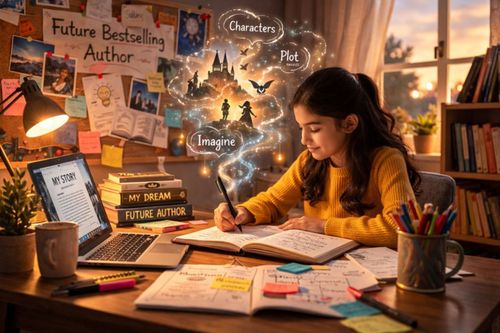

Table of Contents
- Omniscient Narrator: Definition and What is Point Of View in
- Different Types of Omniscient Narrators
- Differences Between the Popular Third-Person Omniscient and
- Examples of the Popular Omniscient Narrators in Children's S
- Why Do Writers Use Omniscient Narrators?
- Tips for Writing in 3rd Person Omniscient
- How PlanetSpark Helps Students in Creative Writing using Omn
- Conclusion
Stories become powerful when the storyteller knows everything, every thought, secret, and hidden motive. An omniscient narrator gives readers that complete view. This narrative voice moves freely between characters, revealing emotions, backstories, and future consequences. From classic literature to modern children’s fiction, this technique allows young readers to understand complex feelings and relationships.
At PlanetSpark, storytelling is not just about imagination; it is about structure, voice, and confidence. Through guided creative writing programmes, students learn how to experiment with narrative styles, including the third person omniscient narrator, to craft compelling stories. With expert mentors and personalised feedback, children master techniques used by celebrated authors, building both communication skills and creative confidence for lifelong success.
Omniscient Narrator: Definition and What is Point Of View in Storytelling?
The first thing that you ask is “what is omniscient narrator?” Well, it is an all-knowing storyteller who has access to every character’s thought, feelings, and motivations. Unlike a limited viewpoint, this narrator can reveal hidden truths and shift perspectives effortlessly. This form of omniscient narration often appears in classic literature.
For example, in Pride and Prejudice, Jane Austen writes, “She is tolerable; but not handsome enough to tempt me.” The narrator later reveals Elizabeth’s private response and Darcy’s internal conflict. Similarly, in Little Women, Louisa May Alcott observes, “Jo was very tall, thin, and brown.” The narrator then shares Jo’s ambitions and insecurities, offering readers full emotional insight.
The omniscient narrator's point of view allows a storyteller to stand outside the narrative world while knowing everything happening within it. This perspective provides a panoramic understanding of events, revealing multiple characters’ thoughts and creating dramatic irony, depth, and layered storytelling.
Different Types of Omniscient Narrators
An omniscient narrator does not always function in the same way. Writers shape this voice differently depending on tone, audience, and emotional depth. Understanding these variations helps young writers recognise how perspective influences reader engagement and character development.
Third Person Omniscient
A third person omniscient narrator knows the thoughts and feelings of all characters and can move between them freely. This style often offers commentary or philosophical reflection.
For example:
In War and Peace, Leo Tolstoy shifts between Pierre, Natasha, and Andrei, revealing private emotions and historical context, giving readers a sweeping, panoramic experience.
Guided Omniscient
In this type, the narrator is all-knowing but subtly directs readers’ sympathies. The storyteller may gently judge characters or hint at moral lessons.
For example:
In Middlemarch, George Eliot frequently pauses to interpret characters’ motives, guiding readers toward deeper understanding rather than remaining neutral.
First Person Omniscient
Rare but powerful, this narrator speaks in first person while knowing more than a typical character should.
For example:
In The Book Thief, Death narrates the story and reveals future events, inner thoughts, and hidden outcomes, demonstrating how a seemingly personal voice can still control the entire narrative scope.
Help your child master the omniscient narrator with clarity and confidence. When young writers understand narrative voice, their storytelling becomes richer and more engaging. Start building stronger creative foundations today!
Invisible Omniscient
Here, the narrator remains detached and objective, revealing thoughts without inserting opinions.
For example:
In The Lion, the Witch, and the Wardrobe, C.S. Lewis moves between the Pevensie children’s experiences while maintaining a calm, storytelling presence.
Limited Omniscient
A limited omniscient narrator focuses closely on one character at a time but may occasionally widen the lens.
For example:
In Harry Potter and the Sorcerer’s Stone, readers primarily access Harry’s thoughts, yet the narrator occasionally hints at information beyond his understanding.
Out of these six types, the third-person omniscient and limited omniscient narrators are more mainstream. Therefore, understanding their subtle distinctions helps young writers decide how much information to reveal and when.
Differences Between the Popular Third-Person Omniscient and Limited Omniscient Narrators
While both narrative styles operate in the third person, they differ significantly in scope and control. The omniscient narrator point of view allows access to every character’s internal world, whereas limited narration restricts readers to one character at a time. This distinction influences suspense, dramatic irony, and emotional closeness.
Below is a clear comparison of their key differences:
Aspect | Limited Omniscient Narrator | Third Person Omniscient Narrator |
Scope of knowledge | The narrator closely follows one primary character, revealing their thoughts and emotions while keeping other characters’ inner worlds mostly hidden. Example: Harry Potter. Readers primarily experience events through Harry’s understanding. | The narrator has unrestricted access to every character’s thoughts, emotions, and motivations. Example: Pride and Prejudice. Readers understand both Elizabeth’s feelings and Darcy’s internal conflicts. |
Perspective movement | The viewpoint remains centred on one character for most of the narrative, rarely shifting away. Example: Percy Jackson. The story consistently aligns with Percy’s awareness. | The narrator can move freely between characters, settings, and timelines without limitation. Example: War and Peace. The narrative shifts across multiple individuals and historical contexts. |
Reader connection | Creates emotional intimacy because readers experience the world almost entirely through one character’s lens. Example: The Hunger Games. Readers feel Katniss’ fear and uncertainty directly. | Offers a broader, panoramic connection to the story world rather than a single emotional viewpoint. Example: Middlemarch. The narrator explores the lives of several characters equally. |
Dramatic irony | Limited, as readers typically know only what the focal character knows at any given time. Example: Harry Potter and the Goblet of Fire. Readers share Harry’s confusion about the Triwizard Tournament. | Frequently used, since the narrator may reveal hidden truths unknown to certain characters. Example: Romeo and Juliet. The audience knows Juliet is alive before Romeo does. |
Tone and authority | More immersive and character-driven, often feeling personal despite third-person narration. | More authoritative and reflective, sometimes including philosophical commentary on events or society. |
Examples of the Popular Omniscient Narrators in Children's Stories
Understanding narration becomes easier when children see it in action. Classic and contemporary children’s books beautifully demonstrate how perspective shapes emotion, suspense, and reader connection. Below are powerful examples that highlight both the limited omniscient narrator and the broader narrative scope of omniscient storytelling.
Limited Omniscient Narrator Examples
Harry Potter (J.K. Rowling):
In Harry Potter and the Philosopher’s Stone, the story primarily follows Harry’s thoughts and experiences. Readers discover Hogwarts as he does, sharing his confusion, excitement, and fears. This makes it a strong limited omniscient narrator example.
“Harry had never even imagined such a strange and splendid place.”
The narration remains close to Harry’s awareness, rarely revealing deeper thoughts of other characters unless necessary.
Percy Jackson (Rick Riordan):
Although written in first person, Percy Jackson and the Lightning Thief mirrors limited narrative scope because readers only know what Percy knows. His understanding shapes every scene.
“Look, I didn’t want to be a half-blood.”
The narration restricts information to Percy’s experiences, maintaining suspense and humour while keeping readers aligned with his perspective.
The Hunger Games (Suzanne Collins):
This novel offers deep psychological closeness to Katniss. Readers feel her fear, moral conflict, and uncertainty directly, making it a strong study in restricted narrative focus.
“I volunteer as tribute!”
The narrative does not reveal hidden plans or private conversations beyond Katniss’ knowledge, heightening tension and emotional immersion.
Third-person Omniscient Examples
Charlotte's Web (E.B. White):
In this beloved classic, the narrator knows the thoughts of Wilbur, Charlotte, and even the human characters. This reflects full omniscient narration.
“Wilbur never forgot Charlotte.”
The narrator gently reveals emotions and events across different characters, providing warmth and insight beyond a single perspective.
The Lion, the Witch, and the Wardrobe (C.S. Lewis):
Lewis frequently moves between the Pevensie children’s thoughts while maintaining an authoritative storytelling voice, a hallmark of the third person omniscient narrator.
“Once there were four children whose names were Peter, Susan, Edmund, and Lucy.”
The narrator shifts freely, revealing private struggles and larger magical truths beyond individual awareness.
Charlie and the Chocolate Factory (Roald Dahl):
Roald Dahl’s narrator often comments directly on characters’ flaws while revealing multiple viewpoints. This broad access defines omniscient storytelling.
“Mr. and Mrs. Bucket were the parents of a small boy called Charlie Bucket.”
The narrator observes, critiques, and explains events beyond any single character’s understanding, adding humour and authority.
Now that we have explored literary examples, the next step is understanding how young writers can confidently apply this expansive perspective in their own creative storytelling.
Want your child to excel in creative writing using an omniscient narrator? Structured guidance and expert feedback can transform simple stories into compelling narratives. Encourage deeper storytelling skills now!
Why Do Writers Use Omniscient Narrators?
Writers often choose an omniscient narrator when they want complete narrative freedom. This perspective allows them to explore multiple characters, reveal hidden motivations, and create layered storytelling. For young readers especially, it builds empathy by showing how different characters think and feel within the same situation.
To reveal multiple viewpoints within one story, giving readers a fuller understanding of conflicts and relationships.
To create dramatic irony, where readers know more than the characters, and increase suspense and emotional tension.
To explore complex themes such as morality, society, or fate through reflective commentary and broader insight.
To move freely across time and settings without restricting the narrative to one character’s awareness.
To provide philosophical or humorous observations, which is a strength often seen in omniscient narration across classic children’s literature.
Tips for Writing in 3rd Person Omniscient
Writing with a third person omniscient narrator requires control, clarity, and deliberate structure. Because the narrator knows everything, the writer must decide carefully what to reveal and when. Without discipline, the story may feel scattered. With mastery, however, it becomes powerful, layered, and emotionally rich.
Establish an Authoritative Narrative Voice: An omniscient voice should sound confident and consistent. The narrator must feel reliable and aware of the broader story world. Avoid uncertainty in tone.
Avoid Jarring "Head-Hopping": Although omniscient narration allows movement between characters, abrupt shifts within the same paragraph can confuse readers. Transitions should be smooth and purposeful.
Use Dramatic Irony Strategically: Because the narrator knows more than the characters, dramatic irony becomes a valuable tool. Reveal hidden information selectively to build suspense, tension, or emotional depth.
Balance "Showing" and "Telling": While insight is powerful, excessive telling can weaken engagement. Combine vivid scenes with reflective commentary to maintain narrative energy.
Master the "Filter" Words: Avoid overusing phrases like “she thought” or “he felt.” Since the narrator already has access to thoughts, simply present them clearly.
How PlanetSpark Helps Students in Creative Writing using Omniscient Narrator?
Understanding narrative perspective is not just a literary concept; it is a skill that strengthens imagination, structure, and clarity of thought. When students learn how to handle an omniscient narrator, they develop the ability to control plot movement, reveal character motivations, and build dramatic tension intentionally.
At PlanetSpark, creative writing sessions go beyond surface storytelling. Children are trained to think like authors, planning perspective shifts, managing narrative voice, and maintaining coherence across scenes. With structured frameworks and personalised mentoring, students gradually gain confidence in experimenting with omniscient narration while preserving clarity and flow.
- Genre-Based Curriculum: Students practice omniscient storytelling across various genres such as short stories, essays, journal writing, and book reviews. Each format is introduced with a lesson structure tailored to help students adapt the omniscient narrator point of view effectively.
- Framework-Driven Writing Instruction: PlanetSpark offers students essential tools like story arcs (beginning-middle-end), the S.T.O.R.Y structure, the 5W1H method, and the PEEL technique for essays and arguments. These frameworks guide students as they experiment with third person omniscient narrator perspectives and master the flow of omniscient narration.
- Writing + Speaking Integration: Children present their written stories aloud, allowing them to strengthen their narrative control and gain confidence in shifting perspectives without confusing their audience.
- Editing, Feedback, and Rewriting: Emphasis is placed on the omniscient narrator during real-time feedback sessions. Students learn how to refine their transitions, ensuring smooth shifts between different narrative perspectives, whether moving from third person omniscient narrator to a limited omniscient narrator or vice versa.
- Real Publishing Opportunities: Selected works are published on PlanetSpark’s blog, e-magazines, and anthologies. This exposure boosts students' confidence in experimenting with omniscient narration while showcasing their creativity.
- Creativity Stimulus Activities: Story prompts, image-based tasks, and guided imagination exercises stimulate original thinking. These activities help children develop compelling stories with omniscient narrator techniques, ensuring they can balance creativity with structure.
By focusing on third person omniscient narrator examples and allowing students to experiment with limited omniscient narrator styles, PlanetSpark ensures that children not only master omniscient narration but also build their skills in crafting engaging and coherent stories.
Turn storytelling lessons into real creative growth. At PlanetSpark, children master creative writing techniques like the omniscient narrator through expert mentoring and live feedback. Book our free trial session today.
Conclusion
Mastering the omniscient narrator empowers young writers to think beyond a single perspective and craft layered, emotionally rich stories. When children understand how narrative voice shapes meaning, they develop stronger imagination, empathy, and structural clarity in their writing.
At PlanetSpark, students learn to experiment confidently with narrative styles through personalised mentoring, structured creative writing frameworks, and AI-powered feedback. With expert guidance, children transform storytelling into a powerful tool for expression, critical thinking, and academic excellence.
Frequently Asked Questions
An omniscient narrator is an all-knowing storyteller who understands every character’s thought, emotions, and motivations. This narrator can reveal hidden information, shift perspectives smoothly, and even foreshadow future events within the story.
Writers choose this style because the omniscient narrator point of view allows flexibility. It enables movement across characters and timelines while building dramatic irony and providing deeper thematic commentary.
Many classics use an omniscient narrative style. A well-known third person omniscient narrator example appears in Pride and Prejudice, where readers understand both Elizabeth’s and Darcy’s inner conflicts.
The main types include third-person omniscient, guided omniscient, first-person omniscient, invisible omniscient, and limited omniscient narrators. Each differs in narrative presence, authority, and how widely perspectives are revealed.
PlanetSpark teaches students structured storytelling, voice control, and character development through personalised mentoring. Children practise multiple narrative forms and receive detailed feedback to strengthen clarity, creativity, and confidence.
Yes. Through creative writing programmes, debate clubs, and AI-powered performance tracking, PlanetSpark builds vocabulary, fluency, structure, and expressive confidence, helping children communicate ideas effectively across academic and creative formats.