
Read Relatable Stories that Inspire Young Minds


Table of Contents
- Why Relatable Stories Matter for Kids
- Best Relatable Stories That Teach Real Life Lessons
- How to Write Engaging Stories Kids Love Reading
- Storytelling Ideas from Real Life Children Can Use
- Making Stories Interesting for Readers
- Emotional Storytelling Techniques That Build Connection
- How Relatable Stories Build Speaking Confidence
- Daily Habits to Help Kids Create Better Stories
- Become a Storyteller With PlanetSpark’s Storytelling Classes
- Every Great Speaker Starts With One Story
What if one simple story could help a child face fear, speak kindly, or believe in themselves again? Many children struggle to understand emotions, friendships, mistakes, and confidence in everyday life. That is where relatable stories become powerful tools. They turn life lessons into memorable moments children can understand and enjoy.
In this blog, you will explore inspiring relatable stories, learn how to write engaging stories, discover storytelling ideas from real life, and understand making stories interesting for readers through simple techniques. You will also learn emotional storytelling techniques that help children connect deeply with stories.
Let us begin with why relatable stories matter so much in a child’s growth journey.
Why Relatable Stories Matter for Kids
Children learn best when they can see themselves inside a story. When a character feels nervous before speaking on stage, struggles to make friends, or learns from mistakes, children instantly connect. These are the moments where relatable stories become life lessons.
Stories that mirror real emotions help children:
- Understand feelings like fear, jealousy, excitement, or sadness: Stories help children recognize emotions in characters and connect them to their own experiences. This makes it easier for them to understand and express their feelings in healthy ways.
- Learn how to solve everyday problems: When characters face challenges and find solutions, children learn practical ways to handle similar situations in real life. Stories teach decision-making in a simple and engaging manner.
- Build empathy for others: By seeing the world through a character’s eyes, children learn to understand different feelings and perspectives. This helps them become kinder and more caring toward others.
- Improve imagination and listening skills: Stories encourage children to picture scenes, characters, and events in their minds. At the same time, listening carefully to stories improves focus and attention span.
- Gain courage to try again after failure: Many stories show characters making mistakes, learning lessons, and succeeding later. This teaches children that failure is temporary and trying again can lead to success.
For example, a story about a shy child who slowly becomes confident can inspire another shy child to raise their hand in class.
Unlike lectures, stories do not feel like teaching. They feel enjoyable. Yet the lessons stay longer in a child’s memory.
Parents and teachers often use relatable stories because they open meaningful conversations. After hearing a story, children naturally ask questions, share opinions, and reflect on their own behaviour.
That is why bedtime stories, school storytelling sessions, and moral tales remain timeless tools for learning.
Worried your child lacks confidence while speaking? Book a PlanetSpark demo class today before this week’s slots fill up.
Best Relatable Stories That Teach Real Life Lessons
Stories become more meaningful when children can connect them with real emotions and everyday situations. These timeless tales are simple, memorable, and full of lessons that help kids grow into thoughtful and confident individuals.
1. The Boy Who Cried Wolf
A shepherd boy becomes bored while watching sheep and repeatedly lies by shouting that a wolf is coming. Villagers rush to help each time, only to discover it was a prank. When a real wolf finally appears, nobody believes him.
Lesson: Trust once broken is hard to rebuild. Honesty is important because people believe those who are truthful.
Why kids relate: Children understand playful teasing and jokes, but this story helps them see that repeated dishonesty can create serious consequences.
2. The Lion and the Mouse
A powerful lion catches a tiny mouse but chooses to let it go. Later, the lion gets trapped in a hunter’s net. The small mouse returns and gnaws through the ropes, setting him free.
Lesson: Kindness always returns. Helping others can bring support when you least expect it.
Why kids relate: It teaches children that size or age does not define value. Even a small act from a child can make a big difference.
3. The Tortoise and the Hare
A speedy hare laughs at the slow tortoise and challenges him to a race. Feeling overconfident, the hare stops to rest. Meanwhile, the tortoise keeps moving steadily and wins.
Lesson: Consistency beats arrogance. Slow and steady effort often leads to success.
Why kids relate: Many children compare themselves to others. This story reminds them that steady progress matters more than being naturally fast or talented.
4. The Cracked Pot
A pot feels ashamed because it leaks water while being carried. But the owner points out that flowers have grown along the path because of the dripping water.
Lesson: Imperfections can create beauty and value.
Why kids relate: Children sometimes feel insecure about mistakes or weaknesses. This story teaches them that flaws can also become strengths.
5. Colonel Sanders and 1,009 Rejections
Harland Sanders faced rejection many times while trying to share his chicken recipe. Instead of quitting, he kept trying until he succeeded and built KFC.
Lesson: Persistence matters more than age or failure.
Why kids relate: It inspires children who feel discouraged after losing, failing, or hearing “no.”
These relatable stories help children connect daily experiences with timeless wisdom that guides their choices and mindset.
Want your child to speak with confidence? Book a free PlanetSpark trial class today before slots fill fast.
How to Write Engaging Stories Kids Love Reading
Learning how to write engaging stories helps children become stronger communicators, thinkers, and creators. A good story captures attention from the first line and keeps readers curious until the end.
Start With a Simple Problem
Every interesting story begins with a challenge that needs solving. Problems create suspense and make readers want to know what happens next.
Examples:
- Lost homework before school
- Fear of speaking on stage
- First day in a new school
- Broken friendship after an argument
- Missing pet or toy
Even small everyday problems can become exciting stories when emotions are involved.
Create a Character Children Understand
Readers connect more deeply when characters feel real and relatable.
Use characters who feel:
- Nervous before a test
- Excited for a birthday party
- Sad after losing a game
- Lonely in a new classroom
- Proud after working hard
When children recognise these emotions, they stay interested.
Add Emotion and Action
Instead of simply telling emotions, show them through actions.
Instead of: “Riya was scared.”
Try: “Riya’s hands shook as she walked toward the microphone.”
This makes scenes feel more vivid and emotional.
Keep Curiosity Alive
Great stories make readers silently ask questions:
- Will she speak confidently?
- Can he fix the mistake?
- Will they become friends again?
- What happens next?
Curiosity keeps children turning pages.
End With Growth
Children enjoy endings where someone learns, improves, apologises, or solves a problem. Positive growth makes the story meaningful.
Teaching kids how to write engaging stories improves writing, creativity, confidence, and communication skills.
Storytelling Ideas from Real Life Children Can Use
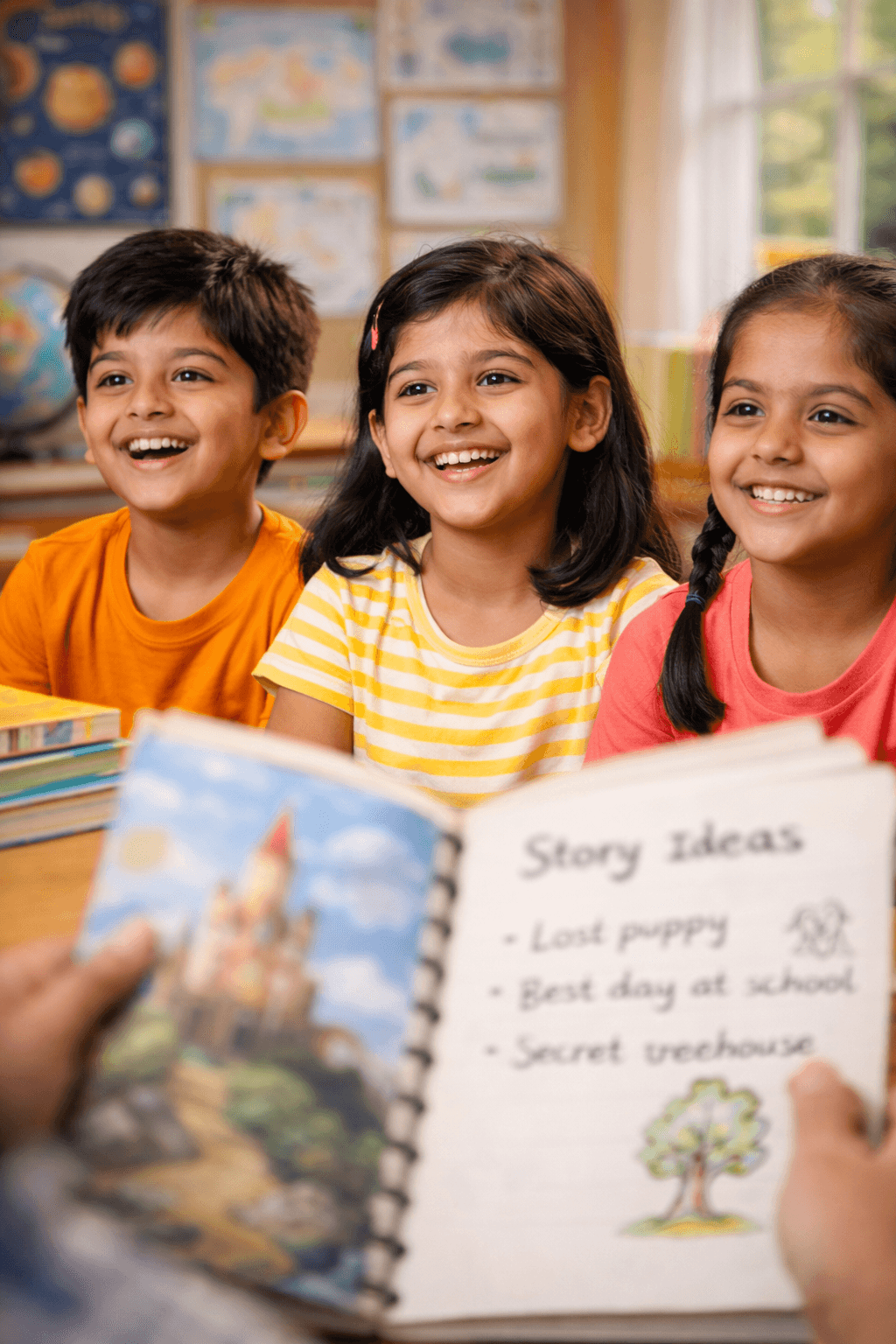
The best storytelling ideas from real life often come from simple everyday moments. Children do not need dragons or magic castles to tell wonderful stories. Their own experiences can be powerful and inspiring.
Real Life Story Ideas
- A child who forgot lines during a speech but recovered bravely
- Helping a new student feel welcome in class
- Losing a favourite toy and finding it later
- Learning to ride a bicycle after many falls
- Solving a fight between two friends
- Winning after weeks of practice
- Overcoming fear of darkness
- Cooking something for the first time
- Standing up for a classmate
Why Real Life Stories Work
They feel believable and emotional. Readers connect faster because they have experienced similar situations themselves.
Children also gain confidence when they realise their own lives are full of meaningful stories.
Turn a Memory Into a Story
Use this simple structure:
- What happened?
- What problem appeared?
- How did you feel?
- What did you do?
- What did you learn?
Example:
“I forgot my speech lines on stage. I panicked at first. Then I took a deep breath, smiled, and started again. Everyone clapped when I finished.”
That becomes a powerful story about courage and resilience.
Using storytelling ideas from real life helps children see that their everyday experiences matter and deserve to be shared.
Looking for a fun way to build confidence and communication? Book a storytelling session today before limited mentor slots are gone.
Making Stories Interesting for Readers
Many children begin stories with excitement but lose readers halfway. The secret to making stories interesting for readers is to keep emotion, movement, surprise, and curiosity alive.
Use Strong Openings
The first sentence should grab attention immediately.
Instead of:
“It was Monday morning.”
Try:
“The principal called my name, and my knees started shaking.”
This creates instant curiosity.
Add Dialogue
Dialogue makes stories feel alive and natural.
Example:
“Are you sure you can do this?” asked Aman.
“I do not know,” whispered Tara.
Conversations reveal emotions and make characters feel real.
Include Small Surprises
Unexpected moments keep readers engaged.
Examples:
- A shy child wins the debate
- The bully apologises sincerely
- The lost notebook was inside the bag all along
- The smallest player scores the winning goal
Surprises do not need to be huge. Even small twists create excitement.
Use Senses
Describe what characters hear, see, smell, or feel.
- The stage lights felt hot
- The classroom was silent
- Her heartbeat sounded loud
- Rain tapped against the window
Sensory details make readers feel present in the story.
Keep Sentences Clear
Children should learn that simple writing can still be powerful. Clear sentences are easier to read and understand.
Build Emotion
Readers often forget facts but remember feelings. Make them laugh, worry, hope, or feel proud of the character.
Mastering making stories interesting for readers turns average writing into memorable storytelling.
Emotional Storytelling Techniques That Build Connection
Great stories stay in memory because they make readers feel something. These emotional storytelling techniques help children create stories that connect deeply.
Show Feelings Through Actions
Instead of saying, “He was nervous,” show nervousness through behaviour.
Example:
He kept rubbing his palms on his shirt and looking at the floor.
Actions make emotions feel real.
Use Inner Thoughts
Let readers know what the character is thinking.
- What if I fail?
- Everyone is staring at me.
- Maybe I can do this.
- I wish I had one more chance.
Inner thoughts help readers connect emotionally.
Add Change
Emotion becomes powerful when characters grow.
Examples:
- Fear to courage
- Anger to forgiveness
- Loneliness to friendship
- Doubt to confidence
Growth gives stories meaning.
Use Meaningful Details
Objects can carry emotion.
Examples:
- A trophy after hard work
- A torn letter after an argument
- An old pencil from a grandparent
- A stage microphone before a big speech
These details make scenes memorable.
Create Hope
Children enjoy stories where effort leads to progress. Even if problems appear, hope keeps readers emotionally invested.
These emotional storytelling techniques help young writers create stories that readers remember long after finishing them.
Does your child avoid speaking in class or competitions? Get expert coaching now with a free PlanetSpark demo session.
How Relatable Stories Build Speaking Confidence
Storytelling is not only useful for writing. It is also one of the best ways to build communication and public speaking skills.
When children narrate stories, they practise:
- Voice modulation by changing tone for different characters
- Eye contact while connecting with listeners
- Body language through gestures and expressions
- Clear structure with beginning, middle, and end
- Emotional expression while sharing feelings
- Audience engagement by keeping listeners interested
A child who tells stories regularly often becomes more confident in:
- Class discussions
- Presentations
- Competitions
- Group activities
- Stage performances
This is why many educators use storytelling before formal speech training. Stories feel fun and natural, so children speak more freely.
Even shy children often become expressive when asked to narrate a favourite story or personal memory.
That makes relatable stories one of the smartest and most enjoyable tools for communication development.
Daily Habits to Help Kids Create Better Stories
Children improve fastest with small consistent practice.
Try These 10 Minute Habits
- Write one memory from today
- Create a new ending for a famous tale
- Describe one emotion without naming it
- Tell a story aloud to family members
- Read one short story daily
- Observe people and imagine their day
- Keep a notebook of funny moments
Why It Works
Storytelling is a skill, not a gift. Daily habits train creativity, structure, and confidence over time.
Become a Storyteller With PlanetSpark’s Storytelling Classes
PlanetSpark storytelling classes are designed for kids who want to improve creativity, speaking confidence, writing skills, and self-expression. Many children have ideas but struggle to organise them, present them clearly, or write engagingly. Structured coaching helps unlock these hidden abilities.
With expert mentors, personalised feedback, and fun live sessions, children learn storytelling in a step-by-step way that builds long-term confidence.
Why Parents Choose PlanetSpark
- Live 1:1 and interactive classes with expert trainers
- Personalised curriculum based on age and skill level
- Storytelling, public speaking, and creative writing combined
- SparkX AI feedback on speech clarity and body language
- Practice clubs, competitions, and showcase opportunities
- Regular progress reports for parents
- Confidence-building framework with measurable growth

Every Great Speaker Starts With One Story
Stories shape how children think, feel, and express themselves. Through relatable stories, kids learn courage, honesty, resilience, and kindness in ways they truly remember. They also develop communication skills that support school success and lifelong confidence.
Encourage your child to read, write, and tell stories regularly. Every story they create strengthens imagination and voice. One small story today can become the confidence they carry for years.
Also Read: Story for Kids: Short English Stories to Inspire Young Minds
Frequently Asked Questions
Relatable stories are stories based on emotions, problems, and situations children understand such as friendship, fear, mistakes, courage, and family life.
They help children learn life lessons, improve empathy, understand emotions, and gain confidence through examples.
Children can learn by reading regularly, observing daily life, practising story structure, and getting expert feedback through guided classes like PlanetSpark.
School challenges, friendship moments, competitions, family memories, learning a new skill, or overcoming fear are excellent real-life story ideas.
PlanetSpark combines live coaching, personalised learning, AI feedback, competitions, and confidence training in one structured platform.
PlanetSpark combines live coaching, personalised learning, AI feedback, competitions, and confidence training in one structured platform.