
Storytelling Framework Explained with Examples


Table of Contents
- What is a Storytelling Framework and Why It Matters
- Key Elements of Effective Story Creation
- The Three-Act Storytelling Framework
- The Hero’s Journey Framework in Creation Story
- PAS Framework for Simple and Powerful Storytelling
- Other Popular Storytelling Frameworks You Should Know
- How to Choose the Right Storytelling Framework
- Practical Tips to Improve Your Story Creation Skills
- PlanetSpark Storytelling Classes
- Build Your Voice Through Powerful Storytelling
Ever wondered why some stories stay with you forever while others are forgotten instantly?
Many people struggle to turn their ideas into engaging narratives. Without a clear storytelling framework, even creative thoughts can feel scattered, making it hard for the audience to connect. A well-structured story helps you present your ideas clearly, build emotional impact, and keep your audience interested from beginning to end.
In this blog, you will learn what a storytelling framework is and why it plays a crucial role in effective communication. You will explore popular frameworks like the Three-Act Structure, Hero’s Journey, and PAS model, along with simple examples that make them easy to understand. You will also discover practical tips to improve your story creation skills and avoid common mistakes.
By the end, you will have the confidence to structure your ideas into powerful, engaging stories that leave a lasting impression.
What is a Storytelling Framework and Why It Matters
A storytelling framework is a structured method used to organize ideas into a meaningful and engaging narrative. It helps transform scattered thoughts into a clear story that connects emotionally with the audience. Instead of guessing how to begin or end your story, a framework gives you a clear direction to follow.
At its core, every story includes three essential elements:
- A character or hero: This is the central figure your audience follows. A relatable character helps build connection and interest.
- A conflict or challenge: This is the problem or obstacle that creates tension and keeps the audience curious about what happens next.
- A resolution or outcome: This shows how the conflict is solved and what the character learns or achieves.
Without structure, even the most creative ideas can lose their impact. A storytelling framework acts like a roadmap that guides your story from beginning to end, ensuring that each part flows logically into the next.
Why is it important?
- Clarity: A framework helps you present your ideas in a clear and organized way so your audience can easily follow along.
- Engagement: When a story has a strong beginning, middle, and end, it keeps the audience interested throughout.
- Consistency: It ensures your message stays focused without unnecessary details or confusion.
- Impact: A well-structured story is more memorable and leaves a lasting impression.
For example, in story creation, if you jump directly to the ending without explaining the problem, the audience may feel disconnected. But when you follow a structured approach, you build curiosity step by step, making the story more engaging.
Whether you are writing a creation story, preparing a speech, or creating content, using a storytelling framework improves both the quality of your ideas and the way you deliver them.
Key Elements of Effective Story Creation
Story creation becomes much easier when you understand the building blocks of a strong narrative. These elements form the foundation of any storytelling framework and help you craft stories that are clear, engaging, and meaningful.
1. Characters
Every story needs a central figure, also known as the protagonist. This could be a person, a group, or even an idea. The audience should be able to relate to this character’s goals, struggles, or emotions. A strong character makes the story more engaging and helps the audience feel connected.
For example, a shy student trying to overcome stage fear is a relatable character for many learners.
2. Setting
The setting is the time and place where the story happens. It provides context and helps the audience visualize the situation. A well-described setting makes the story feel real and immersive.
For instance, describing a classroom, a stage, or a competition environment helps the audience better understand the character’s journey.
3. Conflict
Conflict is the heart of any story. It introduces a challenge or problem that the character must face. Without conflict, a story can feel flat and uninteresting.
Conflict can be:
- Internal, such as fear or self-doubt
- External, such as competition or obstacles
This element keeps the audience curious and emotionally invested.
4. Plot
The plot is the sequence of events that moves the story forward. It connects the beginning, middle, and end in a logical flow. A strong plot ensures that each event leads naturally to the next, keeping the story engaging and easy to follow.
5. Resolution
The resolution is the conclusion of the story where the conflict is solved or transformed. It shows the outcome of the character’s journey and often highlights growth or learning. A satisfying resolution leaves the audience with a clear takeaway or message.
Example of Story Creation
Let’s look at a simple example using these elements:
A student struggles with stage fear and avoids speaking in front of others. They decide to join a speaking program where they practice regularly and receive guidance. Over time, they build confidence and finally deliver a successful speech on stage.
In this example:
- The student is the character
- Stage fear is the conflict
- Practice sessions form the plot
- The confident speech is the resolution
This simple structure shows how a storytelling framework helps turn a basic idea into a meaningful and engaging story.
Struggling to turn your ideas into powerful stories?
Book your free trial class today and start your storytelling journey with expert mentors. Limited seats available.
The Three-Act Storytelling Framework
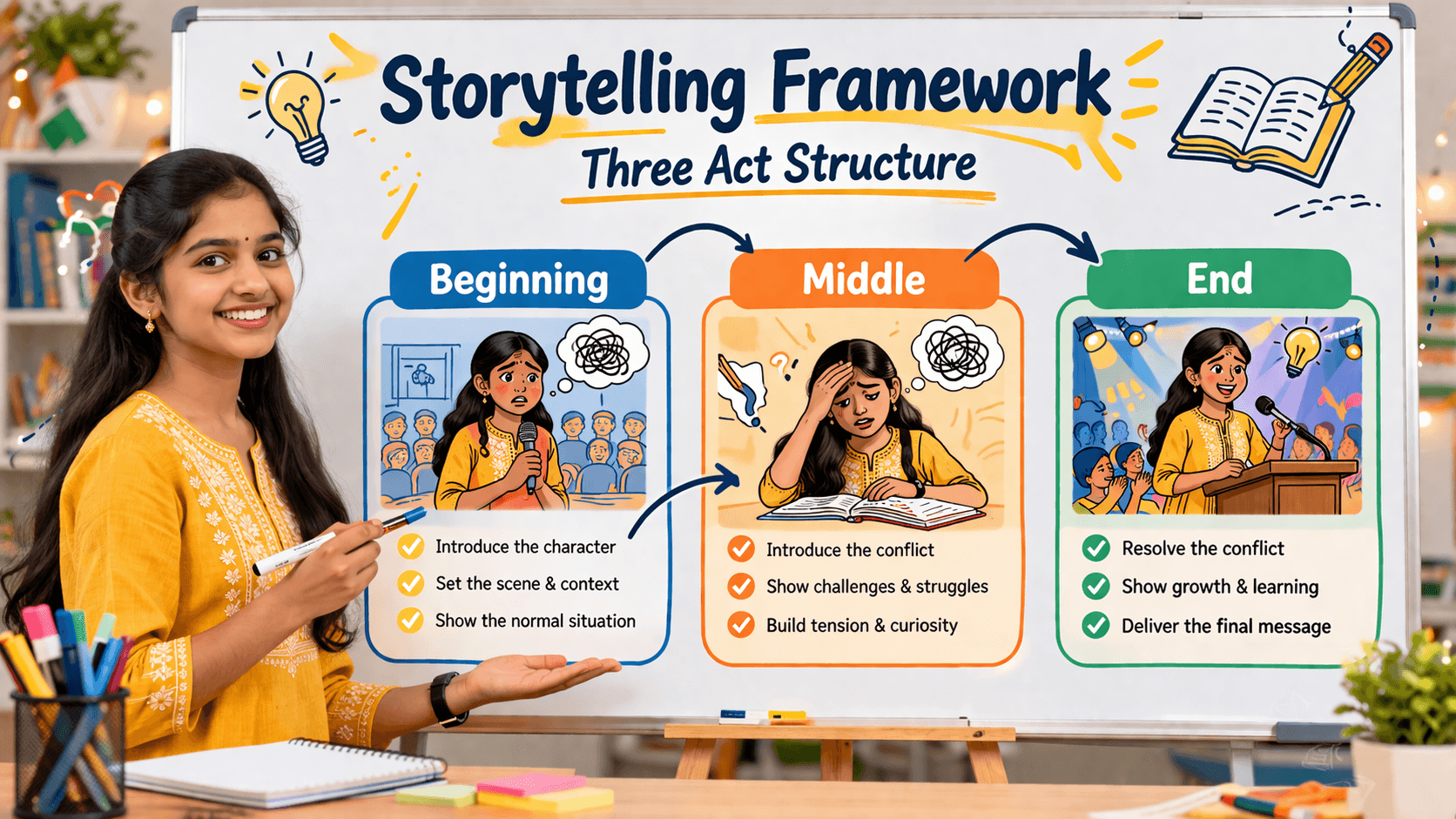
The Three-Act Structure is one of the most widely used storytelling frameworks because it offers a clear and logical flow. It divides a story into three parts that guide the audience from introduction to resolution in a smooth and engaging way. This structure is commonly used in films, speeches, presentations, and even everyday communication.
Act 1: Setup
This is where your story begins. You introduce the main character, the setting, and the situation. The goal here is to help the audience understand who the story is about and what their normal world looks like. A strong setup builds curiosity and prepares the audience for what is coming next.
Act 2: Confrontation
This is the longest and most important part of the story. The main conflict appears, and the character starts facing challenges and obstacles. This section builds tension and keeps the audience engaged. It also shows the effort, struggle, and growth of the character.
Act 3: Resolution
In this final stage, the conflict is resolved. The character either overcomes the challenge or learns something valuable. This part gives closure and leaves the audience with a clear takeaway or message.
Example
- Setup: A child fears public speaking
- Confrontation: The child struggles during practice sessions and feels nervous
- Resolution: With consistent effort, the child gains confidence and performs well on stage
Why it works
- Simple and easy to understand
- Helps organize ideas clearly
- Suitable for beginners and professionals
- Works for both writing and speaking
This storytelling framework is especially useful for structured story creation, presentations, and academic tasks where clarity is important.
The Hero’s Journey Framework in Creation Story
The Hero’s Journey is a powerful storytelling framework that focuses on transformation. It is widely used in movies, books, and motivational stories because it creates a strong emotional connection with the audience. This framework shows how a character evolves through challenges and experiences.
Stages
- Departure: The hero starts in their normal world but faces a call to change or solve a problem
- Initiation: The hero faces challenges, meets mentors, and learns important lessons
- Return: The hero comes back stronger, more confident, and transformed
Example of a Creation Story
A young learner struggles with communication and avoids speaking in public. One day, they discover a mentor who guides them. Through consistent practice and learning, they overcome their fears and become a confident speaker.
Why use this framework
- Builds a deep emotional connection with the audience
- Clearly shows growth and transformation
- Makes the story inspiring and relatable
This framework is ideal for storytelling that aims to motivate, inspire, and highlight personal growth. It works especially well in speeches, personal stories, and success journeys.
Looking to improve storytelling and communication skills fast?
Reserve your trial class today and start learning with expert mentors. Hurry, limited availability.
PAS Framework for Simple and Powerful Storytelling
The PAS framework stands for Problem, Agitate, Solve. It is one of the simplest storytelling frameworks and is highly effective in communication, marketing, and everyday storytelling. It focuses on identifying a problem and guiding the audience toward a solution.
Steps
- Problem: Clearly identify the issue that the audience can relate to
- Agitate: Highlight the impact of the problem and why it matters
- Solve: Present a clear and practical solution
Example
- Problem: Many students fear speaking in public
- Agitate: This fear limits their confidence and prevents them from expressing ideas
- Solve: Structured learning and regular practice help overcome this fear
Benefits
- Easy to understand and apply
- Works well for beginners
- Keeps the message focused and clear
- Highly engaging and relatable
This storytelling framework is widely used in content writing, presentations, and communication training because it delivers a clear message quickly.
Other Popular Storytelling Frameworks You Should Know
Apart from the main frameworks, there are several other storytelling methods that can enhance your story creation skills. Each framework serves a different purpose depending on the type of story you want to tell.
1. Before-After-Bridge
- Before: Describe the current situation or problem
- After: Show the desired or improved outcome
- Bridge: Explain how the transformation happens
This framework is useful for showing change and progress in a simple way.
2. COSR Framework
- Challenge
- Obstacle
- Solution
- Result
This method is often used in case studies and real-life success stories because it highlights both the problem and measurable outcomes.
3. Pixar Framework
- Once upon a time
- Every day
- Until one day
- Because of that
- Until finally
This framework is great for creative story creation and helps build a natural flow in storytelling.
Each of these frameworks supports different storytelling goals, from simple explanations to detailed narratives.
How to Choose the Right Storytelling Framework
Choosing the right storytelling framework is important because it directly affects how your message is received. The best framework depends on your purpose, audience, and the type of story you want to tell.
Ask yourself
- What is the purpose of your story
- Who is your audience
- What emotion do you want to create
Quick guide
- Use the Three-Act Structure for clear and structured storytelling
- Use the Hero’s Journey for inspirational and emotional stories
- Use PAS for simple and direct communication
- Use the Pixar framework for creative story creation
When you choose the right framework, your story becomes more engaging, clear, and impactful. It also helps you communicate your ideas more effectively.
Want to master storytelling step by step?
Join a live demo class today and learn from experts before limited seats fill up.
Practical Tips to Improve Your Story Creation Skills
Improving storytelling is a gradual process that requires practice, patience, and the right techniques. By following a few simple strategies, you can significantly improve your story creation skills.
Tips
- Start with a clear idea and define your main message
- Focus on one central theme to avoid confusion
- Keep your story simple and easy to understand
- Practice storytelling regularly to build confidence
- Use real-life examples to make your story relatable
- Seek feedback and make improvements
Common Mistakes to Avoid
- Overcomplicating the story with too many details
- Ignoring structure and jumping between ideas
- Not including a clear conflict or challenge
- Ending the story without a strong conclusion
Practice Exercise
Try creating a short story using the Three-Act Structure. Begin with a simple setup, introduce a challenge, and end with a clear resolution. This exercise will help you understand how a storytelling framework works in real situations.
PlanetSpark Storytelling Classes
PlanetSpark Storytelling classes are designed for kids, teens, and learners who want to improve communication, creativity, and confidence. These classes solve common challenges like stage fear, lack of structure, and difficulty in expressing ideas clearly. Structured learning ensures consistent growth and skill development.
Features and USPs
- Live interactive one on one classes
- Expert communication trainers
- Real world storytelling and speaking practice
- Personalized feedback after every session
- Confidence building framework
- Structured curriculum for all levels
PlanetSpark also offers advanced tools like AI video analysis, Spark Diary for writing practice, and gamified learning modules that make storytelling engaging and effective.

Build Your Voice Through Powerful Storytelling
Storytelling is more than just a skill. It is a powerful way to express ideas, connect with people, and build confidence. When you use a storytelling framework, you bring clarity and impact to your communication.
Keep practicing, stay consistent, and focus on improving step by step. Over time, your stories will become stronger, more engaging, and more meaningful.
Frequently Asked Questions
A storytelling framework is a structured method to organize ideas into a clear and engaging narrative.
Story creation helps improve communication, creativity, and emotional connection with the audience.
The Three-Act Structure is best for beginners due to its simplicity.
A creation story explains how something began or developed, often focusing on transformation.
Practice regularly, follow a structure, and seek feedback from experts.
Yes, storytelling makes speeches more engaging and memorable.
With consistent practice and guidance, noticeable improvement can happen within weeks.