
Why Sci-Fi Helps Kids Think More Creatively | Full Guide
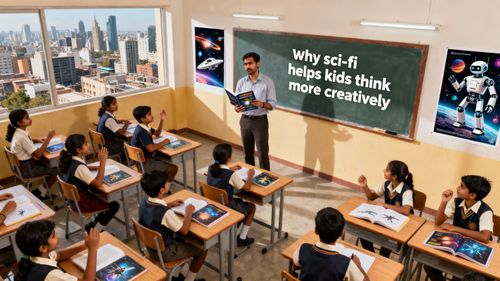

Table of Contents
- How Sci-Fi Expands a Child’s Creative Thinking
- Sci-Fi Teaches Children to Question, Explore, and Innovate
- Sci-Fi Builds Strong Problem-Solving Skills
- Sci-Fi Strengthens Language, Storytelling, and Expression
- Sci-Fi Helps Children Understand Technology and Science
- Sci-Fi Promotes Emotional Intelligence and Empathy
- PlanetSpark Storytelling Course: A Structured Way to Build C
- The Future Belongs to Creative Thinkers: Help Your Child Bec
Science fiction is more than flying cars, robots, and distant galaxies. It is a powerful thinking tool that helps children break mental boundaries, imagine possibilities, question the world around them, and innovate fearlessly. When parents search for “Why Sci-Fi Helps Kids Think More Creatively,” they are looking for more than just genre recommendations. They want to understand how sci-fi stimulates a child’s brain, how it introduces complex ideas in simple ways, and how it nurtures flexible thinking. Sci-fi pushes children to explore the unknown, connect abstract ideas, and picture futuristic scenarios, skills that shape creative, confident, future-ready thinkers.
This blog dives into all aspects of how science fiction enhances imagination, builds problem-solving skills, supports emotional development, boosts storytelling abilities, and prepares children for a world driven by innovation and technology. From cognitive benefits to communication growth, you will discover why sci-fi is one of the most powerful creativity catalysts available to young minds.
How Sci-Fi Expands a Child’s Creative Thinking
The Imagination Multiplier Effect of Science Fiction
Science fiction is not just a genre. It is a mental playground where children can explore worlds that do not yet exist but could exist someday. This “imagination multiplier” effect is the foundation of creative thinking. Children who regularly read or watch sci-fi begin to imagine alternatives to the ordinary: different worlds, different societies, different solutions, and different futures. Sci-fi pushes their minds into unfamiliar spaces where innovation thrives.
Children learn creativity not by memorizing concepts but by visualizing new possibilities. Sci-fi gives them the raw material needed for this visualization. When they picture futuristic cities, alien species, time travel, artificial intelligence, teleportation devices, invisible shields, parallel universes, or intergalactic missions, they stretch their cognitive boundaries beyond what they see around them.
This type of imaginative play is crucial for cognitive development. Neuroscience research shows that when children imagine new scenarios, the parts of their brain responsible for innovation, critical thinking, and problem-solving become more active. Sci-fi triggers these parts of the brain more intensely than most genres because it blends narrative, science, adventure, and complex ideas.
Sci-fi also encourages speculative thinking, the ability to ask “What if…?” and explore endless possibilities. This is the same mode of thought responsible for major scientific breakthroughs in history.
Sci-Fi Teaches Children to Question, Explore, and Innovate
Why Questioning Is the Root of Real Creativity
Children are naturally curious, but sci-fi fuels that curiosity by presenting worlds full of unanswered questions. Why do people live on a spaceship? What caused time travel to exist? How do robots think? Can humans communicate with aliens? Science fiction encourages children to ask these questions and more.
This habit of questioning is essential for creativity. Creative thinkers do not accept the world as it is; they imagine how it can be better. Sci-fi helps kids develop this mindset early.
What makes sci-fi even more impactful is that it shows children the value of questioning. Characters often solve mysteries, challenge unfair systems, or create inventions simply because they dared to ask a deeper question. Kids start to understand that innovation begins with curiosity.
Sci-Fi and the Future-Focused Mindset
A futuristic mindset drives innovation. When children think about possibilities, including impossible ones, they begin forming mental models of the future. This builds resilience, flexibility, and adaptability. Science fiction introduces children to technological advancements, ethical dilemmas, and scientific ideas that help them think ahead.
Sci-fi also exposes children to the consequences of human actions. Whether it’s a planet destroyed due to carelessness, a robot uprising because of programming faults, or a dystopian society created by inequality, children see the importance of responsible thinking.
Kids grow up understanding that the future is shaped by the choices we make today. This makes them:
more mindful
more responsible
more innovative
more aware of global issues
In a rapidly evolving world, such thinking is a priceless skill.
Sci-Fi Builds Strong Problem-Solving Skills
Creative Problem-Solving Through Fictional Challenges
In sci-fi stories, problems are rarely simple. They involve survival challenges, scientific mysteries, technological breakdowns, and moral dilemmas. Children absorb how characters analyze situations, make decisions under pressure, and use creativity to solve problems.
For example:
A character stranded on another planet must use science and logic to survive.
A malfunctioning robot causes chaos, and the hero must figure out the ethical implications of artificial intelligence.
A time-travel scenario forces characters to repair timelines using reasoning.
An explorer must decode an alien message to prevent interplanetary conflict.
A young scientist must create a cure to stop a futuristic disease.
These narrative structures help children develop:
Logical reasoning
Analytical thinking
Strategic planning
Inventive solutions
Critical judgment
Decision-making skills
Why Sci-Fi Encourages Lateral Thinking
Sci-fi naturally trains lateral thinking because its worlds do not follow the usual rules. A child cannot rely on familiar patterns; they must think differently.
For example:
How would you grow food in zero gravity?
What would school look like on a different planet?
How do you communicate with a species without spoken language?
These questions force children’s brains to form unique mental connections. This type of thinking is essential for innovation in science, technology, business, and problem-solving in everyday life.
Lateral thinking also helps children become strong storytellers because they learn to create unique plots, unexpected twists, and imaginative solutions.
Sci-Fi Strengthens Language, Storytelling, and Expression
Exposure to Rich Vocabulary and Complex Ideas
Sci-fi introduces children to advanced vocabulary and sophisticated concepts. Words like dimension, asteroid, gravity, portal, teleportation, artificial intelligence, galactic, evolution, biosphere, quantum, and hologram expand their language capacity. They begin to articulate ideas that are abstract, imaginative, and future-oriented.
This exposure helps children:
express innovative ideas clearly
describe settings vividly
ask deeper questions
understand scientific concepts
communicate confidently
Building the Foundation for Strong Storytelling Skills
Children form their best stories when they have access to interesting ideas. Sci-fi provides endless creative fuel. When kids consume sci-fi, they learn:
How to build fictional worlds
How to create complex characters
How to design plots filled with discovery and conflict
How to express thoughts clearly and confidently
Sci-fi teaches structure, pacing, suspense, imagination, and creativity, all building blocks of exceptional storytelling.
Children often start mimicking sci-fi narratives by:
inventing their own gadgets
creating new planets
designing alien species
writing mystery-filled plotlines
Sci-fi gives them the confidence to create rather than just consume.
Sci-Fi Helps Children Understand Technology and Science
A Gentle Introduction to STEM Concepts
Sci-fi simplifies scientific concepts and makes them appealing. Children learn principles of physics, biology, space science, robotics, engineering, coding, and astronomy through stories rather than textbooks.
Because stories are emotional and memorable, children retain these ideas longer.
Bringing Complex Ideas to a Child’s Level
For example:
Time travel introduces cause and effect
Space travel teaches orbital motion
Robotics introduces coding and artificial intelligence
Alien ecosystems introduce biology and evolution
Futuristic medicine introduces genetics and biotechnology
Children become more observant and curious about real science. They start asking scientific questions, experimenting at home, researching topics, and even showing early interest in STEM careers.
Sci-Fi Promotes Emotional Intelligence and Empathy
Stories Set in the Future Teach About Humanity Today
Though sci-fi explores futuristic worlds, the emotional core remains deeply human. Kids learn about fear, courage, friendship, teamwork, ethical choices, and compassion. They empathize with characters, even alien ones, and understand different perspectives.
Sci-fi often explores moral questions:
Should we create technology that replaces humans?
What makes someone alive?
Should we explore new planets if they already have life?
How should society treat people with special abilities?
These questions help children understand ethics, morality, and justice.
Why Emotional Complexity Matters
Creative thinkers are emotionally intelligent thinkers. They use empathy and introspection to craft solutions, stories, and ideas. Sci-fi builds this foundation in a subtle and meaningful way.
Children learn to process:
fear
curiosity
hope
responsibility
courage
sacrifice
These emotional lessons stay with them, shaping them into thoughtful, mature adults.
PlanetSpark Storytelling Course: A Structured Way to Build Creative Thinkers
1:1 Personal Trainers for Every Child
Each learner at PlanetSpark is paired with a certified communication expert who offers personalised one-on-one live classes. Trainers understand each child’s pace and personality while building skills in storytelling, public speaking, grammar, fluency, and creative writing.
Personalised Learning Roadmap
A detailed assessment helps create a customised learning plan that targets vocabulary gaps, content structuring, grammar improvement, and confidence-building. The roadmap evolves continuously based on progress.
SparkX – AI-Powered Performance Analysis
Children upload their speeches and stories, and SparkX evaluates clarity, expression, grammar, confidence, and stage presence, offering parents clear, actionable progress insights.
AI-Led Practice & Spark Diary
Independent AI-guided speaking sessions and the Spark Diary writing journal help children practise storytelling, speeches, and daily reflections consistently and creatively.
Gamified Learning & Clubs
Interactive games, vocabulary challenges, and grammar competitions make learning fun. Clubs like Debate, Story Writing, Podcasting, and Speech Circles offer real-world creative expression and performance opportunities.
The Future Belongs to Creative Thinkers: Help Your Child Become One
Science fiction is not just entertainment; it is a gateway to future-ready skills. Children who grow up engaging with sci-fi develop sharper problem-solving abilities, richer imaginations, stronger communication skills, and a deeper sense of empathy. By exploring futuristic worlds and complex ideas, they learn to think beyond boundaries, question norms, and imagine innovative solutions, qualities that will define tomorrow’s leaders, creators, and changemakers.
In a world shaped by rapid technological transformation, creativity is no longer optional; it is essential. Sci-fi nurtures this creativity by encouraging children to dream boldly, think differently, and approach challenges with confidence and curiosity.
PlanetSpark is committed to nurturing the next generation of powerful storytellers and creative thinkers. With personalised learning, expert trainers, and immersive storytelling experiences,
You may also read:
Frequently Asked Questions
Yes. Sci-fi exposes children to imaginative worlds, futuristic ideas, and complex problems that encourage creative thinking and innovation.
Children as young as 6–7 can begin with simple sci-fi stories. Older kids can explore more advanced books and films.
Sci-fi strengthens vocabulary, problem-solving, comprehension, STEM interest, and critical thinking—all useful in academics.
Absolutely. Sci-fi introduces world-building, character development, and plot layering that enhance storytelling abilities.
PlanetSpark builds imagination through personalised training, AI-based feedback, writing clubs, storytelling activities, and interactive practice sessions.