
100 Antonym Words and Vocabulary Building Activities Grade 8
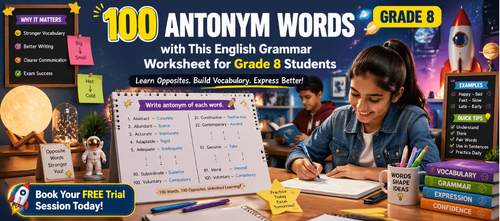

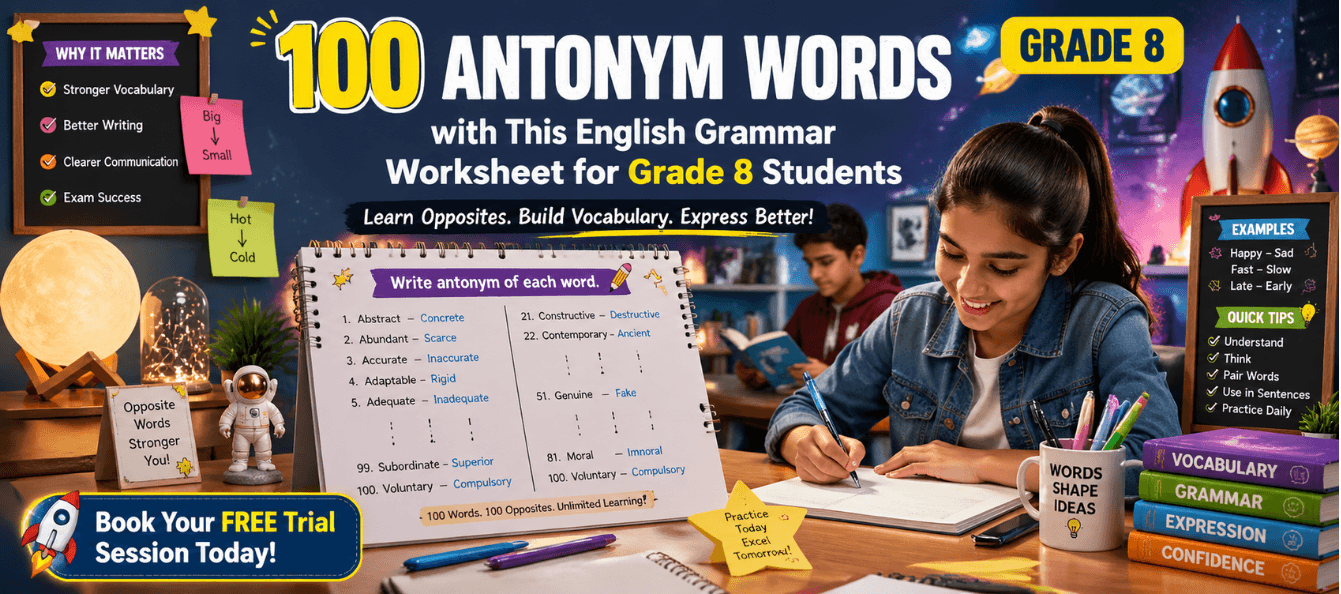
100 Antonym Words with This English Grammar Worksheet for Grade 8 Students
Learning new words can be exciting, especially when you discover how words can have completely opposite meanings. For Grade 8 students, understanding antonyms is an important step in building a strong vocabulary and improving communication skills. This worksheet on 100 antonym words gives students a great opportunity to practice and strengthen their understanding of opposite words in a structured and engaging way. By working through this worksheet, students will become more confident in identifying and using antonyms correctly in both writing and speaking.
Download these English grammar worksheets and practice regularly to strengthen your language skills and build a strong foundation. You can also book a free trial to get expert guidance and improve your reading, writing, and comprehension abilities. The worksheets are designed in a simple and structured way to help K–8 students learn grammar concepts easily and use them confidently in everyday communication.
What Is the Topic?
The topic of this worksheet is antonyms. Antonyms are words that have opposite meanings. For example, “hot” and “cold” are antonyms because they describe completely different conditions. In this worksheet, students are asked to write the antonym of each given word. This helps students understand how language works and improves their ability to express ideas clearly by choosing the right words.
By practicing antonyms, students learn how to:
• Recognize opposite meanings
• Improve vocabulary
• Use words correctly in different contexts
What’s in This Worksheet?
This worksheet is designed to help students practice antonyms in a clear and structured way.
1. A list of 100 words is provided.
2. Students must write the antonym of each word.
3. The words are arranged in a numbered sequence from 1 to 100.
4. The activity focuses on vocabulary building and word understanding.
5. It helps students prepare for exams by strengthening word knowledge.
Definitions, Examples, Techniques, and Tips
Definitions
Antonyms are words that have opposite meanings.
Examples
Big – Small
Happy – Sad
Fast – Slow
Techniques
• Read the word carefully before writing its opposite.
• Think about the meaning of the word in real-life situations.
• Use familiar words to identify opposites easily.
Quick learning tips
• Practice regularly to improve vocabulary.
• Learn words in pairs (word + antonym).
• Use antonyms in sentences to remember them better.
Why Is It Important to Learn This?
Learning antonyms is important because it helps students understand language better. It improves writing skills by allowing students to use a wider range of vocabulary. It also helps in reading comprehension, as students can understand the meaning of words based on context. In exams, antonyms are often asked directly or indirectly, so practicing them increases accuracy and confidence.
Where Will This Knowledge Help You?
This knowledge is useful in many areas:
• Exams – Helps in vocabulary-based questions
• Writing – Improves sentence quality and expression
• Speaking – Enhances communication skills
• Reading – Helps understand meanings easily
How to Use This Worksheet?
1. Attempt all the questions independently.
2. Think carefully before writing each antonym.
3. Review your answers after completing the worksheet.
4. Compare your answers with the correct answers given below.
5. Practice regularly to improve accuracy.
Important Tips and Tricks
1. Always understand the meaning of the word first.
2. Avoid guessing without thinking.
3. Learn common antonym pairs.
4. Keep practicing new words daily.
5. Focus on accuracy and spelling.
Complete Answer Key
Write antonym of each word.
1. Abstract – Concrete
2. Abundant – Scarce
3. Accurate – Inaccurate
4. Adaptable – Rigid
5. Adequate – Inadequate
6. Ambitious – Lazy
7. Anxious – Calm
8. Approximate – Exact
9. Authentic – Fake
10. Aware – Unaware
11. Beneficial – Harmful
12. Brisk – Slow
13. Cautious – Careless
14. Coherent – Incoherent
15. Competent – Incompetent
16. Complex – Simple
17. Concise – Verbose
18. Confident – Uncertain
19. Conscious – Unconscious
20. Consistent – Inconsistent
21. Constructive – Destructive
22. Contemporary – Ancient
23. Convincing – Unconvincing
24. Courteous – Rude
25. Critical – Uncritical
26. Decisive – Indecisive
27. Deficient – Sufficient
28. Deliberate – Accidental
29. Dependant – Independent
30. Desirable – Undesirable
31. Distinct – Indistinct
32. Distant – Near
33. Diverse – Uniform
34. Dominant – Submissive
35. Drastic – Mild
36. Durable – Fragile
37. Efficient – Inefficient
38. Elaborate – Simple
39. Elevate – Lower
40. Eligible – Ineligible
41. Enormous – Tiny
42. Equivalent – Different
43. Essential – Nonessential
44. Ethical – Unethical
45. Evident – Hidden
46. Exceptional – Ordinary
47. Expansive – Limited
48. Explicit – Implicit
49. Flexible – Stiff
50. Frequent – Rare
51. Genuine – Fake
52. Gradual – Sudden
53. Hostile – Friendly
54. Ignorant – Knowledgeable
55. Immense – Small
56. Impartial – Biased
57. Indifferent – Concerned
58. Important – Unimportant
59. Inadequate – Adequate
60. Industrious – Lazy
61. Inevitable – Avoidable
62. Infinite – Finite
63. Initial – Final
64. Innovative – Conventional
65. Insecure – Secure
66. Intense – Mild
67. Internal – External
68. Irregular – Regular
69. Isolate – Connect
70. Legitimate – Illegal
71. Liberal – Conservative
72. Literate – Illiterate
73. Logical – Illogical
74. Loyal – Disloyal
75. Mature – Immature
76. Mechanical – Natural
77. Minor – Major
78. Moderate – Extreme
79. Faint – Strong
80. Faithful – Unfaithful
81. Moral – Immoral
82. Neutral – Biased
83. Valuable – Worthless
84. Whole – Partial
85. Wise – Foolish
86. Passive – Active
87. Predictable – Unpredictable
88. Primary – Secondary
89. Profound – Shallow
90. Prompt – Delayed
91. Rational – Irrational
92. Relevant – Irrelevant
93. Reluctant – Willing
94. Remote – Nearby
95. Rigid – Flexible
96. Scarce – Abundant
97. Severe – Mild
98. Solitary – Social
99. Subordinate – Superior
100. Voluntary – Compulsory
Practicing antonyms through this English grammar worksheet for Grade 8 helps build a strong vocabulary and improves both writing and speaking skills. With consistent effort, students can become more confident in using words correctly and expressing their ideas clearly.