
Adding Facts Informative Writing Worksheet for Grade 3 Kids


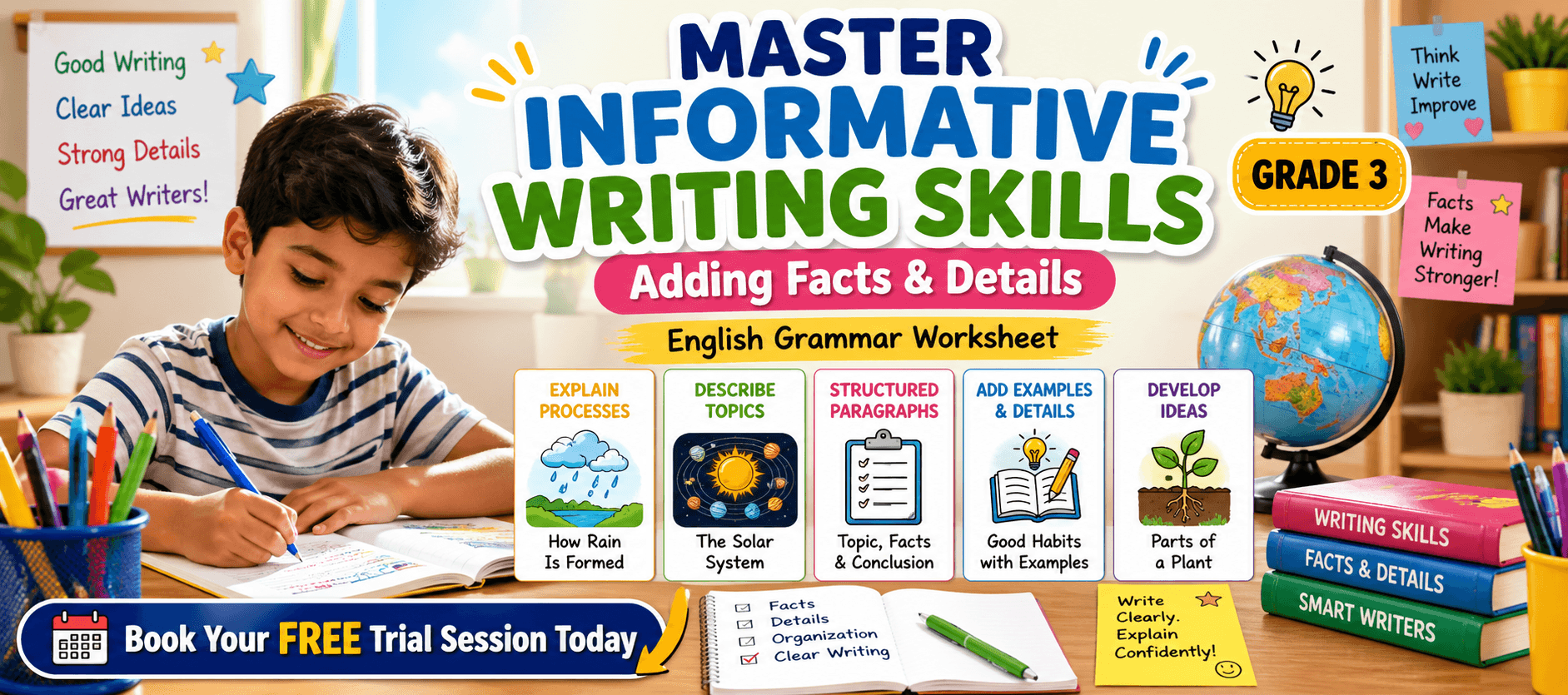
Master Informative Writing Skills: English Grammar Worksheet for Grade 3 on Informative Writing Adding Facts & Details
Learning how to explain ideas clearly using facts is an important step in becoming a confident writer. By Grade 3, students begin learning how to expand simple sentences into informative paragraphs by adding key facts, useful details, and logical explanations. Informative writing helps children organize their thoughts and present information in a meaningful way.
This English grammar worksheet for Grade 3 on Informative Writing Adding Facts & Details helps students practice explaining processes, describing topics, and developing structured paragraphs. The worksheet encourages learners to include supporting facts, organize information step by step, and complete writing tasks using clear details.
Download these English grammar worksheets and practice regularly to strengthen your language skills and build a strong foundation. You can also book a free trial to get expert guidance and improve your reading, writing, and comprehension abilities. The worksheets are designed in a simple and structured way to help K–8 students learn grammar concepts easily and use them confidently in everyday communication.
What Is Informative Writing Adding Facts And Details?
Informative writing focuses on explaining ideas using facts and supporting details. In Grade 3, students learn that a strong paragraph includes important information that helps the reader understand the topic clearly.
Adding facts and details means expanding an idea with explanations, examples, and supporting information. Students learn how to introduce a topic, include useful facts, and complete their writing with meaningful conclusions.
This worksheet teaches learners how to organize information logically, explain processes step by step, and develop informative paragraphs using structured writing techniques.
What’s In This Worksheet?
1. A fill-in-the-details activity explaining how rain is formed using given words.
2. Informative writing practice where students add details about the Solar System.
3. A structured paragraph-writing activity including topic sentence, facts, and conclusion.
4. Writing practice focused on explaining good habits using examples and a conclusion sentence.
5. Paragraph development activity using facts and details about parts of a plant.
6. Exercises designed to strengthen logical thinking, factual writing, and paragraph organization skills required in school assessments.
Definitions, Examples, Techniques, And Tips
Definitions
Informative writing explains a topic using facts, examples, and clear details.
Examples From The Worksheet
Students complete a paragraph explaining rain formation.
Students write details about the Solar System.
Students create a structured paragraph on water conservation.
Students expand ideas using examples of good habits.
Students write a paragraph describing parts of a plant.
Techniques Used In The Worksheet
Using word banks to complete informative paragraphs.
Adding supporting facts to explain ideas clearly.
Writing topic sentences followed by facts and conclusions.
Expanding ideas using examples and detailed explanations.
Quick Learning Tips
Read all instructions carefully before writing.
Use given words and facts exactly where required.
Write information in a logical order.
Check that every paragraph includes enough supporting details.
Why Is It Important To Learn This?
Learning to add facts and details helps students express ideas more clearly. Informative writing strengthens understanding because students must think carefully about how information connects.
This skill improves academic writing, helps students answer descriptive questions in exams, and builds confidence in presenting factual information across subjects like science, environmental studies, and language learning.
Where Will This Knowledge Help You?
Students use informative writing skills in many real situations:
During school exams that require explanation-based answers.
While completing project work and classroom assignments.
When presenting ideas in written reports or discussions.
While explaining processes and concepts in daily learning.
How To Use This Worksheet?
1. Read each question and understand what details are required.
2. Attempt every activity independently before checking answers.
3. Follow the structure mentioned in each exercise carefully.
4. Review your responses and check if all facts and details are included.
5. Compare answers carefully because the solutions follow the exact worksheet order.
6. Practice regularly to improve informative writing skills and confidence.
Important Tips And Tricks
1. Always include all required facts and details mentioned in the question.
2. Use the word bank carefully when completing fill-in-the-blank activities.
3. Begin paragraphs with clear topic sentences whenever instructed.
4. Support ideas with examples or explanations.
5. End paragraphs with meaningful conclusion sentences.
6. Read your writing again to ensure clarity and completeness.
Complete Answer Key
Exercise No. 1
How Rain Is Formed — Fill in the Missing Details
Rain is made through a long process in nature that helps water move around in earth.
First, the sun heats the water in lakes, rivers, and even small puddles on the ground. The warm water slowly turns into water vapor, which rises up into the sky.
As the vapor moves higher, it cools down and changes into tiny drops that join together to make clouds.
After some time, the clouds become heavy and fall with too much water. When they cannot hold any more, the water falls down as rain to the earth.
This whole process helps bring water back to plants, animals, people, and the land again.
Exercise No. 2
Write details about ‘The Solar System’.
The Solar System includes the Sun and all the planets that move around it. The planets travel in space and receive light and heat from the Sun.
Exercise No. 3
Write topic sentence, facts and a conclusion sentence on ‘WATER CONSERVATION’.
Topic Sentence: Water conservation is important for everyone.
Fact 1: Saving water helps people and animals survive.
Fact 2: Turning off taps prevents water wastage.
Conclusion Sentence: Conserving water protects our future.
Exercise No. 4
Good Habits: Write Examples And The Conclusion Sentence in detail.
For example: Brushing twice a day keeps teeth clean and healthy.
Conclusion: In other words, good habits improve our life. They help us grow into healthy and responsible people.
Exercise No. 5
Write a paragraph including all the facts and details on the topic ‘Parts of a Plant’.
A plant has different parts that help it grow. The roots hold the plant in the soil and absorb water. The stem supports the plant and carries nutrients. Leaves make food for the plant using sunlight. Flowers help the plant reproduce.
Practicing this English grammar worksheet for Grade 3 on Informative Writing Adding Facts & Details helps students understand how to expand ideas using supporting information. With regular practice, learners develop strong informative writing skills and gain confidence in presenting knowledge clearly and effectively.