
Adding More Details to Sentences with Grade 5 Writing Practice
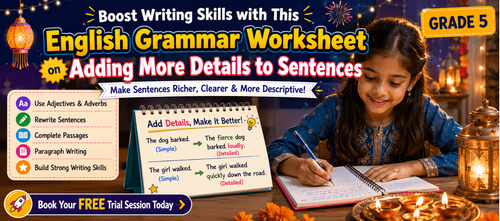

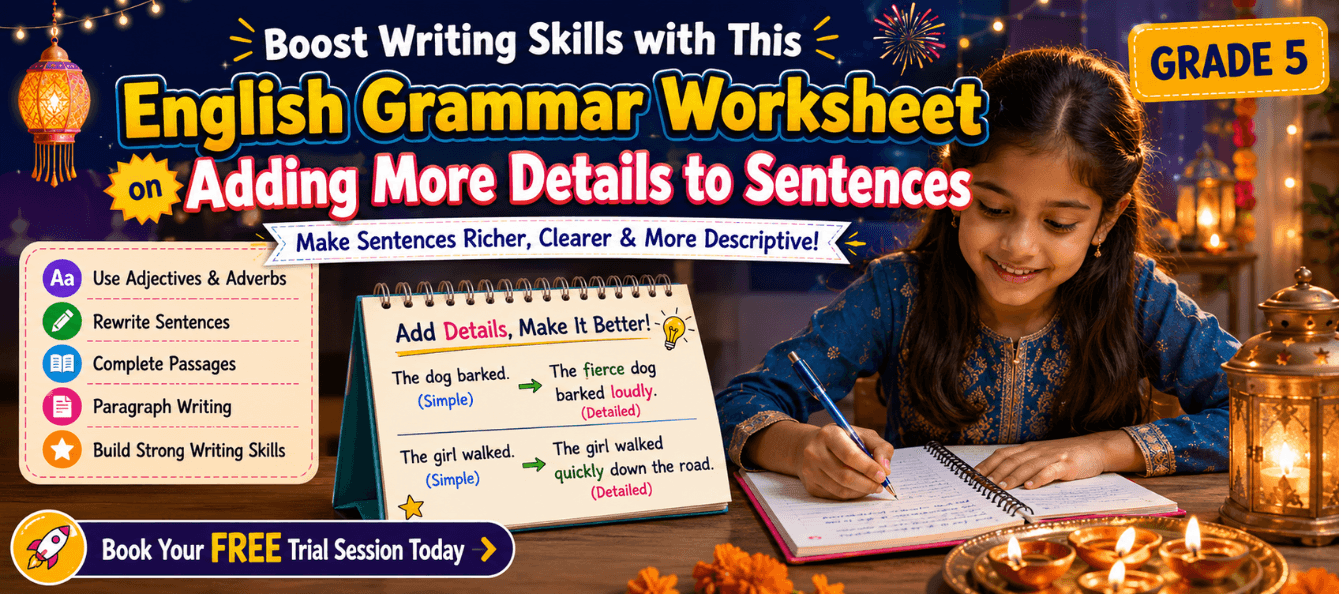
Boost Writing Skills with This English Grammar Worksheet Grade 5 on Adding More Details to Sentences
Writing becomes more exciting when we add meaningful details to our sentences. This English grammar worksheet Grade 5 on Adding More Details to Sentences with Grade 5 Writing Practice helps students learn how adjectives and adverbs make sentences clearer, richer, and more interesting. Through fill-in-the-blanks, multiple-choice questions, sentence rewriting, passage completion, and paragraph writing, students get plenty of practice using descriptive words correctly.
This worksheet is designed in a simple and engaging format so Grade 5 students can confidently improve their sentence-building skills. By practicing these activities, students learn how to add more information to their writing and make their ideas stronger and easier to understand.
Download these English grammar worksheets and practice regularly to strengthen your language skills and build a strong foundation. You can also book a free trial to get expert guidance and improve your reading, writing, and comprehension abilities. The worksheets are designed in a simple and structured way to help K–8 students learn grammar concepts easily and use them confidently in everyday communication.
What Is the Topic?
The topic of this worksheet is adding more details to sentences using adjectives and adverbs. Students learn how describing words and action words improve sentence quality. Adjectives describe nouns, while adverbs describe actions. By adding suitable details, students can make simple sentences more meaningful and interesting.
In this worksheet, students practice:
• Using adjectives to describe people, places, and things
• Using adverbs to describe actions
• Choosing suitable details for sentences
• Rewriting sentences with added details
• Completing a passage using meaningful describing words
• Writing a short paragraph with detailed sentences
Students are expected to understand how details improve communication and help readers imagine situations clearly.
What’s in This Worksheet?
1. Fill in the blanks with suitable adjectives or adverbs to complete sentences meaningfully.
2. Multiple-choice questions where students select the correct detail that follows the rule correctly.
3. Sentence rewriting practice where students add one detail to improve each sentence.
4. A passage completion activity that helps students understand how details improve paragraph writing.
5. A paragraph writing activity on ‘Diwali’ showing how details improve each sentence.
6. Practice with descriptive vocabulary to improve writing quality.
7. Activities that support grammar learning, sentence construction, and exam preparation.
Definitions, Examples, Techniques, and Tips
An adjective is a word that describes a noun.
Examples from the worksheet:
• bright torch
• tiny butterfly
• smooth rock
• shiny coin
• wooden bench
• clean bottle
An adverb is a word that describes an action.
Examples from the worksheet:
• barked loudly
• walked quickly
• blew softly
• rang sharply
• fell slowly
Techniques students can use:
• Think about how something looks, feels, sounds, or moves.
• Add one meaningful describing word to improve the sentence.
• Read the sentence carefully before selecting the correct option.
• Choose details that logically fit the noun or action.
Quick learning tips:
• Adjectives usually come before nouns.
• Adverbs often describe verbs.
• Good details make writing more interesting.
• Meaningful details help readers understand sentences clearly.
Why Is It Important to Learn This?
Learning how to add details to sentences is important because it improves both speaking and writing skills. Detailed sentences help students express ideas clearly and creatively. This topic also strengthens grammar knowledge and builds confidence in communication.
Using suitable adjectives and adverbs helps students:
• Write better essays and paragraphs
• Speak more clearly
• Improve creative writing
• Understand sentence structure
• Make descriptions more interesting
Strong sentence-writing skills are useful in school assignments, classroom activities, and exams.
Where Will This Knowledge Help You?
Students can use this knowledge in many situations:
• School grammar exams
• Creative writing tasks
• Paragraph writing activities
• Story writing
• Classroom discussions
• Reading comprehension activities
• Daily communication
Detailed writing also helps students perform better in English assignments and improve overall language skills.
How to Use This Worksheet?
1. Read each sentence carefully before answering.
2. Identify whether the sentence needs an adjective or adverb.
3. Attempt all activities independently first.
4. Compare your answers carefully with the completed solutions.
5. Check whether your describing word logically fits the sentence.
6. Practice rewriting sentences with additional details regularly.
7. Read the completed passage aloud to understand how details improve writing.
8. The solutions follow the exact worksheet order, so students should compare answers carefully.
Important Tips and Tricks
1. Choose words that make sense with the noun or action.
2. Avoid using unrelated details such as “loud tree” or “salty cloud.”
3. Read all options carefully before selecting the correct answer.
4. Use descriptive words that improve the meaning of the sentence.
5. In writing activities, include details about color, size, sound, movement, or feeling.
6. Examiners expect meaningful and grammatically correct details.
7. Recheck spellings while writing descriptive words.
8. Practice sentence expansion regularly to improve writing confidence.
Complete Answer Key
Exercise No. 1
Fill in the blank with an adjective or adverb to make the sentence more interesting.
1. The fierce dog barked at the mailman.
2. The girl sang beautifully during the concert.
3. We ate a delicious lunch at the cafeteria.
4. The car drove carefully down the icy road.
5. I put on my warm coat before going outside.
6. The rain fell heavily on the tin roof.
7. She took a bite of the juicy apple.
8. The students listened attentively to the teacher.
9. We saw a funny movie on Friday night.
10. The baby cried loudly when he dropped his toy.
Exercise No. 2
Add a detail and select the option that follows the rule correctly.
1. Kabir held a __________.
✓ a) Kabir held a bright torch.
2. Tara saw a __________.
✓ c) Tara saw a tiny butterfly.
3. Ishaan touched a __________.
✓ b) Ishaan touched a smooth rock.
4. Anya kept a __________ bag.
✓ a) Anya kept a light bag.
5. Dev found a __________.
✓ b) Dev found a shiny coin.
6. Sana held a __________ balloon.
✓ c) Sana held a red balloon.
7. Vikram wore a __________ cap.
✓ a) Vikram wore a soft cap.
8. Leela sat on a __________.
✓ b) Leela sat on a wooden bench.
9. Arav saw a __________ tree.
✓ a) Arav saw a tall tree.
10. Mira drank from a __________.
✓ c) Mira drank from a clean bottle.
Exercise No. 3
Add one detail and rewrite each sentence correctly.
1. The small puppy barked loudly.
2. The girl walked quickly down the hallway.
3. The cool wind blew softly.
4. The boy jumped high over the wall.
5. The water felt extremely cold.
6. The bell rang sharply in the classroom.
7. The yellow leaf fell slowly.
8. The bus moved fast on the highway.
9. The teacher spoke kindly to the students.
10. The room looked bright and cheerful.
Exercise No. 4
Read the passage and fill the blanks with suitable words.
Leela walked into the peaceful garden near the library, enjoying the soft morning light that made the petals shine gently. A gentle breeze moved across the flowers, carrying the fresh smell of wet soil and early dew. She noticed a colorful bird sitting quietly on a branch, tilting its head as it watched the students pass by. Kabir pointed to a fallen leaf lying on the bench, its surface still damp from the gardener’s watering. Nearby, a few children were picking up small sticks to build tiny shapes on the ground. Farther ahead, sunlight created long shadowy patterns on the tiled pathway as the breeze rustled the trees. Close to the entrance, the gardener arranged clay pots neatly in a row, ready for the day’s planting. Just then, Mira heard a sharp whistle calling everyone back, and the garden quickly filled with the sound of returning footsteps.
Exercise No. 5
Write a short paragraph on ‘Diwali’ showing how details improve each sentence.
Diwali is a joyful festival celebrated with bright lights and colorful decorations. Families clean their beautiful homes and decorate them with vibrant rangoli designs. Children wear new traditional clothes and happily burst sparkling crackers in the evening. Delicious sweets and tasty snacks are prepared for relatives and friends. At night, glowing diyas light up the entire neighborhood and create a magical atmosphere. People pray together for happiness, peace, and prosperity during the special celebration.
Practicing this English grammar worksheet Grade 5 on Adding More Details to Sentences is a wonderful way to improve sentence-building and writing skills. By learning how to use meaningful adjectives and adverbs, students can make their writing clearer, richer, and more engaging. Regular grammar practice will help students become more confident writers and communicators in both schoolwork and everyday life.