
Advanced Modals Usage Practice Tasks for Grade 8 Learners
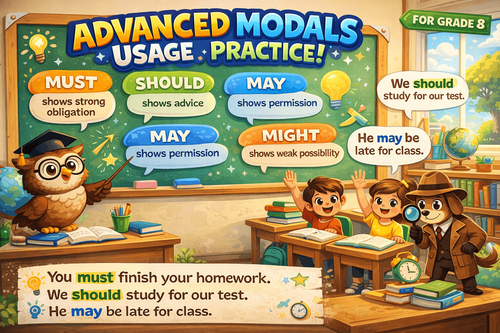

Advanced Modals Usage Practice Tasks for Grade 8 Learners – Complete Worksheet with Answers
Learning English grammar can sometimes feel confusing, especially when different helping verbs change the meaning of a sentence. This English grammar worksheet for Grade 8 focuses on advanced modal verbs and helps students practice them in a fun and structured way. If you have ever wondered when to use words like must, should, may, or might, this worksheet will guide you step by step.
What Is the Topic?
Modal verbs are helping verbs that are used to express possibility, permission, obligation, advice, or ability. In this Grade 8 worksheet, students learn how to use modal verbs correctly in sentences and understand their different meanings.
The worksheet teaches how modal verbs like must, may, should, have to, might, ought to, can, mustn’t, and could are used in real-life situations. Students are expected to identify their correct use, apply them in sentences, and correct mistakes related to them.
What’s in This Worksheet?
1. Matching modal verbs with their correct uses
2. Fill in the blanks using suitable modal verbs
3. Sentence rewriting using appropriate modal verbs
4. Error correction in sentences
5. Paragraph writing using modal verbs
This English grammar worksheet helps Grade 8 learners practice different question types, which improves their understanding and prepares them for exams.
Definitions, Examples, Techniques, and Tips
Modal verbs are used to express meanings such as obligation, possibility, permission, and advice.
Examples from the worksheet include:
- must shows strong obligation
- may shows permission
- should shows advice
- might shows weak possibility
- have to shows external rule or necessity
Students should carefully read each sentence to understand the situation before choosing the correct modal verb.
Why Is It Important to Learn This?
Learning modal verbs is important because they help students express ideas clearly and correctly. They are commonly used in both spoken and written English. Understanding modal verbs improves sentence formation and helps avoid grammatical mistakes.
Where Will This Knowledge Help You?
This knowledge helps in:
- Writing correct sentences in exams
- Speaking politely and clearly
- Understanding instructions and rules
- Improving overall English communication skills
How to Use This Worksheet?
1. Read each question carefully before answering
2. Attempt all questions independently
3. Review your answers after completing each section
4. Compare your answers with the correct answers given below
5. Practice regularly to improve your understanding
The solutions follow the exact worksheet order, so students should compare answers carefully.
Important Tips and Tricks
1. Always understand the meaning of the sentence before choosing a modal verb
2. Do not use “to” after modal verbs like can, should, must
3. Use correct forms of verbs after modals
4. Pay attention to spelling mistakes in modal verbs
5. Practice writing sentences to improve accuracy
Complete Answer Key
Exercise 1
1. must – b
2. may – d
3. should – f
4. have to – c
5. might – a
6. ought to – k
7. can – e
8. mustn’t – i
9. could – j
Exercise 2
1. You must finish your homework before going out.
2. We should bring an umbrella. It looks like rain.
3. He might be the new history teacher. I saw him in the staff room.
4. You ought to speak politely to your elders.
5. I have to go to school early tomorrow. We have a test.
6. She may be at the cafe. I saw her bike parked outside.
Exercise 3
1. He may know the answer.
2. We must wear seat belts.
3. You may leave early today.
4. They need not bring lunch.
5. You should visit the doctor soon.
6. She might win the prize.
7. He can play the piano well.
8. We have to follow the rules.
Exercise 4
1. She must complete her homework before dinner.
2. They can speak three different languages.
3. You should eat more fruits and vegetables.
4. He might be the new class monitor.
5. We could see the stars clearly last night.
6. I will go to the library after school.
7. Can you help me with this question?
8. She may go to the picnic if it doesn’t rain.
9. You must wear your ID card in school.
10. We should revise before the exam.
Exercise 5
I believe mobile phones should not be banned in classrooms. Students can use them for learning purposes. Teachers may allow their use during lessons. They must follow rules while using phones. Schools should guide students on proper usage. Mobile phones can be helpful tools in education.
Practicing modal verbs regularly will make you more confident in using English correctly. This Grade 8 English grammar worksheet on Advanced Modals Usage Practice Tasks helps you build strong grammar skills step by step. Keep practicing, stay consistent, and you will improve your language skills quickly.