
Advanced Sentence Transformation: Grade 7 Grammar Worksheet [Free PDF]
![Advanced Sentence Transformation: Grade 7 Grammar Worksheet [Free PDF]](https://cdn5.planetspark.in/media/small_Class_7_Grammar_Worksheet_on_Advanced_Sentence_Transformation_2b51aae0b3.png)

English Grammar Worksheet Grade 7: Advanced Sentence Transformation (All Types Mixed)
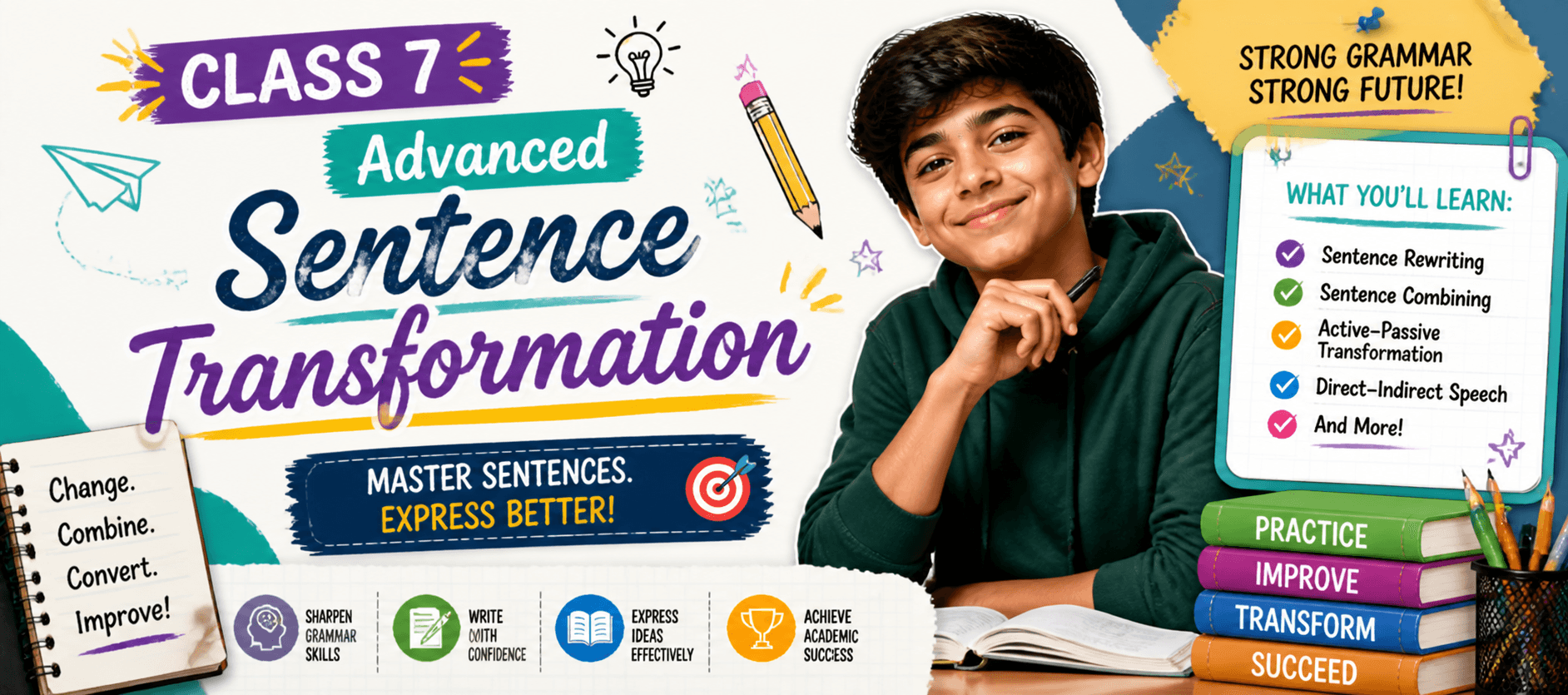
Sentence transformation is an essential skill for refining writing and making it more dynamic and varied. In this Grade 7 worksheet on "Advanced Sentence Transformation (All Types Mixed)," students will practice transforming sentences across different types, such as from simple to compound, or from active to passive voice. This skill allows students to convey ideas in multiple ways, making their writing more interesting and engaging.
Download these English grammar worksheets and practice regularly to strengthen your language skills and build a strong foundation. You can also book a free trial to get expert guidance and improve your reading, writing, and comprehension abilities. The worksheets are designed in a simple and structured way to help K–8 students learn grammar concepts easily and use them confidently in everyday communication. Book a free trial!
## What is the topic?
This worksheet focuses on transforming sentences across multiple types. Students will practice changing sentence types—whether it's switching from a simple to a complex sentence, or transforming from active to passive voice—while maintaining the original meaning. Understanding how to modify sentence structures without altering the intended message is key to improving writing clarity and variety.
Students will learn:
- How to transform sentences between different types, such as simple, compound, and complex.
- How to switch between active and passive voice.
- How to maintain the original meaning of the sentence during transformation.
## What’s in this worksheet?
The worksheet contains exercises to help students practice transforming sentences in various ways. The exercises include:
1. **Underline the words** – Identifying the key elements in a sentence to understand the transformations.
2. **Multiple choice questions** – Choosing the correct transformation for a given sentence.
3. **Sentence rewriting** – Rewriting sentences by changing their structure or voice while preserving the meaning.
4. **Fill in the blanks** – Completing sentences by applying the right transformation.
5. **Paragraph writing** – Writing a short paragraph that demonstrates the use of different sentence types and structures.
By completing these exercises, students will develop a better understanding of how to modify sentences to improve both style and clarity.
## Definitions, examples, techniques, and tips
- **Sentence Transformation Definition**: Sentence transformation is the process of changing a sentence’s structure while keeping its meaning intact. This can involve changing the voice (active to passive), the sentence type (simple to complex), or rearranging the sentence for clarity.
- **Example of Sentence Transformation**:
- **Original**: "The teacher gave us a project."
- **Active to Passive**: "A project was given to us by the teacher."
- **Simple to Complex**: "The teacher gave us a project, which we had to complete by the end of the week."
- **Techniques for transforming sentences**:
1. **Active to Passive Voice**: The subject of the sentence becomes the recipient of the action. Example: "The dog chased the cat" → "The cat was chased by the dog."
2. **Simple to Compound**: Combine two simple sentences using conjunctions like "and," "but," or "so." Example: "He was tired" + "He went to bed" → "He was tired, so he went to bed."
3. **Simple to Complex**: Add subordinate clauses to create a more detailed sentence. Example: "He went to the store" → "He went to the store because he needed groceries."
- **Quick learning tips**:
- Focus on the meaning of the sentence and ensure that it remains unchanged when transforming.
- Practice with different combinations of sentence structures to build flexibility in writing.
- Use conjunctions, relative pronouns, and transitional words to create more complex and varied sentence structures.
## Why is it important to learn this?
Mastering sentence transformation is crucial for:
- **Improving writing flexibility**: Students can convey the same idea in different ways, making their writing more dynamic.
- **Enhancing clarity and style**: By using varied sentence structures, students can keep their writing interesting and easy to follow.
- **Building writing proficiency**: Being able to transform sentences shows a deep understanding of grammar and style, which is essential for academic success.
This skill is important for Grade 7 students as they develop their writing for more complex tasks, such as essays and reports.
## Where will this knowledge help you?
This knowledge will be useful in many contexts:
- **Exams**: Writing tasks often require students to demonstrate their ability to transform sentences correctly.
- **Writing tasks**: Whether writing essays, reports, or creative pieces, sentence transformation helps in crafting clear and engaging text.
- **Class participation**: Transforming sentences allows students to express their ideas clearly and effectively during discussions and presentations.
## How to use this worksheet?
1. **Attempt independently first**: Read each sentence and identify how it can be transformed.
2. **Review answers carefully**: After transforming the sentence, check that the meaning is preserved and the sentence is grammatically correct.
3. **Correct mistakes**: If the sentence feels awkward or unclear, adjust the transformation to improve clarity and flow.
4. **Practice regularly**: Continue practicing sentence transformations to strengthen your writing skills and flexibility.
The solutions follow the exact worksheet order. Compare your answers carefully to ensure accuracy.
## Important tips and tricks
- **Common mistakes**:
- Changing the meaning of the sentence while transforming it.
- Using incorrect punctuation or conjunctions when creating compound or complex sentences.
- **What examiners expect**:
- Correct use of grammar when transforming sentences.
- A good balance of sentence variety without overcomplicating the writing.
- **How to score full marks**:
- Focus on clarity and grammatical correctness when transforming sentences.
- Use varied sentence types to improve the flow and readability of your writing.
- **How to approach activity-based or writing-based tasks**:
- For rewriting exercises, ensure the transformation is smooth and preserves the meaning.
- In paragraph writing, practice using a variety of sentence structures to enhance the paragraph's flow.
## Complete Answer Key
**Exercise No. 1:**
- The teacher gave us a project. (Underline: teacher, Circle: gave)
- The dog chased the cat. (Underline: dog, Circle: chased)
- He completed the work. (Underline: He, Circle: completed)
- She sent an email. (Underline: She, Circle: sent)
- They finished their homework. (Underline: They, Circle: finished)
**Exercise No. 2:**
1. b) He is too weak to run.
2. c) She was too tired that she slept.
3. a) He is too young to drive.
4. c) She is too old so she plays.
5. b) They are too busy so they talk.
**Exercise No. 3:**
1. He is too weak to run. (Ensure correct transformation.)
2. She was too tired that she slept. (Ensure correct transformation.)
3. He is too young to drive. (Ensure correct transformation.)
4. She is too old so she plays. (Ensure correct transformation.)
5. They are too busy so they talk. (Ensure correct transformation.)
**Exercise No. 4:**
1. completion
2. advised
3. omit
4. encounter
5. should
6. submitted
7. grasped
8. reminded
9. need
10. improvements
**Exercise No. 5**: Answers may vary.
## Outro
By mastering sentence transformation, students will improve their ability to write clearly and effectively in various contexts. This skill not only helps in academic writing but also enhances overall communication skills, making it a valuable tool for all types of writing.
Book a free trial!