
Antonyms in Context Worksheet for Grade 5 English Practice
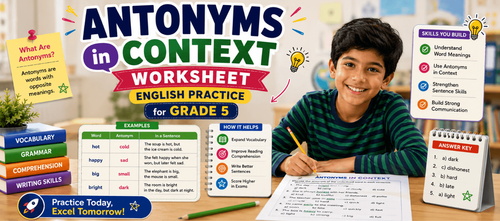

English grammar worksheet for Grade 5 – Antonyms in Context (Advanced Words)
Antonyms are words that mean the opposite of each other. For Grade 5 students, learning antonyms in context is an important skill that builds vocabulary, strengthens comprehension, and improves writing. This English grammar worksheet on Antonyms in Context (Advanced Words) helps learners explore how words can be replaced with opposites to make sentences richer and more precise.
Download these English grammar worksheets and practice regularly to strengthen your language skills and build a strong foundation. You can also book a free trial to get expert guidance and improve your reading, writing, and comprehension abilities. The worksheets are designed in a simple and structured way to help K–8 students learn grammar concepts easily and use them confidently in everyday communication.
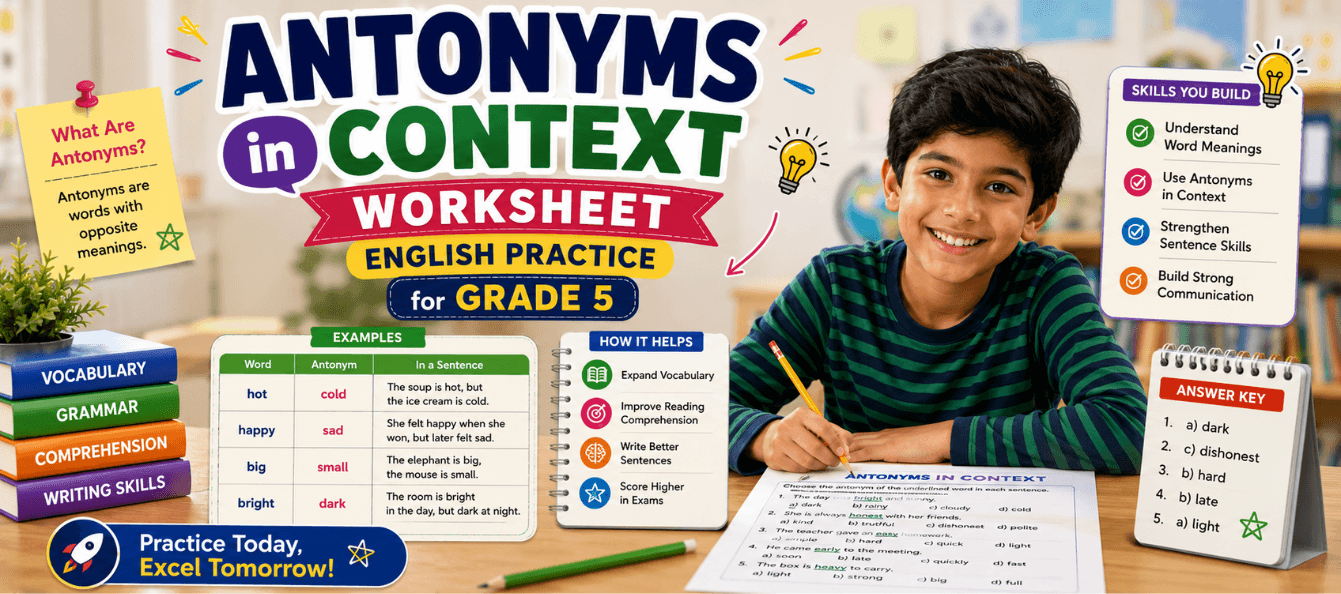
What Is the Topic?
Antonyms in context means using words with opposite meanings in sentences. Students learn to identify antonyms, understand their usage, and apply them correctly. This worksheet focuses on words like abundant, ancient, expand, generous, accept, victory, increase, early, arrive, strong, and their opposites.
What’s in This Worksheet?
1. Match the following words with their correct antonyms.
2. True and false questions to check understanding of opposites.
3. Fill in the blanks with correct antonyms.
4. Multiple choice questions to choose the right antonym.
5. Sentence rewriting practice using antonyms.
Definitions, Examples, Techniques, and Tips
- Antonym: A word with the opposite meaning. Example: “happy” → “sad.”
- Context: The sentence where the word is used. Example: “The room was crowded” → “The room was empty.”
- Technique: Read the sentence carefully and replace the word with an antonym that fits the meaning.
- Quick tip: Antonyms may not always be exact; choose the one that makes sense in the sentence.
Why Is It Important to Learn This?
Learning antonyms helps students expand vocabulary, avoid repetition, and make writing more expressive. It strengthens comprehension by teaching how words can be understood in different contexts. Academically, it prepares students for exams and builds confidence in grammar usage.
Where Will This Knowledge Help You?
- In exams, where antonym-based questions test vocabulary.
- In writing tasks, where antonyms make descriptions clearer.
- In everyday communication, where antonyms help explain ideas precisely.
How to Use This Worksheet?
1. Attempt each exercise independently.
2. Review the answer key in the exact worksheet order.
3. Correct mistakes and practice regularly.
4. Rewrite sentences using antonyms to improve fluency.
Important Tips and Tricks
1. Always check the sentence context before choosing an antonym.
2. Remember that antonyms may differ slightly in meaning.
3. Examiners expect correct usage, not just word replacement.
4. For sentence rewriting, use antonyms naturally in context.
Complete Answer Key
Exercise No. 1
- abundant → scarce
- ancient → modern
- expand → contract
- generous → selfish
- accept → refuse
- victory → defeat
- increase → decrease
- early → late
- arrive → depart
- strong → weak
Exercise No. 2
1. False
2. True
3. False
4. True
5. False
6. False
7. True
8. True
9. False
10. True
Exercise No. 3
1. light
2. boring
3. low
4. cowardly
5. cold
6. dishonest
7. dirty
8. poor
9. difficult
10. awake
Exercise No. 4
1. a) modern
2. c) dishonest
3. a) hopeless
4. a) defeat
5. a) invisible
6. b) decrease
7. b) rude
8. c) selfish
9. b) rigid
10. c) failure
Exercise No. 5
1. The room was empty.
2. The light was dim.
3. The soup is cold.
4. The boy is weak.
5. The girl is cruel.
6. The train arrived late.
7. The door is closed.
8. The rabbit runs slow.
9. The children are sad.
10. The man is poor.
By practicing antonyms, students learn how words can be replaced to make sentences more precise. This Grade 5 English grammar worksheet on Antonyms in Context builds confidence in vocabulary and grammar skills. Keep practicing, and remember that antonyms make your language sharper and more effective.
Book a free trial!