
Understanding Cause-Effect Text Structure: Printable Practice Worksheet
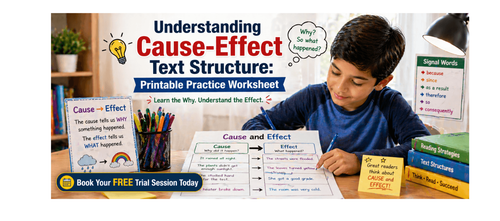

**English grammar worksheet for Grade 7: Cause and Effect in Reading Comprehension**
Understanding cause-and-effect relationships is a key skill in both reading comprehension and writing. In this Grade 7 worksheet, students will explore how causes like poor rainfall and misuse of water led to the problem of water shortage in a Chennai colony. They’ll work through various exercises such as multiple-choice questions, fill-in-the-blanks, and identifying cause-and-effect words to build their understanding of how one event can lead to another. This practical application helps students break down complex texts and understand how events unfold logically.
Download these English grammar worksheets and practice regularly to strengthen your language skills and build a strong foundation. You can also book a free trial to get expert guidance and improve your reading, writing, and comprehension abilities. The worksheets are designed in a simple and structured way to help K–8 students learn grammar concepts easily and use them confidently in everyday communication.
### What is the topic?
This worksheet focuses on understanding cause-and-effect relationships in reading comprehension. Students will learn to recognize how events in a story are linked together by the cause and the resulting effect. In the case of this worksheet, the cause is a poor rainfall leading to a water shortage, and the effect is the solution of implementing rainwater harvesting. By focusing on the logical connections between events, students enhance their comprehension and critical thinking skills.
### What’s in this worksheet?
1. **Types of Questions Included**:
- **Multiple-choice questions** that test students' understanding of cause and effect.
- **Fill-in-the-blanks** where students practice inserting the correct cause or effect based on the passage.
- **True/False questions** to assess students’ ability to identify cause-and-effect statements.
- **Underlining cause or effect words** in sentences to reinforce their understanding of how events are connected.
2. **Grammar Skills Practiced**:
- Identifying cause-and-effect relationships in reading.
- Understanding key vocabulary such as "cause," "effect," "solution," and "result."
- Practicing sentence completion and the correct use of cause-effect phrases.
3. **Structure of the Worksheet**:
- The worksheet includes a short story about water shortage in Green Park Colony, highlighting the causes and effects of water scarcity.
- Each section of the worksheet is designed to practice a different aspect of cause-and-effect comprehension.
- This structure helps students break down the passage and see how individual events are connected.
4. **How It Supports Exam Preparation**:
- The exercises are great practice for standardized reading comprehension exams that often include questions about cause and effect.
- These tasks also prepare students for more advanced tasks in higher grades, where they need to analyze the relationships between events in greater detail.
### Definitions, examples, techniques, and tips
**Definitions**:
- **Cause**: The reason something happens (e.g., "poor rainfall").
- **Effect**: The result or consequence of the cause (e.g., "water shortage").
- **Cause-and-effect relationship**: A connection between two events, where one event (the cause) leads to another event (the effect).
**Examples**:
- **Cause**: The rains were poor last year.
- **Effect**: The groundwater levels dropped.
- **Cause**: People used water carelessly.
- **Effect**: The problem became worse.
**Techniques**:
- Look for **cause words** like "because," "due to," or "as a result."
- Identify **effect words** like "led to," "resulted in," or "caused."
- Practice writing simple cause-and-effect sentences to improve your understanding of these relationships.
**Quick Learning Tips**:
- Focus on the sequence of events in the passage. Ask yourself: "What caused this? What happened because of it?"
- Highlight cause-and-effect words to clearly understand how events are connected.
- Practice with different examples to strengthen your grasp of the concept.
### Why is it important to learn this?
Learning about cause and effect helps improve both **reading comprehension** and **critical thinking**. This skill is essential because:
- It allows students to better understand and analyze texts by recognizing how events are linked together.
- It enhances writing skills by helping students organize ideas logically, showing how one action leads to another.
- Understanding cause and effect is crucial for academic success, especially in subjects like science and history, where students must identify relationships between events.
### Where will this knowledge help you?
This knowledge will benefit students in several ways:
- **Exams**: Reading comprehension questions in exams often test your ability to identify cause-and-effect relationships in passages.
- **Writing Tasks**: When writing essays or reports, students can use cause-and-effect structures to organize their ideas more clearly.
- **Class Participation**: In discussions or projects, recognizing cause-and-effect will help students explain their thoughts logically and support their arguments.
### How to use this worksheet?
1. **Attempt independently first**: Read through the exercises and try to answer the questions without assistance.
2. **Review answers carefully**: Check your answers and see if they match the cause-and-effect relationships in the text.
3. **Correct mistakes**: If you made any mistakes, re-read the passage and identify the correct cause or effect.
4. **Practice regularly**: The more you practice identifying cause-and-effect relationships, the better you’ll understand them in both reading and writing.
Note that the solutions follow the exact worksheet order. Be sure to compare your answers carefully to improve your understanding.
### Important tips and tricks
1. **Common mistakes**:
- Confusing cause and effect: Remember, the cause is what happens first, and the effect is the result.
- Misidentifying cause-and-effect words: Pay attention to words like "because," "as a result," and "led to."
- Overlooking implied causes and effects: Not all causes and effects are stated directly; some may be implied by the context.
2. **What examiners expect**:
- When answering questions, make sure you clearly identify the cause and the effect.
- Use the correct vocabulary to describe the cause-and-effect relationship.
3. **How to score full marks**:
- Focus on understanding the order of events in the passage.
- Use the cause-and-effect words to help guide your answers.
- For writing tasks, try to organize your ideas logically, showing the relationship between causes and their effects.
4. **How to approach activity-based or writing-based tasks**:
- For writing tasks, first identify the key cause and effect in the prompt.
- Then, use clear cause-and-effect phrases to explain the relationship.
- For fill-in-the-blank exercises, ensure the words you choose correctly fit the context of cause and effect.
### Complete answer key
**Exercise No. 1 – Multiple Choice Questions**
1. a) poor rain
2. a) wells dry
3. a) misuse
4. a) difficult
5. a) find solution
6. a) rain water harvesting
7. a) improve
8. a) teamwork
9. a) cause
10. a) action
**Exercise No. 2 – Fill in the Blanks**
1. cause
2. reason
3. effect
4. result
5. action
6. shortage
7. solution
8. improvement
9. cause
10. effect
**Exercise No. 3 – True or False**
1. True
2. False
3. True
4. False
5. True
6. False
7. True
8. True
9. False
10. False
**Exercise No. 4 – Underline Cause or Effect**
1. cause
2. effect
3. effect
4. cause
5. cause
6. effect
7. cause
8. effect
9. effect
10. cause
**Exercise No. 5 – Fill in the Blanks to Show Cause-and-Effect Relationships**
1. increase
2. planning
3. water
4. neglect
5. collective
6. cause
7. water
8. rain
9. improvement
10. sustainable
Book a free trial!