
Build Vocabulary with Synonyms and Antonyms for Grade 7

Synonyms and Antonyms with This English Grammar Worksheet for Grade 7
Learning synonyms and antonyms is a fun and effective way to improve vocabulary and communication skills. This English grammar worksheet for Grade 7 helps students understand how words can have similar meanings or opposite meanings. By practicing these exercises, students become more confident in sentence formation, paragraph writing, and daily communication.
This worksheet includes engaging exercises such as underlining synonyms and antonyms, sorting exercises, rewriting sentences, fill in the blanks, sentence formation, and paragraph writing. These activities encourage students to think carefully about word meanings and improve their understanding of language usage in different contexts.
Students in Grade 7 can strengthen their grammar foundation by learning how to identify describing words, replace words with suitable alternatives, and use vocabulary correctly in sentences. The worksheet also helps students prepare for school assignments, grammar tests, and creative writing tasks.
Download these English grammar worksheets and practice regularly to strengthen your language skills and build a strong foundation. You can also book a free trial to get expert guidance and improve your reading, writing, and comprehension abilities. The worksheets are designed in a simple and structured way to help K–8 students learn grammar concepts easily and use them confidently in everyday communication.
What Is the Topic?
This English grammar worksheet for Grade 7 focuses on synonyms and antonyms.
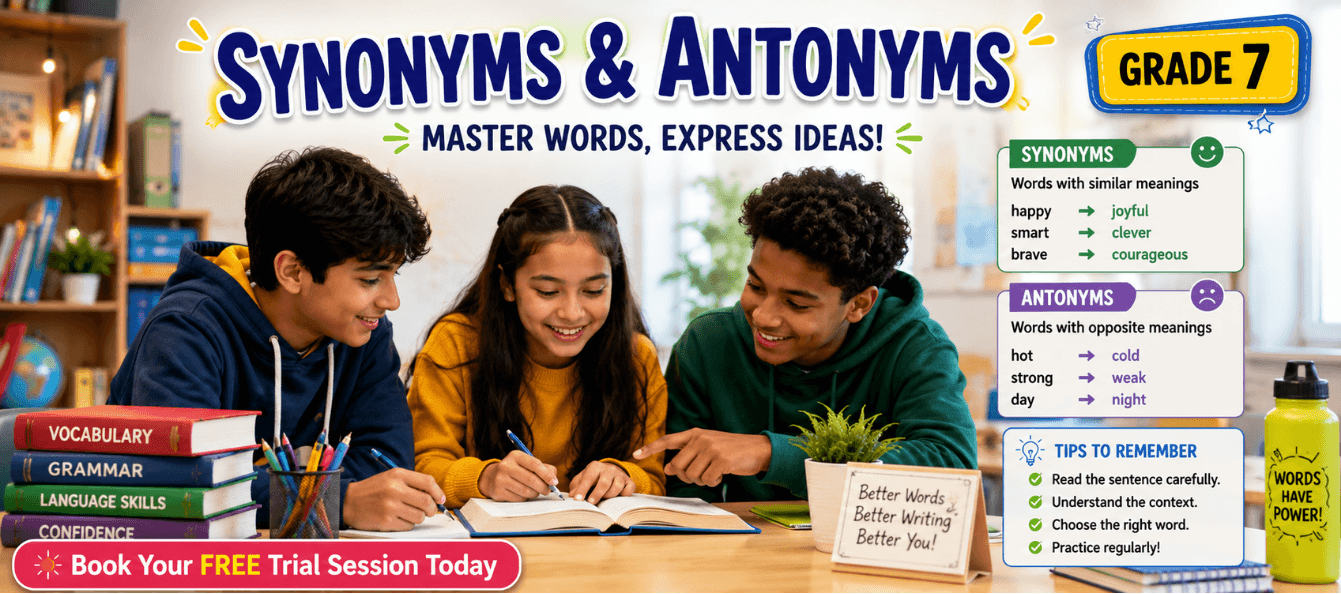
Synonyms are words that have similar meanings. For example, cheerful and happy are synonyms because both words describe similar feelings.
Antonyms are words that have opposite meanings. For example, clean and messy are antonyms because they describe opposite conditions.
In this worksheet, students learn how to:
• Identify synonyms and antonyms in sentences
• Sort words into correct categories
• Complete sentences using suitable words
• Rewrite sentences using synonyms or antonyms
• Use vocabulary words in paragraph writing
The worksheet also improves vocabulary development, sentence structure, and understanding of describing words.
What’s in This Worksheet?
1. Underline and label the synonyms and antonyms in sentences.
2. Sort word pairs into categories such as synonyms, antonyms, and analogies.
3. Complete fill in the blanks using suitable synonyms and antonyms.
4. Rewrite sentences by replacing words with their synonyms or antonyms.
5. Write a paragraph using synonyms and antonyms in meaningful context.
6. Practice identifying describing words correctly.
7. Improve vocabulary and sentence-building skills.
8. Strengthen grammar understanding for school exams and assignments.
9. Learn how to use words with similar and opposite meanings naturally.
10. Build confidence in writing and communication.
Definitions, Examples, Techniques, and Tips
Synonyms are words that have similar meanings.
Examples from the worksheet:
• cheerful – happy
• honest – truthful
• brave – courageous
• strong – powerful
• cold – chilly
Antonyms are words that have opposite meanings.
Examples from the worksheet:
• clean – messy
• easy – difficult
• calm – anxious
• up – down
• night – day
Techniques students can use while solving:
• Read the sentence carefully before choosing the answer.
• Look for describing words in the sentence.
• Identify whether the question asks for a synonym or antonym.
• Compare meanings of words carefully.
• Rewrite sentences by replacing only the required word.
Quick learning tips:
• Practice reading new vocabulary daily.
• Use synonyms to make writing more interesting.
• Use antonyms to understand opposite meanings clearly.
• Underline important clue words in the sentence.
• Revise difficult vocabulary regularly.
Why Is It Important to Learn This?
Learning synonyms and antonyms helps students improve vocabulary and communication skills. It allows students to express ideas more clearly while speaking and writing.
This topic is important because:
• It improves reading comprehension.
• It helps students understand word meanings better.
• It makes writing more creative and interesting.
• It improves sentence construction skills.
• It helps students perform better in grammar exams.
Students who practice synonyms and antonyms regularly become more confident in using English in everyday communication.
Where Will This Knowledge Help You?
Students can use this knowledge in many situations:
• School grammar tests
• Creative writing tasks
• Essay writing
• Reading comprehension exercises
• Classroom discussions
• Vocabulary building activities
• Paragraph writing
• Public speaking
• Daily communication
Understanding synonyms and antonyms also helps students avoid repeating the same words again and again in writing.
How to Use This Worksheet?
1. Read every sentence carefully before answering.
2. Identify whether the question asks for a synonym or antonym.
3. Underline or replace the correct describing word properly.
4. Complete all fill in the blanks using suitable vocabulary words.
5. Rewrite the sentences carefully using the required synonym or antonym.
6. Practice sentence formation regularly to improve writing skills.
7. Compare your answers carefully with the correct solutions.
8. Follow the exact worksheet order while checking answers.
9. Revise difficult words and meanings again after completing the worksheet.
10. Practice similar vocabulary exercises regularly for improvement.
Important Tips and Tricks
1. Always check whether the question asks for a synonym or antonym before answering.
2. Read the full sentence carefully to understand the context.
3. Do not rush while replacing describing words.
4. Use suitable vocabulary words that match the sentence meaning.
5. Practice common synonym and antonym pairs regularly.
6. Underline important words while solving exercises.
7. In rewriting exercises, replace only the required word and keep the sentence structure correct.
8. Use proper spelling while writing vocabulary words.
9. In paragraph writing, use synonyms and antonyms naturally in sentences.
10. Practice vocabulary building daily to score better marks in grammar tests.
Complete Answer Key
Exercise 1
Underline and label the Synonyms and Antonyms as per the sentences.
1. The task was simple, not complicated.
simple – complicated (Antonyms)
2. She looked cheerful and happy.
cheerful – happy (Synonyms)
3. The box was tiny compared to the other one.
tiny – other (Antonyms)
4. The test was difficult but manageable.
difficult – manageable (Antonyms)
5. He is an honest and truthful man.
honest – truthful (Synonyms)
6. My room is always clean but hers is messy.
clean – messy (Antonyms)
7. They were angry and upset after the match.
angry – upset (Synonyms)
8. This puzzle is easy to solve.
easy – difficult (Antonyms)
9. He is very calm while she is anxious.
calm – anxious (Antonyms)
10. That was a brave and courageous act.
brave – courageous (Synonyms)
Exercise 2
Sort the words pairs from the box into the categories given below.
SYNONYMS
1. hot – warm
2. strong – powerful
3. cold – chilly
ANTONYMS
1. happy – sad
2. up – down
3. night – day
4. sharp – blunt
ANALOGIES
1. teacher – school
2. doctor – hospital
3. pen – write
Exercise 3
Complete each sentence with the appropriate synonym or antonym.
1. He was very excited when he heard the good news.
2. This box is light, not heavy.
3. She is very caring, just like her mom.
4. My room is always clean but his is very messy.
5. He is a truthful and honest man.
6. The instructions were confusing, not clear.
7. This coat is warm and cozy.
8. That was a very clever answer.
9. We like peace, not war.
10. She was very sad after losing.
Exercise 4
Rewrite each sentence by identifying and replacing the describing words with its antonym/synonym as specified after every sentence.
1. The water was chilled.
2. She had a small smile on her face.
3. He gave a fast reply.
4. The view from the mountain was ugly.
5. They took a lengthy walk through the forest.
6. It was a quiet argument.
7. The room looked messy after cleaning.
8. She had a selfish heart and never helped others.
9. The speech was filled with difficult ideas.
10. Despite the hostile crowd, he remained peaceful.
Exercise 5
Write a paragraph using at least two sets of synonyms and two antonyms in appropriate context and underline the same.
Yesterday, we visited a beautiful park near our school. The weather was __warm__ and __pleasant__, but by evening it became __cold__. My friend was __cheerful__ and __happy__ throughout the trip, while another student looked __sad__. We took a __long__ walk around the garden and later sat quietly near the fountain. The park was very __clean__, unlike the messy streets nearby. Everyone enjoyed the peaceful atmosphere and had a wonderful day.
Practicing synonyms and antonyms regularly helps students improve vocabulary, writing skills, and communication confidence. This English grammar worksheet for Grade 7 provides useful exercises that make grammar learning simple and enjoyable. Keep practicing sentence formation, rewriting activities, and vocabulary exercises to become more confident in English grammar and writing skills.