
Can and Could Modal Verbs Practice for Class 3 Students
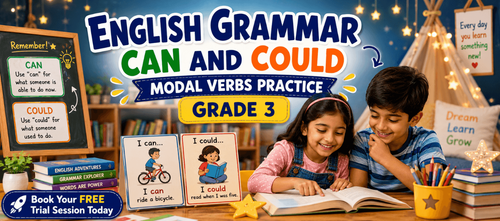

English Grammar Worksheet for Grade 3 on Can and Could Modal Verbs Practice
Learning helping verbs can be fun and exciting when students get to practice them through simple sentences, activities, and exercises. This English grammar worksheet for Grade 3 on Can and Could modal verbs helps children understand how to talk about ability and possibility in everyday situations. Students learn how to use “can” for present ability and “could” for past ability through engaging grammar activities like underlining helping verbs, filling in the blanks, choosing correct options, rewriting sentences, and sentence formation tasks.
This worksheet is designed in a simple and student-friendly format so that Grade 3 learners can practice grammar confidently. By solving these exercises regularly, students improve sentence construction, reading skills, speaking confidence, and grammar accuracy. The activities also encourage children to observe sentence patterns carefully and use helping verbs correctly in daily communication.
Download these English grammar worksheets and practice regularly to strengthen your language skills and build a strong foundation. You can also book a free trial to get expert guidance and improve your reading, writing, and comprehension abilities. The worksheets are designed in a simple and structured way to help K–8 students learn grammar concepts easily and use them confidently in everyday communication.
What Is the Topic?
This English grammar worksheet focuses on helping verbs “can” and “could.” These helping verbs are used to talk about ability and possibility.
The worksheet explains:
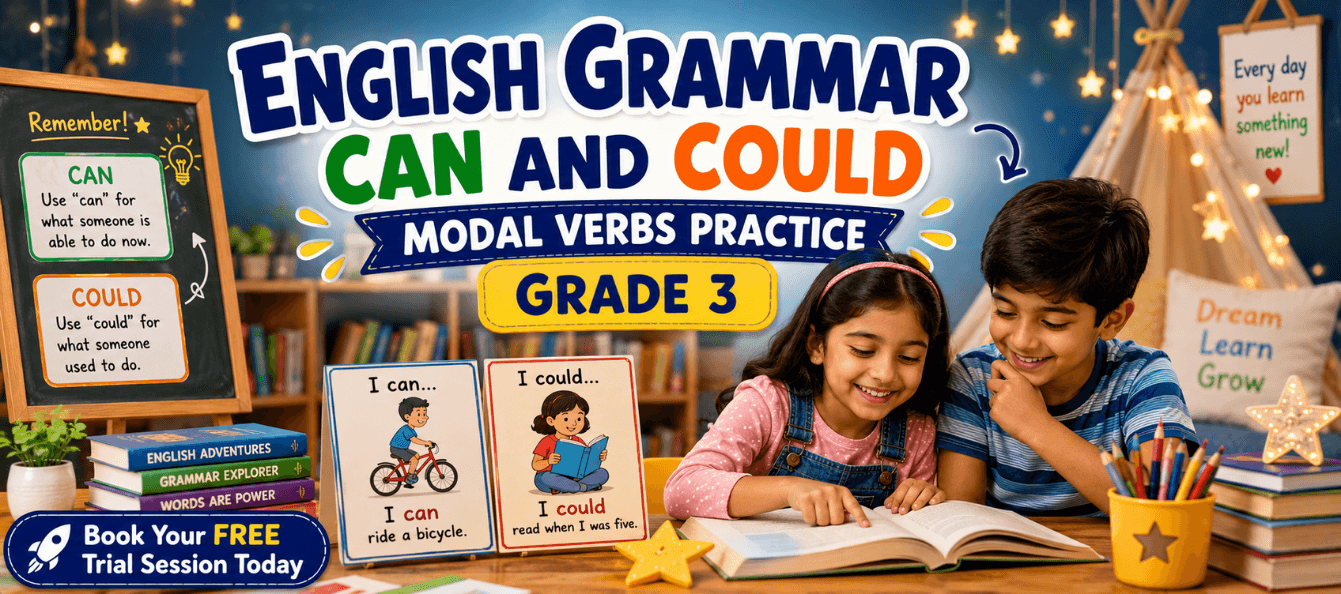
• Use “can” for what someone is able to do now.
• Use “could” for what they used to do.
Examples given in the worksheet:
• I can ride a bicycle.
• She could read when she was five.
Students learn how to:
• Identify helping verbs in sentences
• Use can and could correctly
• Complete sentences using suitable helping verbs
• Rewrite sentences by changing helping verbs
• Form meaningful sentences independently
What’s in This Worksheet?
1. Underline the helping verbs in sentences to identify the correct helping verb.
2. Fill in the blanks using “can” or “could.”
3. Multiple-choice questions to choose the correct helping verb from given options.
4. Rewrite sentences by changing the helping verb and underlining it.
5. Sentence formation activity using helping verbs can and could based on a picture.
6. Practice with positive sentences, negative sentences, and question forms.
7. Exercises arranged step-by-step to help students understand helping verbs easily.
8. Grammar practice that supports school learning, homework preparation, and exam revision.
Definitions, Examples, Techniques, and Tips
Definition:
Helping verbs “can” and “could” talk about ability or possibility.
Rules from the worksheet:
• Use “can” for what someone is able to do now.
• Use “could” for what they used to do.
Examples from the worksheet:
• She can ride a bicycle.
• I could hear the bell from here.
• We can go to the zoo tomorrow.
• He could not open the jar.
• Can you help me with this?
Techniques for learning:
• Read the sentence carefully before choosing the helping verb.
• Look for clues that show present ability or past ability.
• Practice rewriting sentences to improve understanding.
• Underline helping verbs to identify them easily.
Quick learning tips:
• “Can” is usually used for present ability.
• “Could” is usually used for past ability.
• Questions can also begin with “Can” or “Could.”
• Helping verbs come before the main verb in a sentence.
Why Is It Important to Learn This?
Learning helping verbs like “can” and “could” is important because they are used in everyday communication. Students use these words while speaking about what they can do now and what they could do earlier.
This topic helps students:
• Speak clearly and confidently
• Write meaningful sentences
• Understand sentence structure
• Improve grammar accuracy
• Build better communication skills
Understanding helping verbs also helps students answer grammar questions correctly in school exams and classroom activities.
Where Will This Knowledge Help You?
Students can use this grammar knowledge in many situations such as:
• School grammar tests and exams
• Daily speaking and conversations
• Writing simple sentences and paragraphs
• Reading comprehension activities
• Classroom participation
• Homework and worksheet practice
Using helping verbs correctly also helps children communicate ideas clearly and confidently.
How to Use This Worksheet?
1. Read the rules about “can” and “could” carefully before starting the exercises.
2. Attempt every question independently and read each sentence properly.
3. Follow the exercises in the exact order given in the worksheet.
4. Underline the helping verbs wherever instructed.
5. Fill in the blanks using the correct helping verb carefully.
6. Compare your answers with the complete answer key given below.
7. Check sentence structure, spelling, and helping verbs properly.
8. Practice regularly to improve grammar confidence and accuracy.
9. The solutions below follow the exact worksheet order, so students should compare answers carefully.
Important Tips and Tricks
1. Read each sentence fully before choosing between “can” and “could.”
2. “Can” is generally used for present ability.
Example: I can ride my bicycle fast.
3. “Could” is generally used for past ability.
Example: She could read when she was five.
4. Pay attention to question sentences.
Example:
• Can you help me?
• Could he reach the shelf?
5. Negative sentences use “not.”
Example:
• He could not open the jar.
• She could not find her pencil.
6. Underline only the helping verb when instructed.
7. Rewrite the complete sentence carefully without changing its meaning.
8. In sentence formation activities, write meaningful and grammatically correct sentences related to the picture.
9. Practice multiple times to improve grammar and sentence-building skills.
Complete Answer Key
Exercise 1
Underline the helping verbs in each sentence.
1. She __CAN__ ride a bicycle.
2. I __could__ hear the bell from here.
3. We __can__ go to the zoo tomorrow.
4. He __could__ not open the jar.
5. __Can__ you help me with this?
6. They __can__ jump very high.
7. __Could__ he reach the shelf?
8. You __can__ sing well.
9. She __could__ read big words.
10. __Can__ they play outside today?
Exercise 2
Fill in the blanks with the correct helping verb: can or could.
1. I CAN ride my bicycle fast.
2. She can sing a lovely song.
3. He could not lift the bag.
4. We can go to the zoo.
5. They can jump very high.
6. Can you help me with this bag?
7. You can read this book.
8. She could not find her pencil.
9. I could hear the bell.
10. Can they come with us to the park?
Exercise 3
Choose the correct helping verb from the options given below and fill in the blanks.
1. She CAN dance very well.
a) Can
b) Could
2. I could not open the door.
a) Can
b) Could
3. We can play after lunch.
a) Can
b) Could
4. He can jump over the rope.
a) Can
b) Could
5. They can carry their bags.
a) Can
b) Could
6. Can you climb that tree?
a) Can
b) Could
7. You can finish this puzzle.
a) Can
b) Could
8. She could not find her eraser.
a) Can
b) Could
Exercise 4
Rewrite each sentence by changing the helping verb: can or could. Underline the helping verb.
1. She __can__ sing a song.
2. I __could__ open the jar.
3. We __could__ go to the park.
4. He __can__ jump high.
5. They __could__ walk fast.
6. __Can__ you carry this bag?
7. You __could__ eat your lunch.
8. She __can__ find her book.
9. I __could__ tie my laces.
10. __Could__ they play cricket?
Exercise 5
Write 5 sentences using helping verbs can, could on the picture given below.
1. The girl can answer the question.
2. The boy could finish his work quickly.
3. The teacher can help the students.
4. The children can write neatly in class.
5. The students could learn new lessons today.
Practicing this English grammar worksheet for Grade 3 on Can and Could modal verbs regularly will help students become more confident in grammar and sentence writing. These exercises improve understanding of helping verbs through fun and structured practice. By completing activities carefully and reviewing answers properly, children can strengthen their grammar foundation and communicate more effectively in school and daily life.