
Can You Count It? Grade 6 Noun Practice with Real Examples
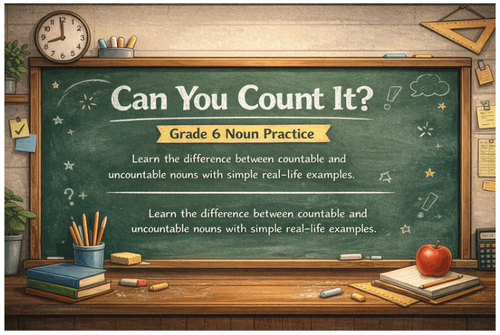

Can You Count It? Grade 6 Noun Practice with Real Examples – Complete English Grammar Worksheet Guide
Have you ever wondered why we say “many books” but “much water”? This Grade 6 English grammar worksheet on countable and uncountable nouns helps you understand exactly that in a fun and practical way. With real-life examples and engaging exercises, this worksheet makes learning nouns simple, clear, and useful for everyday communication.
What Is Countable And Uncountable Nouns?
Countable and uncountable nouns are types of nouns that help us understand whether something can be counted or not. Countable nouns are things we can count easily, like books, apples, or chairs. Uncountable nouns are things we cannot count individually, like water, sugar, or information.
In this Grade 6 English grammar worksheet, students learn how to identify these nouns in sentences, use them correctly, and choose the right words like much, many, some, and any. The worksheet focuses on building a clear understanding of how nouns behave in real-life situations.
What’s In This Worksheet?
1. Identifying countable and uncountable nouns in sentences using underline and circle activities
2. Sorting nouns into correct categories
3. Filling in blanks using suitable words like much, many, some, any, a little, and a few
4. Choosing the correct word in multiple-choice style sentences
5. Finding and correcting errors in sentences related to noun usage
This structure helps students practice recognition, application, and correction skills, which are important for exams and daily communication.
Definitions, Examples, Techniques, and Tips
Countable nouns can be counted and usually have singular and plural forms. Examples from the worksheet include books, apples, chairs, birds, and vegetables.
Uncountable nouns cannot be counted individually and usually do not have plural forms. Examples include water, sugar, rice, money, and information.
Students also learn how to use words like much and many. “Many” is used with countable nouns, while “much” is used with uncountable nouns.
Another important technique is choosing the correct quantifiers like some, any, a little, and a few depending on the noun type.
Why Is It Important To Learn This?
Understanding countable and uncountable nouns helps students form correct sentences. It improves both writing and speaking skills. When students know how to use words like much, many, and some correctly, their communication becomes clearer and more accurate.
This topic is also very important for exams, as grammar questions often test these concepts directly.
Where Will This Knowledge Help You?
This knowledge helps in:
• School exams and grammar tests
• Writing sentences correctly in assignments
• Speaking clearly in conversations
• Understanding English better in daily life
How To Use This Worksheet?
1. Read each question carefully and try to answer on your own
2. Follow the exact instructions like underline, circle, or fill in the blanks
3. Compare your answers with the answer key given below
4. Practice regularly to improve your understanding
The answers below follow the exact order of the worksheet. Compare each answer carefully to check your mistakes.
Important Tips And Tricks
1. Use “many” only with countable nouns like books, chairs, apples
2. Use “much” only with uncountable nouns like water, sugar, money
3. Do not use “a” or “an” with uncountable nouns
4. Words like information, advice, furniture are always uncountable
5. Read the sentence carefully before choosing the correct word
6. For correction questions, identify the wrong word and replace it properly
Complete Answer Key
Exercise - 1
1. My <u>mother</u> bought <u>vegetables</u> and (rice) from the <u>market</u>.
2. We saw <u>elephants</u> and (water) at the <u>zoo</u>.
3. She drank (juice) and ate <u>biscuits</u> for <u>breakfast</u>.
4. There is (sugar) on the <u>table</u>.
5. He has <u>many</u> <u>books</u> in his <u>bag</u>.
6. Please give me some (information) about the <u>project</u>.
7. They collected <u>shells</u> and (sand) at the <u>beach</u>.
8. I need a <u>pen</u> and some (paper) to write.
Exercise - 2
Countable Nouns: pencil, apple, chair, banana, books, vegetables, birds, chairs
Uncountable Nouns: milk, sugar, rice, water, salt, money, water
Exercise - 3
1. There isn’t much water in the bottle.
2. She has many friends in her new school.
3. I need a little sugar for the recipe.
4. Do you have any information about the event?
5. They bought some apples from the market.
6. We have some time before the movie starts.
7. Are there any chairs available?
8. He added some salt to the soup.
Exercise - 4
1. How much water do you drink daily?
2. There are many books on the shelf.
3. She doesn’t have much money left.
4. I saw many birds in the garden.
5. We need many chairs for the event.
6. He added much salt to the soup.
7. There isn’t much milk in the fridge.
8. They have many friends in the city.
9. Is there much traffic on the road?
10. She owns many houses in the area.
Exercise - 5
1. many
2. some
3. much
4. much
5. many
6. some
7. little
8. furniture
9. a piece of paper
10. much
This Grade 6 English grammar worksheet on countable and uncountable nouns gives you strong practice through real examples and structured exercises. By completing each section carefully, you build confidence in using nouns correctly in both writing and speaking. Keep practicing regularly, and you will notice a big improvement in your grammar skills.