
Chronological Order in Text Structure: Reading Practice for Kids
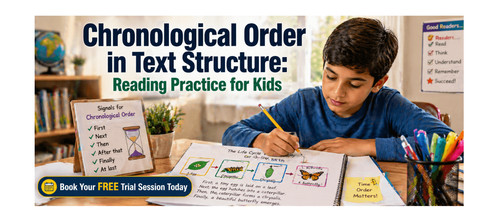

**English grammar worksheet for Grade 7: Text Structure (Chronological Order)**
In Grade 7, one of the essential grammar skills students develop is understanding text structure, specifically in chronological order. The concept of chronological order is crucial for both reading comprehension and effective writing. It helps students identify the sequence of events in a story, essay, or even a scientific process. This worksheet is designed to enhance the students' ability to recognize, use, and understand chronological order by practicing various activities based on a real-life scenario. The skills learned here will not only improve students' grammar but also boost their writing and comprehension capabilities.
Download these English grammar worksheets and practice regularly to strengthen your language skills and build a strong foundation. You can also book a free trial to get expert guidance and improve your reading, writing, and comprehension abilities. The worksheets are designed in a simple and structured way to help K–8 tudents learn grammar concepts easily and use them confidently in everyday communication.
### What is the topic?
Chronological order is the arrangement of events or actions in the order they occurred. This concept is crucial for structuring both written and spoken narratives. By understanding chronological order, students learn how events flow and how to logically sequence their thoughts. In this worksheet, students will focus on recognizing and applying chronological order to a real-life story about Aarav's project on rainwater harvesting. They will practice this concept through multiple exercises such as filling in blanks, choosing correct answers, and identifying time-order words. This will help solidify their understanding and ability to use chronological order in writing and reading.
### What’s in this worksheet?
1. **Types of Questions Included**:
- Multiple-choice questions to check students' understanding of chronological order.
- Fill-in-the-blank activities that require students to identify the correct time sequence.
- True and false statements based on events in chronological order.
- Underlining time-order words in sentences.
- Writing-based tasks that allow students to arrange events in chronological order.
2. **Grammar Skills Practiced**:
- Recognition and understanding of time words like "first," "next," "then," "finally."
- Ability to arrange events or actions in the proper sequence.
- Use of chronological order in writing and reading comprehension.
3. **Structure of the Worksheet**:
- The worksheet includes a story about Aarav and his project on rainwater harvesting.
- It features questions based on that story, with tasks to identify time words and arrange actions in the right order.
4. **How It Supports Exam Preparation**:
- The worksheet prepares students for exams that assess reading comprehension and grammar skills, particularly those involving sequence and organization of events.
### Definitions, examples, techniques, and tips
**Definitions**:
- **Chronological order**: The arrangement of events or actions in the order in which they happened.
- **Time words**: Words that help show the sequence of events, such as "first," "next," "then," "later," "finally."
**Examples**:
- In the story, Aarav researched the topic first, then gathered materials, and after that, he built the model. Each event is placed in chronological order using time words like "first," "then," and "after that."
**Techniques**:
- Look for time-order words in a story or passage. These words often signal the sequence of events.
- Pay attention to the transitions between actions and identify when one event follows another.
**Quick learning tips**:
- Use visual aids like timelines or sequence charts to practice putting events in chronological order.
- When reading a passage, highlight time words to better understand how events are connected in sequence.
### Why is it important to learn this?
Understanding chronological order is crucial for several reasons:
- **Strengthens reading comprehension**: It allows students to follow the flow of a story or process and understand the relationships between events.
- **Improves writing skills**: Knowing how to present events in a logical sequence is essential for good storytelling and academic writing.
- **Increases clarity**: When events are in chronological order, the message becomes clearer, and the audience can better understand the sequence of actions.
### Where will this knowledge help you?
This knowledge of chronological order will benefit students in several practical areas:
- **Exams**: Many reading comprehension questions require students to identify the order of events in a passage. By mastering chronological order, students can quickly and accurately answer these questions.
- **Writing tasks**: Whether it’s writing a story, a report, or an essay, students will need to organize their ideas logically. Chronological order helps create clear, coherent writing.
- **Class participation**: Understanding the sequence of events will allow students to contribute more effectively during discussions and activities that require a structured explanation.
### How to use this worksheet?
1. **Attempt independently first**: Try to answer the questions on your own without looking at the answer key.
2. **Review answers carefully**: Once completed, check your answers to see if they align with the correct sequence of events.
3. **Correct mistakes**: If you made any mistakes, review the correct answers and understand why they are the right choice.
4. **Practice regularly**: Regular practice will help reinforce your understanding of chronological order and improve your grammar skills.
Note that the solutions provided follow the exact order of the worksheet. Be sure to compare your answers carefully to ensure complete understanding.
### Important tips and tricks
1. **Common mistakes**:
- Forgetting to use time words to show the sequence of events.
- Mixing up the order of events when writing a narrative.
- Confusing "then" with "later" when they represent different times in the sequence.
2. **What examiners expect**:
- When answering questions about chronological order, make sure to correctly identify the sequence using time words.
- Ensure that the events are logically arranged in the order they occurred.
3. **How to score full marks**:
- Carefully read each question and the passage to understand the sequence of events.
- Use the time words provided in the worksheet to structure your answers.
- For writing tasks, focus on organizing your ideas in the correct order.
4. **How to approach activity-based or writing-based tasks**:
- For writing tasks, first identify the events that need to be arranged.
- Use a graphic organizer or outline to help structure your writing in chronological order.
- For fill-in-the-blank and multiple-choice questions, focus on recognizing the correct sequence based on the story.
### Complete answer key
**Exercise No. 1 – Multiple Choice Questions**
1. a) research
2. a) first try
3. a) improve
4. a) add filter
5. a) waterflow
6. a) practice
7. a) present
8. a) appreciate
9. a) time word
10. a) chronological
**Exercise No. 2 – Fill in the Blanks**
1. chronological
2. order
3. first
4. next
5. then
6. after
7. later
8. finally
9. process
10. time
**Exercise No. 3 – True or False**
1. False
2. True
3. True
4. True
5. False
6. True
7. True
8. False
9. False
10. True
**Exercise No. 4 – Underline Time Words**
1. First
2. Next
3. Then
4. After that
5. Later
6. Finally
7. First
8. Finally
9. Time
10. Finally
**Exercise No. 5 – Fill in the Blanks to Arrange Events**
1. chronological
2. time
3. immersive
4. sequence
5. focus
6. order
7. understand
8. expand
9. overcome
10. success
Book a free trial!