
Clarity in Writing Worksheet for Grade 7 – English Practice PDF
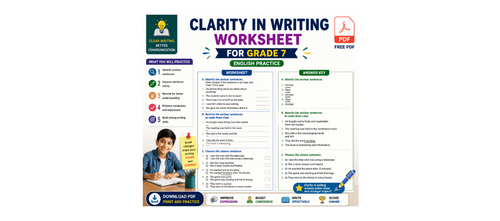

Editing for Clarity in Informational Texts: English grammar worksheet for Grade 7
In Grade 7, students are introduced to the important skill of editing for clarity in informational texts. This worksheet focuses on refining the ability to select the clearest words and phrases to enhance the overall readability and coherence of writing. With a clear structure, this worksheet helps students understand how to choose words that make sentences more effective and how to improve writing by avoiding confusion and vagueness. As students practice with this worksheet, they will develop key editing skills that will be valuable for both academic writing and real-world communication.
Download these English grammar worksheets and practice regularly to strengthen your language skills and build a strong foundation. You can also book a free trial to get expert guidance and improve your reading, writing, and comprehension abilities. The worksheets are designed in a simple and structured way to help K–8 students learn grammar concepts easily and use them confidently in everyday communication.
What is the topic?
This worksheet focuses on the skill of editing for clarity in informational texts. The goal is to help students refine their ability to choose the most effective words that clearly convey information. In editing, clarity refers to the ability to make writing easy to understand, avoiding ambiguity and unnecessary complexity. The exercises in this worksheet guide students in improving sentences, paragraphs, and other text types by selecting clear, precise, and concise language.
Students are expected to learn how to:
- Choose the clearest word in a sentence
- Understand how clarity affects readability
- Improve the overall structure of their writing by eliminating vagueness
- Develop editing skills that make informational writing easier to understand
What’s in this worksheet?
This worksheet contains various exercises that help students practice editing for clarity, focusing on the selection of precise and clear words. Here's what's included:
1. **Exercise 1 – Choose the clearest word to improve each sentence**
This exercise helps students select the best word choice to enhance clarity in sentences.
2. **Exercise 2 – Fill the blanks using suitable clarity words from the bank**
Students will choose the appropriate clarity-related words to fill in the blanks and make the sentences clearer.
3. **Exercise 3 – True or False**
This section tests students’ understanding of clarity in writing, where they need to determine if statements are true or false based on clarity principles.
4. **Exercise 4 – Underline the nouns and circle the verbs**
This activity helps students understand sentence structure, which is crucial for writing clearly.
5. **Exercise 5 – Write sentences using words related to clarity**
A creative task where students form sentences with clarity-related words, practicing their understanding in context.
This worksheet not only supports grammar learning but also prepares students for exams and real-world tasks that require clear communication.
Definitions, examples, techniques, and tips
Definitions:
- **Clarity**: The quality of being easy to understand, free from confusion or ambiguity. In writing, clarity ensures that the reader understands the message without effort.
- **Conciseness**: Referring to expressing ideas briefly and directly, avoiding unnecessary words or complexity.
- **Precision**: Using specific, accurate language to communicate ideas clearly and correctly.
Examples:
1. "The report gives ______ about rainfall in Chennai."
Clear: information
2. "Riya wrote a ______ note about the project."
Clear: detailed
3. "Meera used ______ words to explain the idea."
Clear: clear
Techniques:
- Always opt for specific terms over vague words like "stuff" or "things".
- Use simple language that communicates the idea directly, avoiding over-complication.
- Be careful with technical terms—ensure that they are relevant and understood by the intended audience.
Quick learning tips:
- Focus on the most essential word that can improve the sentence’s meaning.
- When filling blanks, make sure the word fits contextually and helps reduce confusion.
- For writing-based tasks, be mindful of sentence length; long sentences can often be simplified for better clarity.
Why is it important to learn this?
Learning how to edit for clarity is crucial for improving both written and spoken communication. When students master this skill, they are better equipped to express their ideas in a way that others can easily understand. Clarity makes writing more professional and effective, especially when presenting information. Whether it's for academic assignments, projects, or everyday tasks, clear writing helps convey messages without misinterpretation.
This skill also builds students’ confidence, knowing they can communicate complex ideas simply and clearly. As they learn to choose the right words, they strengthen their ability to be precise and direct, a skill they can use in both exams and future professional work.
Where will this knowledge help you?
1. **Exams**: Clarity in writing helps ensure that students' answers are easily understood by examiners. A clear explanation of concepts and well-structured answers can lead to better grades.
2. **Writing tasks**: Whether it’s essays, reports, or summaries, clarity helps students present their thoughts effectively. It improves the organization of ideas, which is crucial in structured writing tasks.
3. **Class participation**: Being able to communicate ideas clearly also helps students contribute effectively in discussions, present projects, and work collaboratively with peers.
How to use this worksheet?
1. **Attempt independently first**: Begin by attempting the exercises on your own. Try to choose words or fill in blanks based on your understanding of clarity.
2. **Review answers carefully**: After completing the exercises, check your answers to see if your choices truly enhance clarity.
3. **Correct mistakes**: If you made mistakes, correct them and try to understand why the correct answers are clearer.
4. **Practice regularly**: Consistent practice with worksheets like this will help strengthen your clarity in writing.
Remember:
- The solutions follow the exact order of the worksheet, so compare your answers carefully.
- Don’t rush through the exercises—take time to understand how each word choice impacts the sentence’s clarity.
Important tips and tricks
1. **Common mistakes**:
- Using vague words that don’t provide enough detail or specificity.
- Overcomplicating sentences with unnecessary details or jargon.
- Not paying attention to the overall structure of a sentence, which may confuse readers.
2. **What examiners expect**:
Examiners expect students to use precise language and avoid unnecessary words. Clear writing shows that you can explain concepts in a way that anyone can understand, which is highly valued in both written and oral exams.
3. **How to score full marks**:
To score well, ensure your writing is clear and direct. Avoid fluff or filler words that don't add value to your explanation. Practice using simple and effective language.
4. **How to approach activity-based or writing-based tasks**:
When writing sentences or completing open-ended tasks, remember to be specific. Use clear, concise language, and make sure the structure of your sentence is easy to follow. Avoid complex sentence structures unless necessary.
Complete answer key
**Exercise 1 – Choose the clearest word to improve each sentence**
1. information
2. detailed
3. clear
4. specific
5. clear
6. accurate
7. simplified
8. clear
9. clear
10. specific
**Exercise 2 – Fill the blanks using suitable clarity words from the bank**
1. information
2. clear
3. detailed
4. simplified
5. accurate
6. clearly
7. clear
8. specific
9. clear
10. specific
**Exercise 3 – True or False**
1. True
2. False
3. True
4. False
5. True
6. True
7. False
8. True
9. True
10. False
**Exercise 4 – Underline the nouns and circle the verbs**
1. Noun: topic, Verb: explains
2. Noun: paragraph, Verb: writes
3. Noun: article, Verb: reads
4. Noun: teacher, Verb: shows
5. Noun: students, Verb: understand
6. Noun: guide, Verb: explains
7. Noun: notes, Verb: prepares
8. Noun: diagram, Verb: draws
9. Noun: report, Verb: gives
10. Noun: class, Verb: discusses
**Exercise 5 – Write sentences using words related to clarity**
1. Clear – The writing was very clear and easy to follow.
2. Detail – The report was filled with important details about the subject.
3. Simple – The language used in the article was simple and easy to understand.
4. Explain – The teacher will explain the topic in detail.
5. Note – Make sure to take note of all the instructions.
6. Report – The report includes all the necessary data.
7. Chart – The chart shows the sales growth over the past year.
By practicing this worksheet, you are on your way to mastering clarity in your writing. The more you practice, the better you will get at making your writing concise and understandable.
Book a free trial!