
Class 1 Grammar Exercises on Time Words Usage
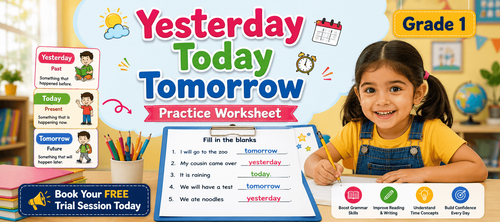

Interesting English Grammar Worksheet for Grade 1 Yesterday Today Tomorrow Practice
Understanding time-related words helps children describe events clearly and correctly. This English grammar worksheet for Grade 1 focuses on the words “yesterday,” “today,” and “tomorrow.” These words help students talk about past events, present activities, and future plans in simple sentences. Through easy fill-in-the-blank exercises, children learn how to identify the correct time word according to the sentence meaning.
This Grade 1 worksheet gives students enjoyable grammar practice using familiar daily situations such as going to the zoo, visiting relatives, watching cartoons, and attending classes. Learning these concepts improves sentence understanding and helps students communicate more confidently in both speaking and writing. Regular practice also strengthens grammar basics and improves overall language skills.
Download these English grammar worksheets and practice regularly to strengthen your language skills and build a strong foundation. You can also book a free trial to get expert guidance and improve your reading, writing, and comprehension abilities. The worksheets are designed in a simple and structured way to help K–8 students learn grammar concepts easily and use them confidently in everyday communication.
What Is the Topic?
“Yesterday,” “today,” and “tomorrow” are words that tell us about time. They help students understand whether something happened in the past, is happening now, or will happen in the future.
In this English grammar worksheet for Grade 1, students practice choosing the correct time-related word to complete each sentence correctly.
Students are expected to:
1. Understand simple time concepts
2. Identify past, present, and future events
3. Choose suitable words according to sentence meaning
4. Improve grammar and reading skills
5. Build confidence in sentence formation
The worksheet uses simple and relatable examples to make learning easy for young learners.
What’s in This Worksheet?
1. Fill in the blanks questions using “yesterday,” “today,” and “tomorrow”
2. Sentence-reading and understanding practice
3. Grammar exercises based on time-related words
4. Simple daily-life examples suitable for Grade 1 students
5. Activities that improve vocabulary and sentence formation
6. Practice that supports school grammar preparation
7. Exercises that help students understand sequence of time
Definitions, Examples, Techniques, and Tips
Definition
“Yesterday,” “today,” and “tomorrow” are words used to talk about time.
Examples From the Worksheet
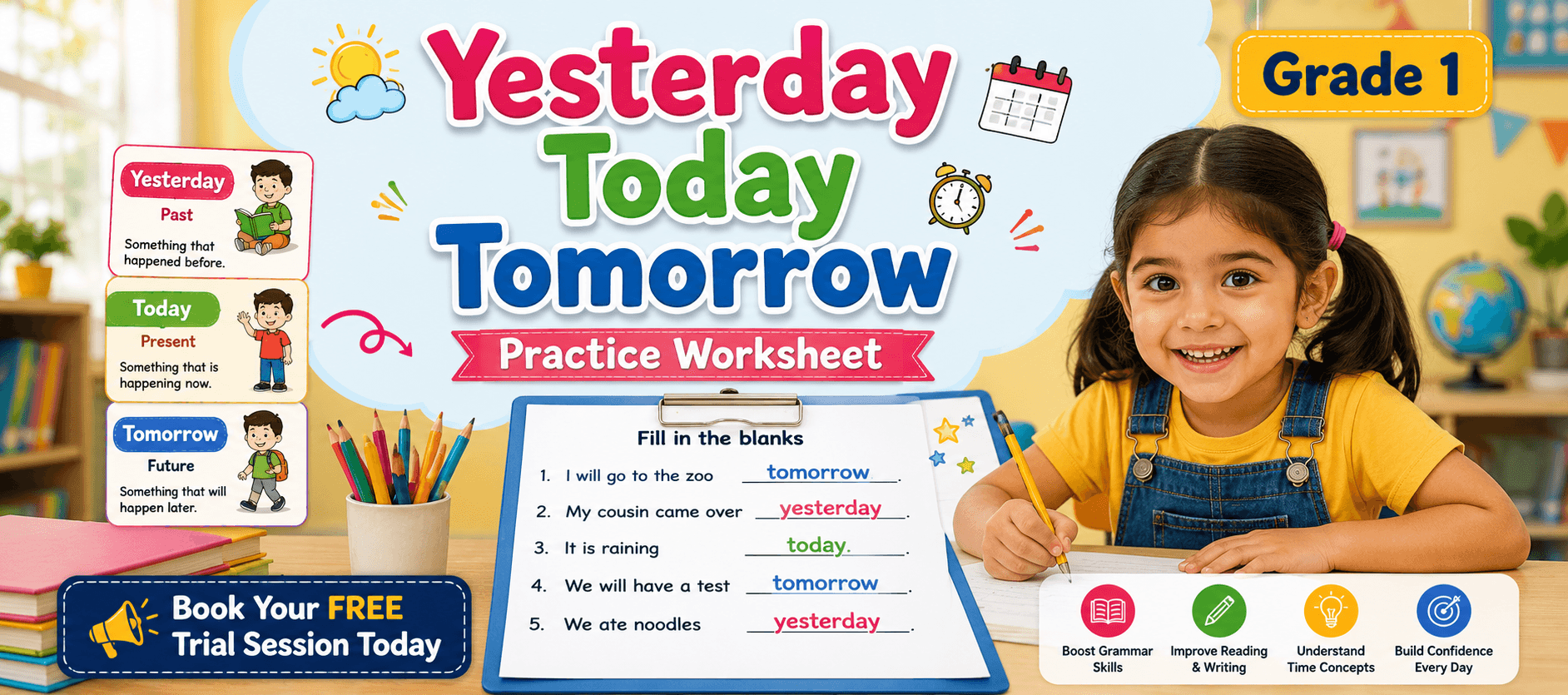
1. I will go to the zoo tomorrow.
2. My cousin came over yesterday.
3. It is raining today.
4. We will have a test tomorrow.
5. We ate noodles yesterday.
6. I have a drawing class today.
7. He will visit the park tomorrow.
8. I watched cartoons yesterday.
9. I will visit my aunt tomorrow.
10. Today is a holiday.
Techniques
1. Read the sentence carefully before selecting the answer.
2. Look for clues like “will,” “ate,” or “is” to understand the time.
3. Think about whether the action happened before, now, or later.
4. Choose the word that makes the sentence meaningful.
Quick Learning Tips
1. “Yesterday” talks about the past.
2. “Today” talks about the present.
3. “Tomorrow” talks about the future.
4. Practice reading simple time-related sentences every day.
Why Is It Important to Learn This?
Learning about “yesterday,” “today,” and “tomorrow” helps children understand time and sequence correctly. These words are commonly used in daily conversations, school activities, and writing tasks.
This grammar topic helps students:
1. Describe events clearly
2. Improve sentence-building skills
3. Understand daily routines better
4. Speak and write with confidence
5. Strengthen grammar foundations
Students who understand time words can communicate ideas more accurately in both classroom and everyday situations.
Where Will This Knowledge Help You?
Students will use time-related words in many learning activities and daily conversations.
1. School grammar tests
2. Speaking activities in class
3. Writing simple sentences
4. Reading comprehension tasks
5. Describing daily routines
6. Storytelling and paragraph writing
7. Understanding schedules and plans
How to Use This Worksheet?
1. Read each sentence carefully before answering.
2. Identify whether the action belongs to the past, present, or future.
3. Fill in the blank with the correct word.
4. Complete the worksheet independently first.
5. Compare your answers carefully with the answer key.
6. Follow the exact worksheet order while reviewing answers.
7. Practice similar sentences regularly for better grammar understanding.
Important Tips and Tricks
1. Look for clue words such as “will,” “watched,” or “is.”
2. “Will” usually shows future actions.
3. Past actions often use words like “came,” “ate,” or “watched.”
4. Present actions describe what is happening now.
5. Read the sentence completely before choosing the answer.
6. Practice time words daily to improve grammar confidence.
7. Careful reading helps students avoid mistakes in exams.
Complete Answer Key
Fill in the blanks with the correct word (yesterday /today/tomorrow).
1. I will go to the zoo tomorrow.
2. My cousin came over yesterday.
3. It is raining today.
4. We will have a test tomorrow.
5. We ate noodles yesterday.
6. I have a drawing class today.
7. He will visit the park tomorrow.
8. I watched cartoons yesterday.
9. I will visit my aunt tomorrow.
10. Today is a holiday.
Practicing grammar regularly helps children become better readers, writers, and speakers. This English grammar worksheet for Grade 1 on “yesterday,” “today,” and “tomorrow” gives students a simple way to understand time-related words and use them correctly in sentences. With continuous practice, children can strengthen their grammar skills and communicate ideas clearly and confidently.