
Class 2 English Grammar Worksheet on A, An, and The

Interactive Articles English Grammar Worksheet for Grade 2 Students
Learning grammar becomes easier and more enjoyable when students understand how small words can change the meaning of a sentence. This English grammar worksheet for Grade 2 on Articles helps young learners identify and use articles correctly in everyday sentences. Through simple examples and sentence-based practice, students improve their reading and grammar skills while learning how articles are used before naming words.
In Grade 2, children begin understanding sentence structure more clearly, and articles play an important role in making sentences complete and meaningful. This worksheet provides students with easy practice sentences where they can carefully identify the correct article in each sentence. The activity encourages observation, reading accuracy, and grammar confidence in a fun and structured way.
Download these English grammar worksheets and practice regularly to strengthen your language skills and build a strong foundation. You can also book a free trial to get expert guidance and improve your reading, writing, and comprehension abilities. The worksheets are designed in a simple and structured way to help K–8 students learn grammar concepts easily and use them confidently in everyday communication.
What Is the Topic?
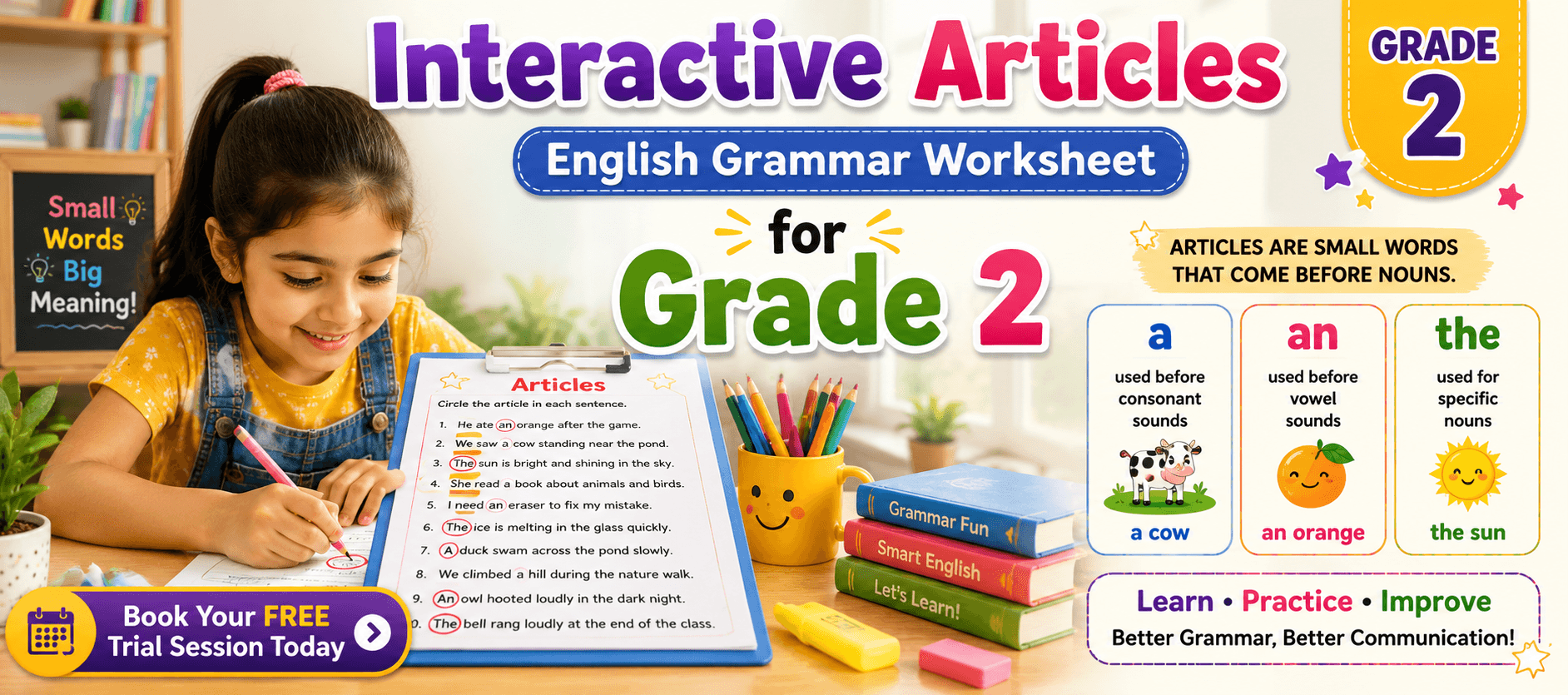
Articles are small words used before naming words in sentences. They help make sentences clearer and more meaningful. Common articles include “a,” “an,” and “the.” These words are used in everyday speaking and writing.
In this English grammar worksheet for Grade 2, students practice identifying articles by reading each sentence carefully and circling the correct article. The worksheet uses simple and familiar examples that help children recognize articles naturally in sentences.
Students are expected to:
• Read sentences carefully
• Identify the article in each sentence
• Understand how articles are used
• Improve grammar and reading skills
What’s in This Worksheet?
1. The worksheet contains sentence-based grammar practice focused on articles.
2. Students identify and circle the article in each sentence.
3. The worksheet includes simple Grade 2 level examples related to daily life.
4. Students practice reading sentences carefully to recognize grammar patterns.
5. The activity strengthens sentence understanding and grammar identification skills.
6. The worksheet supports classroom learning and grammar revision practice.
7. The questions encourage students to pay attention to small but important grammar words.
Definitions, Examples, Techniques, and Tips
Definition
Articles are small words used before naming words in a sentence.
Examples From the Worksheet
• an orange
• a cow
• The sun
• a book
• an eraser
• The ice
• A duck
• a hill
• An owl
• The bell
Techniques for Learning Articles
• Read each sentence slowly and carefully.
• Look for small words placed before naming words.
• Identify whether the article is “a,” “an,” or “the.”
• Circle only the article in the sentence.
Quick Learning Tips
• Articles are usually placed before naming words.
• Pay attention to sentence beginnings and noun phrases.
• Read aloud to hear how articles sound in sentences.
• Practice identifying articles during reading activities.
Why Is It Important to Learn This?
Learning articles is important because they are used in everyday speaking and writing. Articles help make sentences complete and easier to understand. Students who understand articles can improve sentence formation and grammar accuracy.
This topic also helps children:
• Build stronger grammar skills
• Improve sentence reading
• Write clearer sentences
• Understand sentence structure better
• Develop confidence in English communication
Understanding articles early helps students become more comfortable with grammar and language learning.
Where Will This Knowledge Help You?
Students use articles in many school and daily activities.
• During grammar worksheets and exams
• While reading books and stories
• During classroom discussions
• While writing sentences and paragraphs
• In spoken English conversations
• During comprehension and language activities
Knowing how to identify articles helps students read and write more accurately.
How to Use This Worksheet?
1. Read each sentence carefully before selecting the article.
2. Try to identify the article independently first.
3. Circle the correct article neatly in every sentence.
4. Compare your answers carefully with the answer key.
5. Review mistakes and understand the correct article usage.
6. Practice similar sentence activities regularly.
7. Follow the worksheet order while checking answers.
8. Make sure every answer matches the worksheet correctly.
Important Tips and Tricks
1. Articles are usually short words like “a,” “an,” and “the.”
2. Read the full sentence before circling the article.
3. Do not confuse articles with naming words.
4. Look carefully at the word placed before the noun.
5. Practice reading simple sentences daily to identify articles faster.
6. During exams, focus carefully on small grammar words.
7. Circle neatly and clearly while solving grammar worksheets.
8. Check every sentence again after completing the worksheet.
Complete Answer Key
Circle the article in each sentence.
1. He ate an orange after the game.
Article: an
2. We saw a cow standing near the pond.
Article: a
3. The sun is bright and shining in the sky.
Article: The
4. She read a book about animals and birds.
Article: a
5. I need an eraser to fix my mistake.
Article: an
6. The ice is melting in the glass quickly.
Article: The
7. A duck swam across the pond slowly.
Article: A
8. We climbed a hill during the nature walk.
Article: a
9. An owl hooted loudly in the dark night.
Article: An
10. The bell rang loudly at the end of the class.
Article: The
Practicing articles regularly helps students improve grammar, reading, and sentence-building skills. This English grammar worksheet for Grade 2 on Articles gives children simple and meaningful practice through easy daily-life examples. With careful reading and regular practice, students can confidently identify and use articles correctly in their everyday communication and schoolwork.