
Class 2 Worksheet on Wind Poem – Fun Learning Exercises
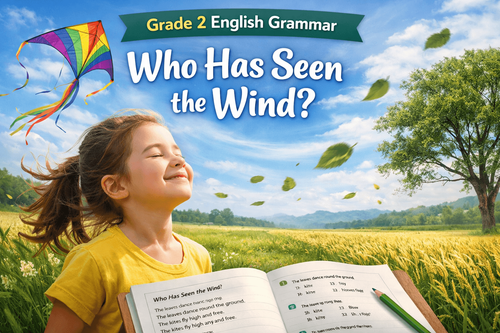

Class 2 Worksheet on Wind Poem – Fun Learning Exercises
Did you ever felt something around you that you couldn’t see but could clearly feel? That’s exactly what this beautiful English grammar worksheet for Grade 2 explores through the poem “Who Has Seen the Wind?” This engaging and simple poem helps young learners understand how we can experience things like the wind even when we cannot see them. Let’s dive into this fun and meaningful worksheet designed especially for Grade 2 students.
What Is the Topic?
The topic of this worksheet is “Understanding Poems: Who Has Seen the Wind?” It focuses on reading comprehension through a short and simple poem.
In this English grammar worksheet, students learn how to read a poem carefully and understand its meaning. The poem talks about the wind, which cannot be seen but can be felt. Students are expected to observe how the wind affects things around them, like leaves, kites, and trees.
The main goal is to help students:
• Read and understand poems
• Identify key details from the poem
• Answer questions based on what they read
• Think about what they feel and observe in daily life
This worksheet helps build basic reading comprehension skills in a fun and relatable way.
What’s in This Worksheet?
This Grade 2 English grammar worksheet includes different types of questions to help students understand the poem better.
1. A short and simple poem from everyday life
2. Objective-type questions to check clear facts
3. Subjective-type questions to check deeper understanding
4. Questions that focus on observation and thinking
5. Answers to all the questions
The worksheet is structured in a way that first introduces the poem and then gradually checks understanding through multiple-choice and written questions. It helps students prepare for exams by improving their ability to read, think, and answer correctly.
Definitions, Examples, Techniques, and Tips
Definitions
Reading comprehension means understanding what we read. In this worksheet, students read a poem and answer questions based on it.
Examples
The poem gives examples of how we know the wind is present:
• Leaves dance round the ground
• Kites fly high and free
• Trees sway
• Wind whispers through fields of rice
• It cools our cheeks
These examples help students understand that even though we cannot see the wind, we can feel and observe its effects.
Techniques
• Read the poem slowly and carefully
• Look for clues in each line
• Think about what each line means
• Connect the poem to real-life experiences
Quick Learning Tips
• Focus on keywords like leaves, kites, trees, and rice fields
• Remember how the wind feels: soft, cool, and fresh
• Visualize the scenes described in the poem
Why Is It Important to Learn This?
Learning to understand poems is very important for students in Grade 2. This topic helps in developing reading and thinking skills.
It teaches students how to:
• Understand the meaning of lines in a poem
• Observe things around them
• Improve their imagination
• Build strong comprehension skills
This English grammar worksheet also helps students become better readers and listeners, which is useful in all subjects.
Where Will This Knowledge Help You?
This knowledge is useful in many ways:
• Exams: Helps answer comprehension questions correctly
• Writing tasks: Helps describe feelings and observations
• Class participation: Helps students share their thoughts confidently
• Daily life: Helps students notice and understand things around them
Understanding poems like “Who Has Seen the Wind?” makes learning enjoyable and meaningful.
How to Use This Worksheet?
1. Attempt independently first
Read the poem carefully and try to answer all questions on your own.
2. Review answers carefully
After completing the worksheet, check your answers with the given solutions.
3. Correct mistakes
Understand where you went wrong and learn the correct answers.
4. Practice regularly
Read similar poems and practice more questions to improve your skills.
The solutions follow the exact worksheet order, so students should compare their answers carefully.
Important Tips and Tricks
1. Read the poem more than once to understand it fully
2. Focus on what the poem is showing, not just the words
3. Look for clues in lines like leaves dancing and kites flying
4. Remember that wind cannot be seen but can be felt
5. For multiple-choice questions, read all options before choosing
6. For written answers, keep them simple and clear
7. For opinion-based questions, write what you feel
Complete Answer Key
Who Has Seen the Wind?
Who has seen the wind go by?
Neither you nor I.
But when the leaves dance round the ground,
we know it’s come without a sound.
It lifts the kites so high and free,
and hums along each swaying tree.
It whispers low through fields of rice,
it cools our cheeks—so soft, so nice.
Though we can’t see where it has been,
we feel its touch, so fresh, so clean.
Choose the correct answer.
1. Who has seen the wind?
a) No one
b) The clouds
c) The birds
d) The sun
Answer: a) No one
2. What do leaves do in the wind?
a) Dance
b) Sleep
c) Hide
d) Fall silently
Answer: a) Dance
3. What flies high in the sky?
a) Kites
b) Balls
c) Birds only
d) Planes
Answer: a) Kites
4. What crops does the wind pass through?
a) Wheat fields
b) Corn plants
c) Rice fields
d) Sugarcane
Answer: c) Rice fields
5. How does the wind feel on skin?
a) Cool and soft
b) Hot and sharp
c) Rough and dry
d) Sticky and warm
Answer: a) Cool and soft
6. What sound does the wind make?
a) A whistle
b) A hum
c) A roar
d) No sound
Answer: b) A hum
Answer the following questions.
7 Leaves, kites, and trees move.
8 It cools and freshens the air.
9 Leaves, kites, and rice plants.
10 Yes, they’re fun for kites.
Outro
This Grade 2 English grammar worksheet on “Who Has Seen the Wind?” is a wonderful way to help young learners understand poems while enjoying the beauty of simple words and ideas. By practicing regularly, students can improve their reading comprehension skills and become more confident in understanding what they read. Keep exploring, keep reading, and enjoy learning through poems!