
Class 3 Adjectives Exercises to Improve English Grammar Skills
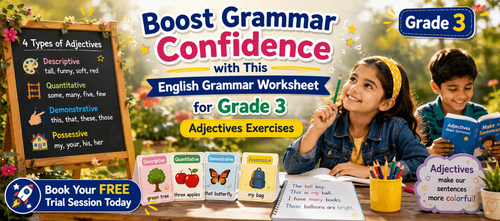

Boost Grammar Confidence with This English Grammar Worksheet for Grade 3 Adjectives Exercises
Learning adjectives can make sentences more colorful, meaningful, and interesting. This English grammar worksheet for Grade 3 helps students understand how adjectives describe people, places, animals, and things. Through engaging exercises like filling in the blanks, circling adjectives, underlining and classifying words, and changing adjectives into different types, students get plenty of practice using adjectives correctly.
This Grade 3 adjectives worksheet is designed in a simple and structured format so students can improve grammar skills step by step. The activities help children identify descriptive, quantitative, demonstrative, and possessive adjectives while building confidence in sentence formation and language usage.
Download these English grammar worksheets and practice regularly to strengthen your language skills and build a strong foundation. You can also book a free trial to get expert guidance and improve your reading, writing, and comprehension abilities. The worksheets are designed in a simple and structured way to help K–8 students learn grammar concepts easily and use them confidently in everyday communication.
What Is the Topic?
Adjectives are words that tell us more about nouns. They help explain how something looks, how many there are, whose something is, or which one is being talked about.
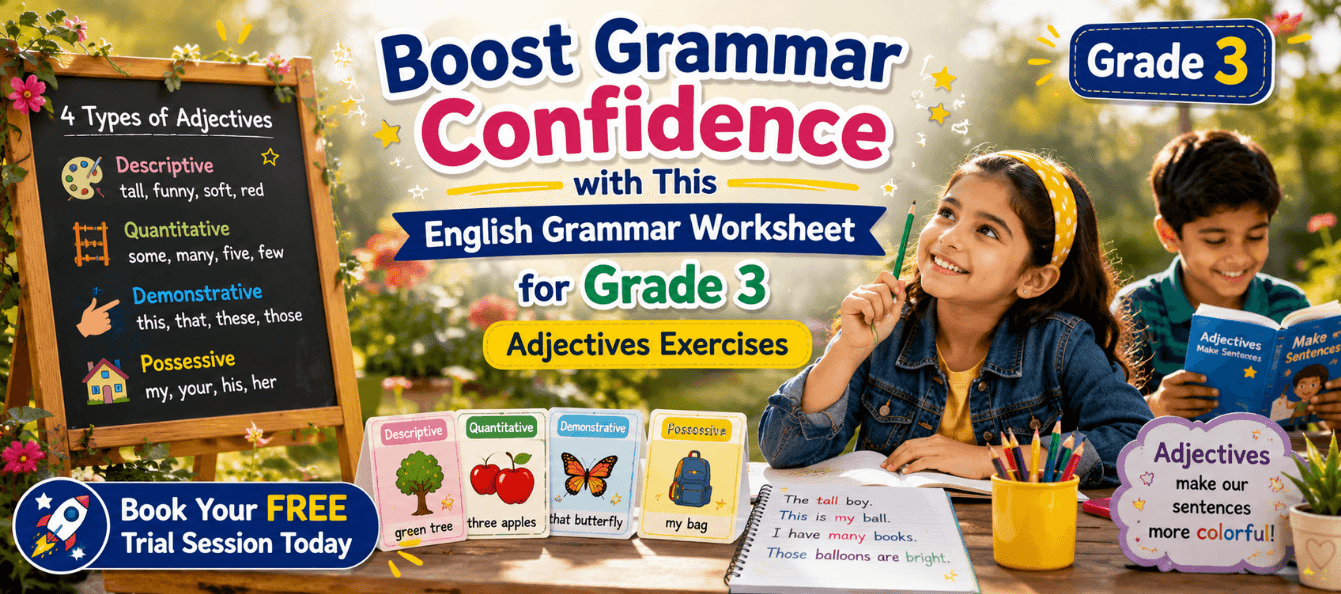
This Grade 3 English grammar worksheet explains four types of adjectives:
1. Descriptive Adjectives
These tell us what a noun is like.
Examples: tall, funny, soft, red
Example: The sky is clear.
2. Quantitative Adjectives
These tell us how much or how many.
Examples: some, many, five, few
Example: I ate two apples.
3. Demonstrative Adjectives
These point out specific nouns.
Examples: this, that, these, those
Example: Look at that butterfly!
4. Possessive Adjectives
These show ownership.
Examples: my, your, his, her
Example: This is my pencil.
Students are expected to learn how to identify adjectives, classify them correctly, and use them properly in sentences.
What’s in This Worksheet?
1. Fill in the blanks questions to practice suitable adjectives and identify adjective types.
2. Sentence-based exercises where students circle descriptive adjectives.
3. Activities that ask students to replace descriptive adjectives with quantitative, demonstrative, or possessive adjectives.
4. Underline and classify activities that help students recognize adjective categories.
5. Practice sentences that improve observation and grammar skills.
6. Structured exercises that support grammar revision and exam preparation.
7. Exercises arranged in a simple order to help Grade 3 students practice step by step.
Definitions, Examples, Techniques, and Tips
Definitions
Adjective:
An adjective is a word that tells us more about a noun.
Descriptive Adjectives:
These tell us what a noun is like.
Quantitative Adjectives:
These tell us how much or how many.
Demonstrative Adjectives:
These point out specific nouns.
Possessive Adjectives:
These show ownership.
Examples
The sky is clear.
I ate two apples.
Look at that butterfly!
This is my pencil.
Techniques
1. Read the sentence carefully and identify the noun first.
2. Look for words that describe the noun.
3. Check whether the adjective shows quality, number, ownership, or points to something specific.
4. Practice classifying adjectives into the correct categories.
Quick Learning Tips
1. Descriptive adjectives usually tell how something looks or feels.
2. Quantitative adjectives usually show number or amount.
3. Demonstrative adjectives point to nouns.
4. Possessive adjectives show ownership.
5. Practice reading sentences aloud to identify adjectives easily.
Why Is It Important to Learn This?
Learning adjectives helps students make sentences clearer and more interesting. Adjectives improve speaking and writing skills by adding details to nouns.
This grammar topic also helps students:
1. Build stronger vocabulary.
2. Write better descriptions.
3. Improve sentence structure.
4. Understand grammar rules clearly.
5. Perform better in school grammar activities and exams.
Understanding adjectives also helps students communicate ideas more effectively in daily conversations and written work.
Where Will This Knowledge Help You?
1. School Exams
Students can identify and use adjectives correctly in grammar sections.
2. Writing Tasks
Adjectives help improve story writing, paragraph writing, and sentence formation.
3. Reading Skills
Students understand descriptions better while reading passages and stories.
4. Speaking Activities
Using adjectives makes spoken sentences more meaningful and expressive.
5. Classroom Participation
Students can answer grammar questions with more confidence.
How to Use This Worksheet?
1. Read each sentence carefully before answering.
2. Attempt every question independently first.
3. Identify the noun and then find the adjective connected to it.
4. Compare your answers carefully with the complete answer key.
5. Follow the exact worksheet order while checking answers.
6. Correct mistakes neatly after reviewing answers.
7. Practice the worksheet regularly to improve grammar accuracy.
8. Revise adjective types again after completing all exercises.
Important Tips and Tricks
1. Do not confuse nouns with adjectives.
2. Read the full sentence before choosing the adjective type.
3. Quantitative adjectives show number or quantity.
4. Possessive adjectives show ownership words like my, your, his, her, our, and their.
5. Demonstrative adjectives point to nouns using words like this, that, these, and those.
6. Descriptive adjectives explain qualities like color, size, shape, and feeling.
7. Underline only the adjective asked in the sentence.
8. While classifying adjectives, check the function of the word carefully.
9. Practice sentence reading daily to identify adjectives faster.
10. Write answers neatly and in the correct order during exams.
Complete Answer Key
Exercise 1
1. I have many books in my bag. — Quantitative
2. That cat is sleeping on the sofa. — Demonstrative
3. This is my pencil. — Possessive
4. She gave me five apples. — Quantitative
5. Those shoes are too big. — Demonstrative
6. He forgot his lunchbox. — Possessive
7. I saw many monkeys in the zoo. — Quantitative
8. Her dress belongs to Ria. — Possessive
9. We carried heavy bags up the stairs. — Descriptive
10. These children were playing outside. — Demonstrative
Exercise 2
1. The blue sky smiled at the happy birds.
blue, happy
2. A bright star twinkled in the quiet night.
bright, quiet
3. The tall giraffe ate from the green tree.
tall, green
4. My fluffy cat sleeps on a soft pillow.
fluffy, soft
5. The loud drum echoed in the empty hall.
loud, empty
6. I wore a shiny hat and a striped shirt.
shiny, striped
7. The hot sun shone on the golden sand.
hot, golden
8. The funny clown made silly faces.
funny, silly
9. The angry lion roared at the nervous animals.
angry, nervous
10. We ran through the wet grass on a cool morning.
wet, cool
Exercise 3
1. I have many pencils.
2. That dog barked at me.
3. She took my book.
4. Those birds flew away.
5. He has five pencils.
6. That is her dress.
7. He bought many apples.
8. She likes her toys.
9. I saw these monkeys.
10. They ate many grapes.
Exercise 4
1. She wore a yellow dress to the party.
yellow — Descriptive
2. Those cookies smell delicious.
Those — Demonstrative
3. I have three pencils in my case.
three — Quantitative
4. We played with our new puppy.
our — Possessive
new — Descriptive
5. He climbed the tall tree quickly.
tall — Descriptive
6. My jacket is hanging on the hook.
My — Possessive
7. The child saw many stars in the sky.
many — Quantitative
8. This book is about dinosaurs.
This — Demonstrative
9. They brought their toys to school.
their — Possessive
10. The dog chased a small ball across the yard.
small — Descriptive
Practicing adjectives regularly can help students become more confident in grammar and sentence building. This English grammar worksheet for Grade 3 gives students useful practice with descriptive, quantitative, demonstrative, and possessive adjectives in a simple and engaging way. Keep practicing these adjective exercises to improve writing, speaking, and overall grammar skills step by step.