
Class 3 Concrete and Abstract Nouns Activity Sheet
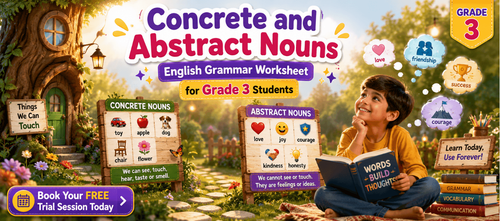

Concrete and Abstract Nouns English Grammar Worksheet for Grade 3 Students
Learning nouns becomes much more exciting when children can identify things they can touch and feelings they can experience. This Class 3 Concrete and Abstract Nouns Activity Sheet helps students understand the difference between concrete nouns and abstract nouns through fun and engaging exercises. With activities like sentence formation, sorting exercises, picture-based learning, and identifying nouns, students get multiple opportunities to strengthen their grammar concepts in an easy and enjoyable way.
This English grammar worksheet for Grade 3 is designed to help young learners improve their understanding of nouns through simple examples and practice questions. Students will learn how concrete nouns are things we can see or touch, while abstract nouns describe ideas, emotions, and qualities. Regular practice with these activities can improve grammar, vocabulary, sentence writing, and communication skills.
Download these English grammar worksheets and practice regularly to strengthen your language skills and build a strong foundation. You can also book a free trial to get expert guidance and improve your reading, writing, and comprehension abilities. The worksheets are designed in a simple and structured way to help K–8 students learn grammar concepts easily and use them confidently in everyday communication.
What Is Concrete and Abstract Nouns?
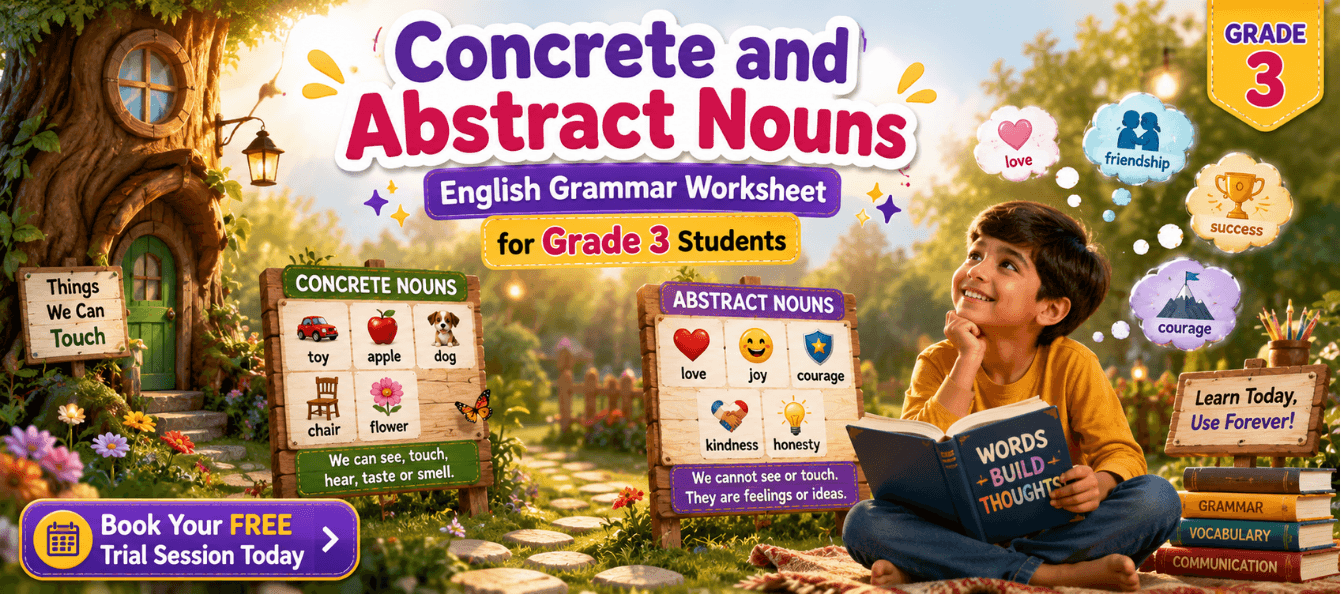
Concrete nouns are words used for things that we can see, touch, hear, taste, or smell. These nouns describe real objects around us. Examples given in the worksheet include toy, apple, dog, chair, and flower.
Example:
I have a toy in my bag.
The dog is barking.
Abstract nouns are words used for feelings, ideas, emotions, or qualities that cannot be seen or touched physically. Examples given in the worksheet include love, joy, fear, kindness, and honesty.
Example:
I feel happy today.
Her kindness made me smile.
In this Grade 3 English grammar worksheet, students learn how to identify and classify nouns into concrete nouns and abstract nouns using different activities and exercises.
What’s in This Worksheet?
1. Definitions and examples of concrete nouns and abstract nouns.
2. A sorting exercise where students place nouns into abstract and concrete categories.
3. Sentence formation activities using given nouns.
4. A picture and identification activity where students decide whether words can be drawn or are abstract nouns.
5. Circle-the-correct-answer exercises to identify abstract nouns from groups of words.
6. Simple and engaging grammar practice suitable for Grade 3 students.
7. Exercises arranged in a step-by-step format to help students understand the topic clearly.
8. Activities that improve grammar understanding, sentence writing, vocabulary, and noun identification skills.
Definitions, Examples, Techniques, and Tips
Definition of Concrete Nouns
A Concrete Noun is something you can see, touch, hear, taste, or smell. It’s real and you can point to it.
Examples:
toy
apple
dog
chair
flower
Definition of Abstract Nouns
An Abstract Noun is something you cannot see or touch. It is a feeling, idea, or quality.
Examples:
love
joy
fear
kindness
honesty
Examples From the Worksheet
Concrete noun examples:
toy
chair
book
apple
car
phone
desk
tiger
Abstract noun examples:
love
joy
fear
kindness
honesty
courage
trust
pride
Techniques to Identify Concrete and Abstract Nouns
1. Ask yourself whether the noun can be touched or seen physically.
2. If you can draw or physically point to the noun, it is usually a concrete noun.
3. If the noun describes a feeling, quality, or emotion, it is an abstract noun.
4. Practice sentence writing regularly to understand noun usage better.
Quick Learning Tips
1. Concrete nouns are physical things.
2. Abstract nouns are feelings or ideas.
3. Read each word carefully before identifying the noun type.
4. Use examples from daily life for easier understanding.
Why Is It Important to Learn This?
Learning concrete and abstract nouns helps students build stronger grammar skills. It improves vocabulary and helps children express ideas more clearly in speaking and writing. Understanding noun types also helps students create meaningful sentences and improve comprehension abilities.
For Grade 3 students, this topic is important because it forms the foundation for advanced grammar concepts in higher classes. It also helps students identify emotions, ideas, and real objects correctly while reading stories or writing answers.
Where Will This Knowledge Help You?
1. In school grammar exams and class tests.
2. During sentence writing and paragraph writing activities.
3. While reading English stories and comprehension passages.
4. In classroom discussions and speaking activities.
5. In identifying noun types correctly during grammar exercises.
6. In improving vocabulary and communication skills.
How to Use This Worksheet?
1. Read the definitions and examples of concrete nouns and abstract nouns carefully.
2. Attempt every exercise independently before checking the answers.
3. Follow the exact worksheet order while solving the exercises.
4. Compare your answers carefully with the complete answer key.
5. Correct mistakes and understand why each noun is concrete or abstract.
6. Practice sentence formation regularly to improve grammar skills.
7. Revise difficult words multiple times for better understanding.
Important Tips and Tricks
1. Concrete nouns can usually be seen, touched, or drawn.
2. Abstract nouns describe feelings, emotions, ideas, or qualities.
3. Read all options carefully before circling the correct answer.
4. While writing sentences, make sure the noun fits naturally in the sentence.
5. Avoid confusing feelings with physical objects.
6. Practice identifying nouns from daily conversations and books.
7. In exams, check whether the noun is physical or emotional before answering.
8. Write neat and complete sentences for better marks.
Complete Answer Key
Exercise 1
ABSTRACT
love
joy
fear
anger
happiness
freedom
kindness
honesty
dream
idea
respect
courage
anger
trust
laughter
bravery
sadness
music
pride
CONCRETE
chair
book
pencil
school
clock
ball
table
box
apple
car
phone
cloud
soap
desk
bottle
spoon
eraser
tiger
Exercise 2
1. Gift – The little girl opened her gift. – Concrete noun
2. Mountain – We climbed the tall mountain. – Concrete noun
3. Happiness – Happiness filled the classroom. – Abstract noun
4. Door – The door was painted blue. – Concrete noun
5. Fear – Fear stopped him from entering the room. – Abstract noun
6. Book – I read a book before sleeping. – Concrete noun
7. Pride – She felt pride after winning the race. – Abstract noun
8. Laugh – Her laugh made everyone smile. – Abstract noun
Exercise 3
honesty – abstract noun
pencil – Draw a pencil
chair – Draw a chair
book – Draw a book
courage – abstract noun
pride – abstract noun
fear – abstract noun
apple – Draw an apple
dream – abstract noun
Exercise 4
1. table, joy, apple
Circle: joy
2. fear, clock, bottle
Circle: fear
3. school, chair, pride
Circle: pride
4. mouse, desk, kindness
Circle: kindness
5. spoon, anger, cat
Circle: anger
6. truth, lamp, radio
Circle: truth
7. shelf, friendship, pen
Circle: friendship
8. cloud, bravery, phone
Circle: bravery
This Grade 3 Concrete and Abstract Nouns Activity Sheet is a wonderful way for young learners to practice noun identification and sentence formation skills. By solving these engaging exercises regularly, students can improve their grammar understanding and become more confident in English communication. Continued practice with this English grammar worksheet will help students strengthen their vocabulary, writing, and reading skills step by step.