
Class 3 Declarative Sentences English Grammar Activities
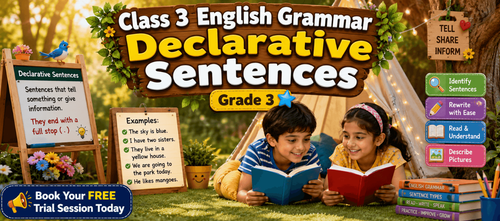

Class 3 English Grammar Worksheet on Declarative Sentences
Declarative sentences help us tell something clearly and confidently. We use declarative sentences every day when we share information, talk about things around us, or describe what we see. This Class 3 English grammar worksheet on Declarative Sentences helps students understand how simple statements work in daily communication. Through fun activities like sorting exercises, sentence rewriting, underlining activities, and picture description tasks, students get many chances to practice declarative sentences in an enjoyable way.
This worksheet is designed in a simple and engaging format so that Grade 3 students can easily identify sentences that tell or share information. Students also learn how declarative sentences are different from questions, commands, and exclamations. By solving these activities carefully, children can improve grammar skills, sentence formation, reading, and writing confidence.
Download these English grammar worksheets and practice regularly to strengthen your language skills and build a strong foundation. You can also book a free trial to get expert guidance and improve your reading, writing, and comprehension abilities. The worksheets are designed in a simple and structured way to help K–8 students learn grammar concepts easily and use them confidently in everyday communication.
What Is Declarative Sentences?
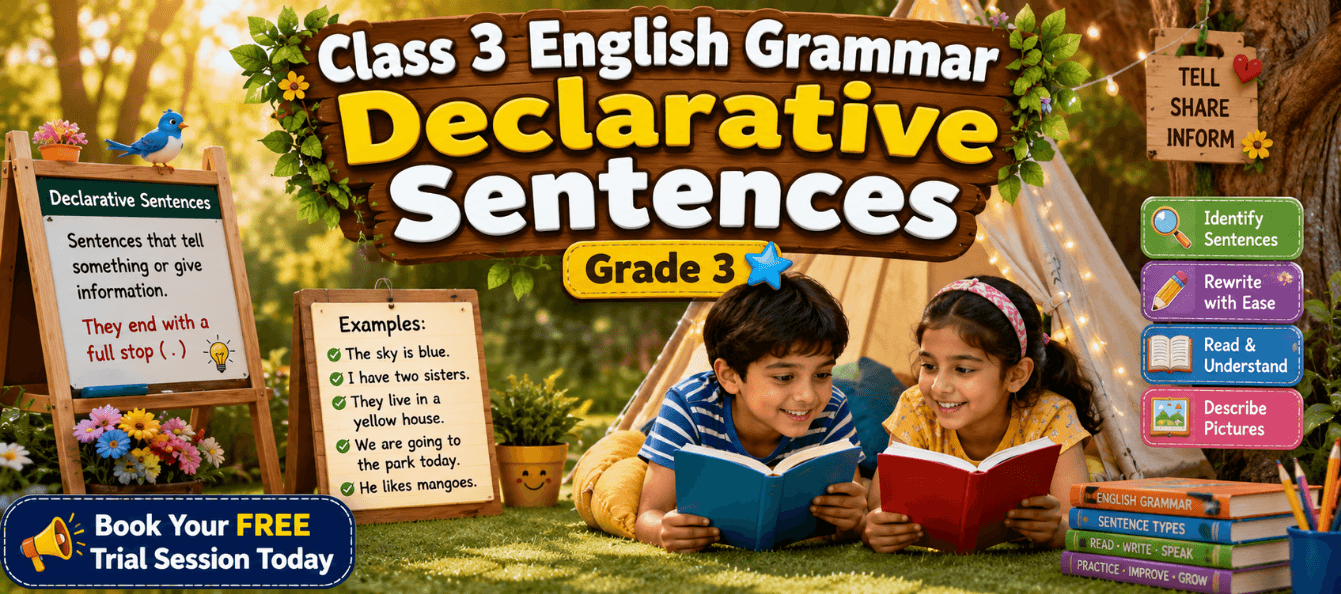
Declarative sentences are sentences that tell something or give information. They are simple statements that help us share facts, ideas, or information with others. These sentences always end with a full stop (.).
In this Grade 3 English grammar worksheet, students learn how to identify declarative sentences and how to change other kinds of sentences into declarative sentences. The worksheet also helps students understand how statements are used in daily life.
Examples from the worksheet:
The sky is blue.
I have two sisters.
Students are expected to:
• Identify declarative and non-declarative sentences
• Read and understand statements
• Rewrite sentences correctly
• Practice sentence formation
• Observe pictures and write information sentences
What’s in This Worksheet?
1. Declarative and Not Declarative Identification
Students read sentences carefully and decide whether the sentence is declarative or not declarative.
2. Information Sentence Sorting
Students identify sentences that tell or share information from a mixed group of sentences.
3. Story Reading and Sentence Identification
Students read short stories and underline sentences that tell or share information.
4. Sentence Rewriting Activity
Students rewrite questions, commands, and exclamatory sentences into declarative sentences.
5. Picture Description Activity
Students observe a playground picture and write five declarative sentences about it.
6. Grammar Skill Practice
The worksheet improves sentence recognition, reading skills, sentence writing, and understanding of punctuation.
7. Exam Preparation Support
The exercises help students practice important grammar concepts commonly asked in school assignments and grammar tests.
Definitions, Examples, Techniques, and Tips
Definition:
Declarative sentences are used when we tell something or give information.
Important Features:
• They are simple, everyday statements.
• They always end with a full stop (.).
• They help us say what we know or believe.
Examples:
The sky is blue.
I have two sisters.
They live in a yellow house.
We are going to the park today.
He likes mangoes.
Techniques:
• Read the sentence carefully.
• Check whether the sentence shares information.
• Look for a full stop at the end.
• Questions and commands are not declarative sentences.
Quick Learning Tips:
• Declarative sentences sound calm and clear.
• They give facts or information.
• They are easy to identify because they state something directly.
• Practice reading aloud to understand sentence types better.
Why Is It Important to Learn This?
Learning declarative sentences is important because they are used in everyday speaking and writing. Students use declarative sentences while answering questions, describing pictures, writing stories, and sharing information in class.
This topic also helps students:
• Improve sentence formation
• Build better grammar understanding
• Write clearly and correctly
• Speak confidently
• Understand punctuation rules
Declarative sentences are one of the most common sentence types in English grammar, so practicing them regularly helps students become stronger communicators.
Where Will This Knowledge Help You?
Students can use declarative sentences in many places, such as:
• School grammar exams
• Classroom activities
• Picture composition tasks
• Story writing
• Daily conversation
• Reading comprehension
• Homework assignments
• Speaking activities
Understanding declarative sentences also helps students identify other sentence types more easily.
How to Use This Worksheet?
1. Read Every Sentence Carefully
Understand whether the sentence tells something, asks something, gives a command, or shows strong feeling.
2. Attempt the Exercises Independently
Try solving each exercise without help first to improve confidence and grammar understanding.
3. Follow the Exact Question Order
The solutions follow the exact worksheet order, so students should compare answers carefully.
4. Review the Answers Properly
Check punctuation, sentence structure, and meaning while reviewing answers.
5. Correct Mistakes Carefully
If any answer is incorrect, rewrite it properly and practice again.
6. Practice Regularly
Regular grammar practice improves reading, writing, and speaking skills.
Important Tips and Tricks
1. Declarative sentences always give information or tell something.
2. Always check for a full stop at the end of the sentence.
3. Questions usually end with a question mark (?) and are not declarative.
4. Commands tell someone what to do and are not declarative.
5. Exclamatory sentences show strong feelings and are not declarative.
6. Read the complete sentence before deciding the answer.
7. While rewriting sentences, make sure the new sentence tells information clearly.
8. During picture description activities, write clear and meaningful declarative sentences.
9. Keep your grammar neat and punctuation correct to score full marks.
10. Practice sentence rewriting activities regularly for better understanding.
Complete Answer Key
Exercise 1
1. Please pass me the notebook. – Not Declarative
2. Where is my water bottle? – Not Declarative
3. They live in a yellow house. – Declarative
4. We are going to the park today. – Declarative
5. How beautiful the rainbow is! – Not Declarative
6. What time is your class? – Not Declarative
7. He likes mangoes. – Declarative
8. My sister has a pet cat. – Declarative
9. Close the window now. – Not Declarative
10. The sun rises in the east. – Declarative
Exercise 2
1. She reads a book before bedtime.
2. The birds are singing in the tree.
3. We play cricket every evening.
4. My father drives a red car.
5. Our teacher is very kind.
Exercise 3
1. It was sports day at school.
Children wore their white uniforms.
Everyone ran fast and clapped for the winners.
2.Amit went to the zoo with his father.
They saw lions and monkeys.
They had a fun day.
Exercise 4
1. You can close the door.
2. You water the plants.
3. That building is very tall.
4. Your school bag is on the table.
5. You should clean your room now.
6. She finished her homework.
7. That is a beautiful flower.
8. You should stop making noise.
9. We can go to the playground.
10. You should not touch the stove.
Exercise 5
1. The children are playing in the playground.
2. Two children are sitting on the swing.
3. A girl is sliding down the slide.
4. The children look happy.
5. A boy is standing near the playground equipment.
This Class 3 English grammar worksheet on Declarative Sentences is a great way to build strong grammar basics through fun and engaging activities. By practicing sentence identification, rewriting tasks, and picture description exercises, students can become more confident in writing and speaking English correctly. Regular practice with declarative sentences will help students improve communication skills and perform better in school grammar activities.