
Class 4 Countable & Uncountable Nouns Worksheet
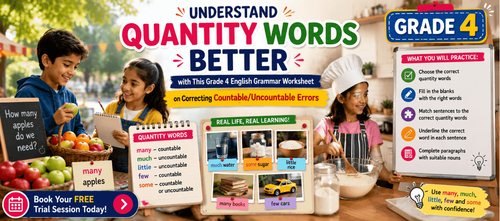

Understand Quantity Words Better with This Grade 4 English Grammar Worksheet on Correcting Countable/Uncountable Errors
Countable and uncountable nouns help us talk about quantity correctly. Some nouns can be counted, such as apples, books, and chairs, while others are measured, such as water, rice, and sugar. In this Grade 4 English grammar worksheet on Correcting Countable/Uncountable Errors, students practice choosing the correct quantity words, filling in blanks, matching sentences, underlining the correct word, and completing a paragraph.
This English grammar worksheet is specially designed for Grade 4 students to strengthen their understanding of countable and uncountable nouns. Through structured and engaging exercises, learners can improve their grammar skills and use words like many, much, little, few, and some accurately in writing and speaking.
Download these English grammar worksheets and practice regularly to strengthen your language skills and build a strong foundation. You can also book a free trial to get expert guidance and improve your reading, writing, and comprehension abilities. The worksheets are designed in a simple and structured way to help K–8 students learn grammar concepts easily and use them confidently in everyday communication.
What Is Correcting Countable/Uncountable Errors?
Correcting countable and uncountable errors means identifying and fixing mistakes in the words used to describe quantities.
In this Grade 4 English grammar worksheet, students learn to:
- Choose the correct countable and uncountable words to complete sentences
- Fill in blanks with suitable quantity words
- Match sentences to the correct quantity words
- Underline the correct countable/uncountable word in each sentence
- Complete a paragraph using suitable countable or uncountable nouns
The goal is to help students use words such as many, much, little, few, and some correctly.
What’s in This Worksheet?
1. Multiple choice questions to choose the correct countable and uncountable words.
2. Fill in the blanks using the correct words from each pair.
3. Match each sentence to the correct countable and uncountable words from the right.
4. Underline the correct countable/uncountable word in each sentence.
5. Paragraph completion with suitable countable or uncountable nouns.
6. Practice with many, much, little, few, and some.
7. Structured exercises that support school exam preparation.
Definitions, Examples, Techniques, and Tips
Definitions
Countable nouns can be counted, and uncountable nouns are measured rather than counted.
Examples from the worksheet:
- many butterflies
- little juice
- much dust
- many books
- some sugar
Examples
The worksheet includes both countable and uncountable nouns:
- apples
- homework
- flour
- cookies
- cars
- honey
Techniques
- Read the noun carefully.
- Decide whether it can be counted.
- Use many and few with countable nouns.
- Use much and little with uncountable nouns.
- Use some when asking for or offering something.
Quick Learning Tips
- Use many with books, apples, and cars.
- Use much with homework, sugar, and juice.
- Use few with countable nouns.
- Use little with uncountable nouns.
- Use some with nouns like sugar and bread.
Why Is It Important to Learn This?
Countable and uncountable nouns help students express quantities correctly. Learning to correct these errors improves grammar, sentence structure, and writing accuracy.
Students use these quantity words in:
- Grammar worksheets
- Story writing
- Reading comprehension
- Classroom discussions
- School exams
Strong quantity-word skills help students communicate more clearly and confidently.
Where Will This Knowledge Help You?
Students will use countable and uncountable nouns in many practical situations:
- Describing food and objects
- Writing complete sentences
- Completing grammar exercises
- Answering test questions
- Reading stories
- Participating in class discussions
Using the correct quantity words makes writing natural and accurate.
How to Use This Worksheet?
1. Attempt each exercise independently.
2. Read every sentence carefully.
3. Identify whether the noun is countable or uncountable.
4. Choose the quantity word that fits best.
5. Compare your answers with the complete answer key.
6. Follow the exact worksheet order while checking solutions.
7. Practice regularly to improve accuracy.
Important Tips and Tricks
1. Use many with countable nouns such as apples and books.
2. Use much with uncountable nouns such as sugar and homework.
3. Use few for small numbers of countable nouns.
4. Use little for small amounts of uncountable nouns.
5. Use some when asking for or referring to an unspecified amount.
6. In paragraph completion tasks, choose words that match the noun type.
7. Practice often to build confidence and accuracy.
Complete Answer Key
Exercise No. 1
Choose the correct countable and uncountable words to complete each sentence.
1. (b) many
2. (a) little
3. (a) many
4. (c) little
5. (b) many
6. (a) much
7. (c) many
8. (c) little
9. (b) many
10. (a) much
Exercise No. 2
Fill in the blanks with the correct countable and uncountable words from each pair.
1. many
2. little
3. many
4. much
5. some
6. few
7. much
8. many
9. much
10. many
Exercise No. 3
Match each sentence to the correct countable and uncountable words from the right.
1. little
2. many
3. little
4. few
5. much
6. many
7. much
8. several
9. few
10. many
Exercise No. 4
Underline the correct countable/uncountable word in each sentence.
1. few
2. much
3. few
4. little
5. many
6. many
7. much
8. many
9. little
10. many
Exercise No. 5
Fill the blanks in the paragraph given below with suitable countable or uncountable nouns.
1. many
2. much
3. much
4. few
5. some
6. much
7. many
8. few
9. little
10. much
Answers may vary.
This Grade 4 English grammar worksheet on Correcting Countable/Uncountable Errors gives students meaningful practice in choosing the correct quantity words for different kinds of nouns. By completing each exercise and reviewing the answers carefully, learners can use many, much, little, few, and some with greater confidence and accuracy in all their writing and speaking tasks.