
Class 5 Comma with Nonessential Clause: Grammar Worksheet Practice
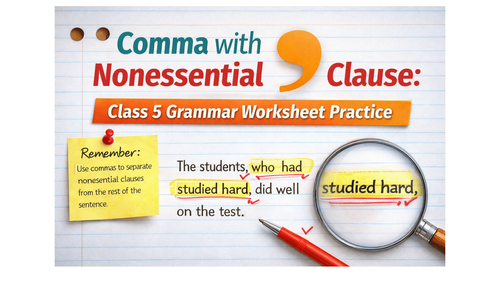

Learning punctuation can sometimes feel tricky, but it becomes much easier with practice. This English grammar worksheet for Grade 5 focuses on the topic “Comma with Nonessential Clause.” Through engaging questions and activities, students learn how commas can be used to add extra information to sentences. When learners practice identifying and adding commas correctly, they strengthen their grammar skills and improve their writing clarity.
What Is the Comma With Nonessential Clause?
A comma with a nonessential clause is used when extra information is added to a sentence. The added words give more details about a person, place, animal, or thing, but the sentence can still make sense even if that extra part is removed. In this Grade 5 grammar topic, students learn how commas help separate the extra information from the main sentence.
In this English grammar worksheet, the focus is on sentences where a clause gives additional details about something. The extra information is placed between commas so that readers can easily understand that it is not necessary for the main meaning of the sentence. By practicing this rule, students learn how commas can make sentences clearer and easier to read.
Students are expected to recognize sentences with correct comma placement, identify whether commas are used properly, and practice adding commas where needed. This helps them understand how punctuation changes the structure and clarity of a sentence.
What’s In This Worksheet?
This Grade 5 English grammar worksheet includes a variety of exercises designed to help students practice comma usage with nonessential clauses.
1. Multiple Choice Questions
Students read sentences and choose the option that shows the correct comma placement for a nonessential clause.
2. True and False
Students read sentences and decide whether the comma with the nonessential clause has been used correctly.
3. Fill in the Blanks
Students complete sentences by inserting commas in the correct places to mark nonessential clauses.
4. Sentence Rewriting
Students replace one word in the sentence using a suitable word from the word box to correct the sentence.
5. Paragraph Writing Activity
Students read a short passage and fill in the blanks with suitable words related to comma usage with nonessential clauses.
These exercises help learners recognize correct punctuation patterns and practice applying the rule in different sentence structures. The worksheet structure allows students to gradually build confidence with commas.
Definitions, Examples, Techniques, and Tips
Definition
A nonessential clause gives extra information about the subject in a sentence. This extra information is separated by commas.
Example From the Worksheet
Riya, who runs daily, won the race.
In this example, “who runs daily” gives extra information about Riya. The sentence still makes sense without this clause.
Another Example
The bus, which arrives daily, was late.
Here, the clause “which arrives daily” adds extra information about the bus.
Technique Students Practice
Students identify the extra information that appears in the middle of the sentence. Once they recognize the additional clause, they place commas before and after it.
Learning Tip
If the extra information can be removed and the sentence still makes sense, commas are used to separate that clause from the rest of the sentence.
Another Worksheet Example
Meera, who loves books, reads often.
The clause “who loves books” adds extra information about Meera.
Why Is It Important to Learn This?
Understanding commas with nonessential clauses helps students write clearer sentences. Punctuation helps readers understand which parts of a sentence are important and which parts simply add more details.
When students learn this concept in Grade 5 English grammar, they begin to see how punctuation organizes ideas. Correct comma usage also helps students avoid confusing sentence structures.
This skill is important for writing paragraphs, stories, and answers in school assignments. When commas are used correctly, sentences become easier to read and understand.
Where Will This Knowledge Help You?
Learning how to use commas with nonessential clauses helps students in many school situations.
Examinations
Students often answer grammar questions that test punctuation rules. Knowing how to use commas correctly helps them score better.
Writing Tasks
Students writing essays, stories, or paragraphs need to include descriptive information. Nonessential clauses help add these details.
Class Participation
During grammar lessons, students can confidently identify sentences with correct punctuation.
Daily Language Practice
Understanding punctuation improves both reading and writing skills.
How to Use This Worksheet?
1. Attempt the worksheet independently first
Students should read each sentence carefully and try to answer the questions on their own.
2. Review the answers carefully
After completing the worksheet, students should compare their responses with the answer key.
3. Correct mistakes
If any answers are incorrect, students should rewrite the sentence and understand the correct comma placement.
4. Practice regularly
Grammar improves with regular practice. Revisiting similar sentences helps students remember punctuation rules.
The solutions in the answer key follow the exact order of the worksheet questions. Students should carefully compare their responses with the listed answers.
Important Tips and Tricks
1. Look for extra information
If a clause only gives additional details and the sentence still works without it, it should be separated by commas.
2. Check both sides of the clause
A nonessential clause placed in the middle of a sentence usually needs a comma before and after it.
3. Read the sentence aloud
Reading the sentence slowly helps students notice where a pause naturally occurs.
4. Watch common mistakes
Sometimes students forget to add the second comma after the extra clause.
5. Follow instructions carefully
Some questions require selecting the correct sentence, while others require adding commas.
Complete Answer Key
Exercise No. 1
Choose the sentence with correct commas for a nonessential clause.
1. b) who runs daily won the race easily.
2. b) who lives in Delhi, plays well.
3. c) who likes stories, loves reading.
4. b) who teaches English, praised us.
5. a) Which comes daily, arrived late.
6. b) which is nearby, is very clean.
7. a) which opened today, sells sweets.
8. c) which chased cats, barked loudly.
9. a) which runs near town, flows fast.
10. b) who trained hard, scored twice.
Exercise No. 2
Write True or False: Each sentence uses a comma with a nonessential clause correctly.
1. True
2. True
3. False
4. False
5. False
6. False
7. False
8. True
9. True
10. True
Exercise No. 3
Fill each blank with commas to mark a nonessential clause.
1. Riya, who runs daily, won the race.
2. The teacher, who teaches English, smiled.
3. The bus, which arrives daily, was late.
4. Meera, who loves books, reads often.
5. The shop, which opened today, sells sweets.
6. The park, which is nearby, looks clean.
7. The dog, which chased cats, barked loudly.
8. The river, which runs here, flows fast.
9. The player, who trained hard, scored twice.
10. The guide, who helped us, spoke kindly.
Exercise No. 4
Replace one word using a word from the box to correct the sentences.
1. The teacher who teaches English smiled.
2. The dog that chased cats barked loudly.
3. Riya, who runs daily, won the race.
4. The shop that opened today sells sweets.
5. The river that runs here flows fast.
6. The player who trained hard scored twice.
7. The guide who helped us spoke kindly.
8. The park, which is nearby, looks clean.
9. The bus, which arrives daily, was late.
10. Meera, who loves books, reads often.
Exercise No. 5
In class, the teacher explained how commas help add extra information to a sentence. She wrote an example on the board: Riya, who loves reading, visits the library every afternoon after school. The teacher explained that the words between the commas give extra information about Riya. Ravi then read another example aloud: The park, which is near our school, looks beautiful in the spring. The class discussed how these clauses can be removed, and the sentence still makes sense. Students practiced adding commas correctly to mark nonessential clauses in similar sentences.
Learning grammar becomes easier when students practice regularly with structured exercises. This Grade 5 English grammar worksheet on comma with nonessential clause helps learners understand how commas add clarity and extra details to sentences. By practicing these exercises and reviewing the answers carefully, students can build stronger writing skills and gain confidence in using punctuation correctly.