
Class 6 Contextual Antonyms in Sentences Worksheet PDF

Grade 6 English Grammar Worksheet – Contextual Antonyms in Sentences with Practice Exercises and Answer Key
Learning grammar becomes more interesting when you explore how words change meaning based on context. In this English grammar worksheet for Grade 6, students practice understanding contextual antonyms in sentences. Instead of simply memorizing opposite words, this worksheet helps learners identify antonyms based on how words are used in real sentences.
The worksheet on Contextual Antonyms in Sentences includes engaging exercises that encourage students to think carefully about meaning, context, and word relationships. From identifying correct and incorrect antonyms to choosing the right opposite word in a sentence, each activity helps build strong grammar skills step by step.
Download these English grammar worksheets and practice regularly to strengthen your language skills and build a strong foundation. You can also book a free trial to get expert guidance and improve your reading, writing, and comprehension abilities. The worksheets are designed in a simple and structured way to help K–8 students learn grammar concepts easily and use them confidently in everyday communication.
What Is the Topic?
Contextual Antonyms in Sentences is the main focus of this worksheet. Antonyms are words that have opposite meanings, but in this worksheet, students learn how to choose antonyms based on the context of a sentence. This means that the opposite word must fit the meaning of the sentence correctly.
In this Grade 6 English grammar worksheet, students read sentences carefully and identify whether words are true opposites or not. They also learn how to choose the correct antonym from given options and use antonyms to form meaningful sentences.
What’s in This Worksheet?
1. True or False questions where students check if the given words in sentences are correct antonyms.
2. Sort the Words activity where students classify word pairs into antonyms and not antonyms.
3. Fill in the Blanks where students choose the correct antonym based on sentence context.
4. Multiple Choice Questions where students select the best antonym for each sentence.
5. Sentence Rewriting task where students write sentences using antonyms.
These exercises help students understand antonyms in different contexts and improve their ability to use correct words in sentences. The worksheet is designed to support both practice and exam preparation.
Definitions, Examples, Techniques, and Tips
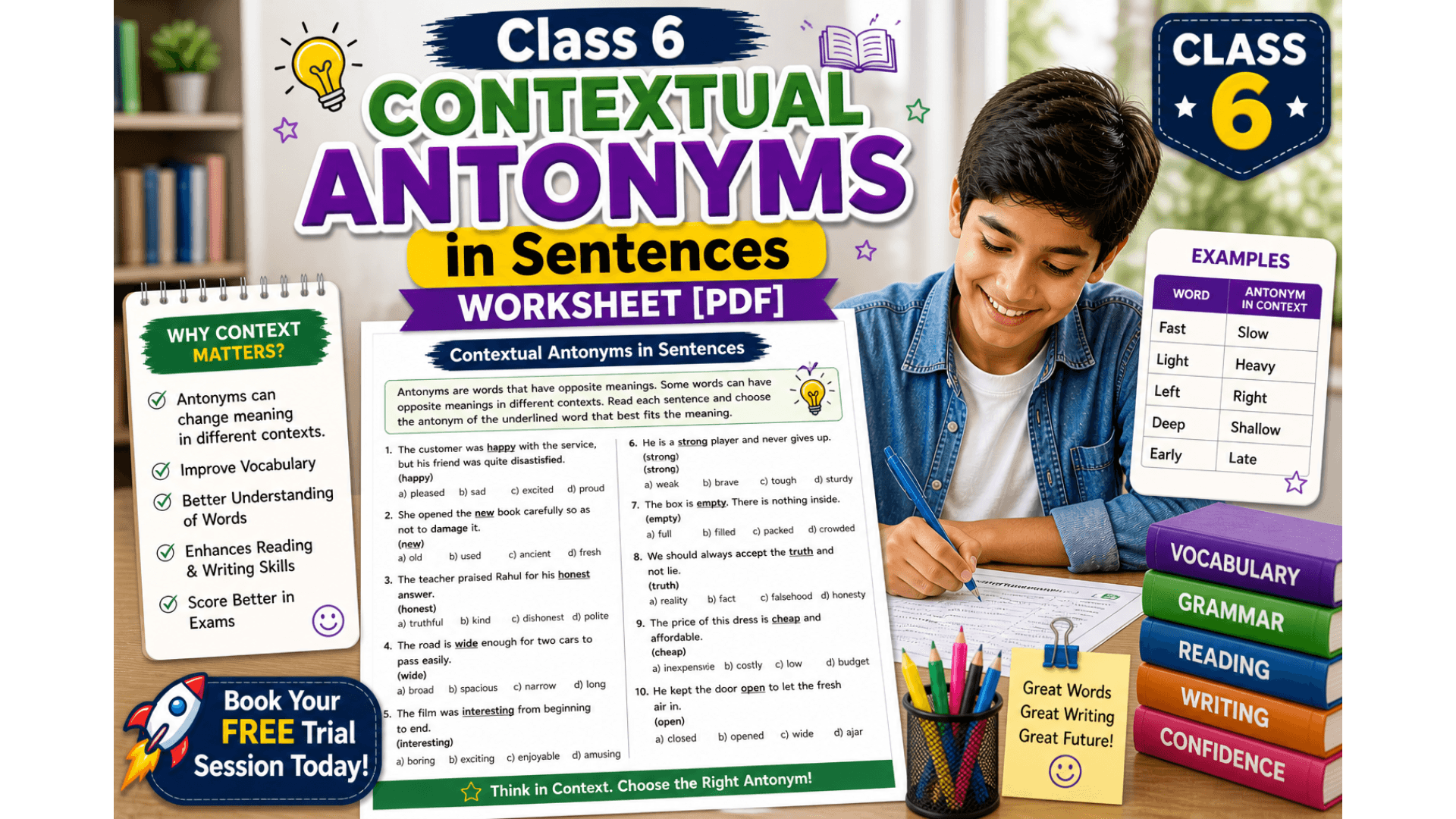
Antonyms are words that have opposite meanings. In this worksheet, students practice identifying antonyms such as huge and tiny, strong and weak, empty and full, early and late, and light and heavy.
Examples from the worksheet include:
- The box was huge, but the toy inside was tiny.
- The glass was empty, not full.
- She reached early, but her brother came late.
Techniques used in the worksheet:
- Reading the sentence carefully to understand the meaning
- Identifying opposite words within the sentence
- Choosing the correct antonym from given options
- Sorting word pairs based on their relationship
Quick learning tips:
- Focus on the meaning of the sentence
- Look for contrast words like but and not
- Choose the antonym that best fits the sentence context
Why Is It Important to Learn This?
Learning contextual antonyms helps students understand how words work in sentences. It improves vocabulary and helps students choose the correct words while writing and speaking.
This topic strengthens grammar skills by teaching students how meaning changes with context. It is important for understanding passages, answering grammar questions, and expressing ideas clearly.
Where Will This Knowledge Help You?
This knowledge is useful in:
- Exams where students need to identify correct word meanings
- Writing tasks where correct word choice is important
- Class discussions and reading comprehension
- Understanding texts more clearly
Knowing contextual antonyms helps students become confident and accurate in using English.
How to Use This Worksheet?
1. Attempt all questions independently before checking answers.
2. Read each sentence carefully and understand the context.
3. Identify the correct antonym based on meaning.
4. Review your answers after completing the worksheet.
5. Correct your mistakes and learn from them.
6. Practice regularly to improve your grammar skills.
The solutions follow the exact worksheet order, so students should compare their answers carefully with the given answers.
Important Tips and Tricks
1. Always read the full sentence before deciding the antonym.
2. Look for clues like but and not that indicate contrast.
3. Do not rely only on memorized antonyms; focus on context.
4. Choose the word that fits the meaning of the sentence.
5. In sorting activities, check if both words are true opposites.
6. In multiple-choice questions, eliminate incorrect options carefully.
7. For writing tasks, make sure the antonym fits naturally in the sentence.
8. Examiners expect correct usage based on context, not just word pairs.
Complete Answer Key
Exercise No. 1
Choose T if the statements are correct, and F if they are not.
1. T
2. T
3. T
4. T
5. F
6. T
7. F
8. T
9. T
10. T
Exercise No. 2
Sort the following word pairs into Antonyms and Not Antonyms.
Antonyms
accept/refuse
increase/reduce
whisper/shout
dangerous/safe
arrive/depart
borrow/lend
expand/shrink
victory/defeat
light/heavy
forward/backward
kind/cruel
success/failure
Not antonyms
create/build
repair/fix
allow/permit
Exercise No. 3
Choose the correct antonym from the options to complete each sentence based on context.
1. hot
2. wide
3. correct
4. full
5. strong
6. heavy
7. bright
8. difficult
9. quiet
10. long
Exercise No. 4
Choose the correct antonym that best fits the sentence.
1. quiet
2. wide
3. correct
4. full
5. heavy
6. long
7. bright
8. hard
9. noisy
10. short
Exercise No. 5
Write one sentence using the antonym of each given word.
1. The classroom was quiet during the test.
2. The glass was full of water.
3. The man is strong and healthy.
4. The sky looked bright in the morning.
5. The story was long and interesting.
6. The bag felt heavy to carry.
7. The question was difficult to solve.
8. The child was noisy in class.
9. The road is wide and clear.
10. She arrived late to the meeting.
Practicing this English grammar worksheet for Grade 6 on Contextual Antonyms in Sentences will help you improve your understanding of opposite words and how they are used in real sentences. Keep practicing regularly, and you will become more confident in your grammar skills and communication.