
Direct Speech Statements Worksheet for Class 6 [Free PDF]
![Direct Speech Statements Worksheet for Class 6 [Free PDF]](https://cdn5.planetspark.in/media/small_1_6679639b0d.png)

English grammar worksheet for Grade 6: Direct Speech (Statements)
Understanding direct speech is essential for effective communication. For Grade 6 students, mastering direct speech (statements) helps them report what others say accurately and confidently. This worksheet covers all the key aspects of direct speech, from identifying the correct usage to rewriting sentences and practicing through fill-in-the-blanks. The activities will engage students and help them grasp how punctuation and sentence structure change in reported speech. These skills are essential for speaking and writing clearly, especially when reporting someone else's words.
Download these English grammar worksheets and practice regularly to strengthen your language skills and build a strong foundation. You can also book a free trial to get expert guidance and improve your reading, writing, and comprehension abilities. The worksheets are designed in a simple and structured way to help K–8 students learn grammar concepts easily and use them confidently in everyday communication.
What is the topic?
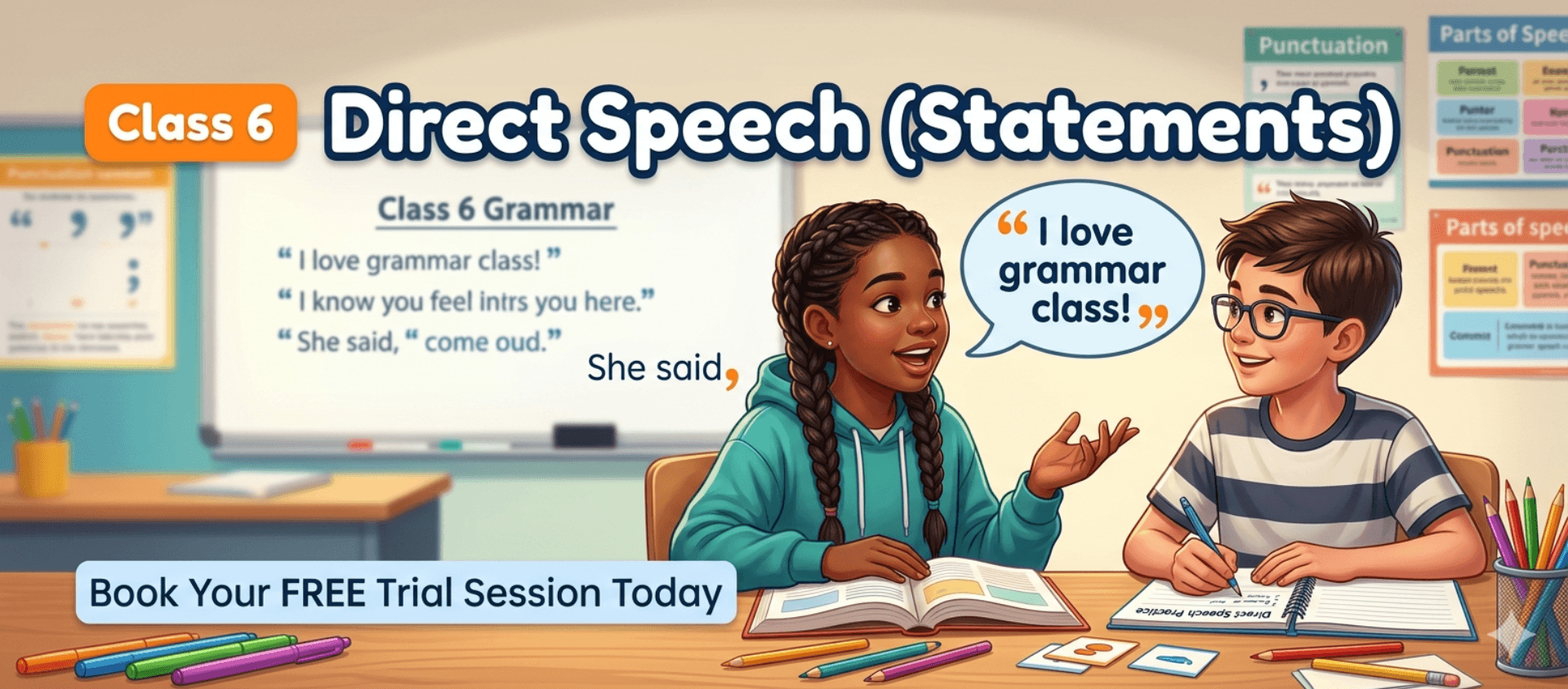
Direct speech is a method of reporting the exact words spoken by a person. It uses quotation marks to enclose the exact words spoken, often preceded by a reporting verb like “said.” This worksheet focuses on recognizing the use of direct speech in statements, understanding its punctuation, and practicing correct formats. Students will also learn to change direct speech to indirect speech and vice versa. By mastering this, students will be able to convey speech accurately and improve their writing skills.
What’s in this worksheet?
1. **Underline the Words:** Identify the reporting verb and quoted words.
2. **Multiple Choice Questions:** Choose the correct form of direct speech.
3. **Sentence Rewriting:** Convert direct speech to indirect speech.
4. **Fill in the Blanks:** Complete sentences by inserting direct speech correctly.
5. **Paragraph Writing:** Use direct speech in a short narrative.
Definitions, examples, techniques, and tips
**Direct Speech:** This is when we quote the exact words spoken by someone. It is usually written with quotation marks.
Example: She said, "I am learning."
- **Reporting Verb:** This is the verb used to attribute the speech to the speaker, such as "said," "asked," or "told."
- Example: Raj said, "I will go home."
- **Punctuation:** In direct speech, the exact words spoken are enclosed in quotation marks.
- Example: "It is a sunny day," she said.
- **Techniques:**
- Always ensure that the punctuation inside the quotation marks is correct (comma, question mark, etc.).
- Change pronouns in direct speech when converting to indirect speech (e.g., "I" becomes "she").
Why is it important to learn this?
Mastering direct speech helps students:
- Accurately report someone else’s words.
- Improve clarity in communication.
- Write stories, dialogues, and narratives with proper punctuation.
- Enhance grammar skills, which are essential for writing and speaking tasks.
Where will this knowledge help you?
Understanding direct speech helps in:
- **Exams:** When answering questions about reported speech or changing speech formats.
- **Writing tasks:** Especially for narrative or dialogue-based writing.
- **Class participation:** In discussions or when quoting someone’s words.
- **Everyday communication:** Knowing how to quote accurately helps in casual conversations.
How to use this worksheet?
1. **Attempt independently:** Try to fill in the blanks and rewrite sentences on your own.
2. **Review answers carefully:** After completing, go through your answers to check for mistakes.
3. **Correct mistakes:** Understand the errors and learn the right way to write direct speech.
4. **Practice regularly:** The more you practice, the easier it becomes to use direct speech correctly.
The solutions follow the exact worksheet order, so students should compare their answers carefully.
Important tips and tricks
1. **Pay attention to punctuation:** Direct speech always needs quotation marks and correct punctuation inside.
2. **Use reporting verbs properly:** Ensure you use appropriate verbs like "said" or "told."
3. **Mind the word order:** When changing direct to indirect speech, make sure the sentence structure is correct.
4. **Consistency is key:** Keep the tense and pronouns consistent when converting between direct and indirect speech.
Complete Answer Key
Exercise No. 1
Underline the reporting verb and quoted words:
1. Riya said, "I am ready."
2. Meera said, "I like mangoes."
3. The girl said, "I am tired today."
4. The student said, "I understand this."
5. Asha said, "I can swim well."
6. Ravi said, "I will play cricket."
7. The teacher said, "Complete your work."
8. The boy said, "I found a coin."
9. Raj said, "I have finished my work."
10. My friend said, "I will help you."
Exercise No. 2
Choose the correct direct speech sentence:
1. c) She said, "I am happy."
2. b) He said, "I am late."
3. a) They said, "We are ready."
4. b) She said, "I like tea."
5. b) He said, "I can swim."
Exercise No. 3
Rewrite each sentence as directed:
1. She said that she was tired.
2. They said that they were playing.
3. Riya said that she could swim.
4. He said that he was late.
5. Meera said that she was happy.
6. Raj said that he would go.
7. The girl said that she liked mangoes.
8. He said that he was ready.
9. The boy said that he had a pen.
10. She said that she had finished her work.
Exercise No. 4
Fill in the blanks:
1. Riya said, "I am excited for the school trip tomorrow."
2. Her friend said, "I will come with you."
3. The teacher said, "Bring your lunch boxes and water bottles."
4. All the students smiled happily and sat near the school bus.
5. Riya then said, "This will be a wonderful day for everyone."
6. They walked carefully and moved towards the playground before leaving.
7. The children said, "We will enjoy the trip a lot," and talked about the fun activities.
8. Everyone said, "We are ready now," and packed their bags neatly.
9. The excitement grew as they said, "This is going to be amazing."
Exercise No. 5
Write a short paragraph using direct speech:
Sample Answer:
Riya said, "I am so excited for our trip to the zoo tomorrow." Meera replied, "I can't wait to see the lions and tigers." The teacher said, "Make sure to bring your lunch and wear comfortable shoes." Later, Raj said, "I'll meet you all at the bus stop at 9 AM." Everyone agreed, saying, "We will be ready!" The excitement for the day was building, and the students couldn't wait for the adventure.
---
By regularly practicing with this English grammar worksheet on direct speech (statements), Grade 6 students can confidently use correct punctuation, reporting verbs, and speech formats in their writing and speaking. This will improve their grammar skills and boost their communication abilities.