
Class 6 Mixed Antonyms Review Worksheet with Answers
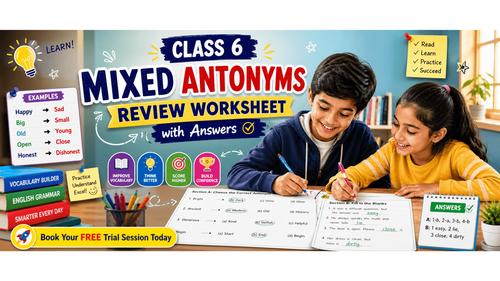

Grade 6 English Grammar Worksheet – Mixed Antonym Review with Practice Exercises and Answer Key
Learning grammar becomes more effective when students revise multiple concepts together. In this English grammar worksheet for Grade 6, students work on a mixed antonym review that covers different types of opposite words in various contexts. This helps learners strengthen their understanding and apply antonyms confidently in real-life situations.
The worksheet on Mixed Antonym Review includes engaging exercises that test students’ ability to identify, compare, and use antonyms correctly. From True or False to sentence rewriting, each activity builds strong grammar and vocabulary skills step by step.
Download these English grammar worksheets and practice regularly to strengthen your language skills and build a strong foundation. You can also book a free trial to get expert guidance and improve your reading, writing, and comprehension abilities. The worksheet is designed in a structured and student-friendly way to support Grade 6 learners.
What Is the Topic?
Mixed Antonym Review is the focus of this worksheet. Students revise different types of antonyms such as simple opposites (big/small), contextual antonyms (light/heavy), and logical opposites (open/closed).
In this worksheet, students learn to identify whether sentences correctly show opposites, sort word pairs, choose correct antonyms, and rewrite sentences using opposite words.
What’s in This Worksheet?
1. True or False questions where students check if opposite meanings are used correctly.
2. Sort the Words activity where students classify pairs into antonyms and not antonyms.
3. Fill in the Blanks where students choose correct antonyms based on context.
4. Multiple Choice Questions where students select the correct opposite word.
5. Sentence Rewriting activity where students replace words with antonyms.
These exercises help students revise and strengthen their understanding of antonyms in different contexts.
Definitions, Examples, Techniques, and Tips
Antonyms are words that have opposite meanings. In this worksheet, students work with examples such as wide/narrow, bright/dark, clean/dirty, strong/weak, and easy/difficult.
Examples from the worksheet include:
- The road is wide, not narrow.
- The water is cold, not hot.
- The answer is right, not wrong.
Students also learn incorrect usages such as:
- The glass is full and empty at the same time.
- The door is open and closed together.
Techniques used in the worksheet:
- Identifying correct and incorrect opposite meanings
- Understanding logical contradictions
- Choosing antonyms based on context
- Rewriting sentences correctly
Quick learning tips:
- Read each sentence carefully
- Check if the meaning is logical
- Choose antonyms that fit the context
Why Is It Important to Learn This?
Learning antonyms through mixed practice helps students revise and apply grammar concepts effectively. It improves vocabulary, comprehension, and sentence construction skills.
This topic is important because it prepares students for exams and helps them use language accurately in speaking and writing.
Where Will This Knowledge Help You?
This knowledge is useful in:
- Exams and grammar tests
- Writing and editing tasks
- Reading comprehension
- Everyday communication
Understanding antonyms helps students become confident and accurate in English.
How to Use This Worksheet?
1. Attempt all questions independently before checking answers.
2. Read each sentence carefully.
3. Identify whether the opposite meaning is correct.
4. Choose the correct antonym based on context.
5. Review your answers and correct mistakes.
6. Practice regularly for better results.
The solutions follow the exact worksheet order, so students should compare their answers carefully.
Important Tips and Tricks
1. Always check if the sentence makes logical sense.
2. Avoid contradictions like “full and empty together.”
3. Focus on context, not just word pairs.
4. Eliminate incorrect options in MCQs.
5. Practice rewriting sentences to improve clarity.
6. Understand both words before deciding.
7. Use context clues carefully.
8. Examiners expect accuracy and clarity.
Complete Answer Key
Exercise No. 1
Choose T if it shows the correct opposite meaning based on context, or F if it does not.
1. T
2. F
3. T
4. F
5. T
6. F
7. T
8. F
9. F
10. T
Exercise No. 2
Sort each word pair into Antonyms and Not Antonyms based on their meanings.
Antonyms
light/dark
clear/cloudy
sharp/blunt
happy/sad
right/left
fair/unfair
light/heavy
hard/soft
Not antonyms
match/same
bank/river
right/correct
fair/festival
present/gift
close/shut
early/soon
Exercise No. 3
Fill in the blanks with the correct antonym from the given options.
1. narrow
2. empty
3. clean
4. happy
5. easy
6. strong
7. long
8. cold
9. new
10. big
Exercise No. 4
Choose the correct antonym that best fits the sentence.
1. quiet
2. cold
3. curved
4. heavy
5. boring
6. poor
7. long
8. cold
9. new
10. big
Exercise No. 5
Rewrite each sentence by replacing the highlighted word with its correct antonym.
1. The library was very noisy.
2. The playground was dirty after the match.
3. The player was weak during the game.
4. The stars looked dark at night.
5. The road was curved near the village.
6. The sum was difficult for the students.
7. The classroom floor was dirty in the morning.
8. The athlete was weak in the competition.
9. The air felt warm in the evening.
10. The hall was noisy during the meeting.
Practicing this English grammar worksheet for Grade 6 on Mixed Antonym Review will help you revise and strengthen your understanding of opposite words in different contexts. Keep practicing regularly to improve your grammar and communication skills.