
Class 6 Verb Forms Worksheet for Principal and Auxiliary Verbs


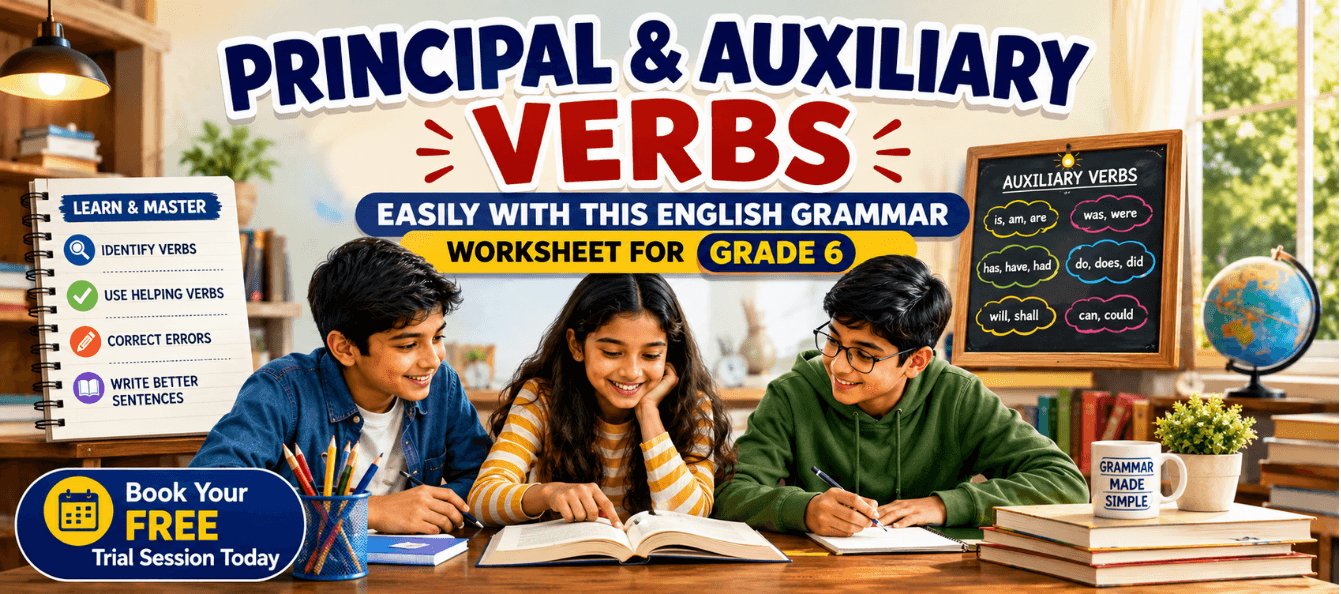
Verb Forms Easily with This English Grammar Worksheet for Grade 6 on Principal and Auxiliary Verbs
Learning verb forms becomes much easier when students practice with well-structured exercises. This English grammar worksheet for Grade 6 on Principal and Auxiliary Verbs helps students understand how verbs work in sentences and how auxiliary verbs support the main action words. Through activities like underlining verbs, filling in blanks, rewriting sentences, and sentence formation, students can improve their grammar skills step by step.
This worksheet gives Grade 6 students a chance to identify principal verbs and auxiliary verbs correctly, use suitable helping verbs in sentences, and correct common verb errors. Regular practice with such exercises helps students become more confident in writing and speaking English correctly.
Download these English grammar worksheets and practice regularly to strengthen your language skills and build a strong foundation. You can also book a free trial to get expert guidance and improve your reading, writing, and comprehension abilities. The worksheets are designed in a simple and structured way to help K–8 students learn grammar concepts easily and use them confidently in everyday communication.
What Is the Topic?
Principal and auxiliary verbs are important parts of English grammar. Principal verbs are the main action words in a sentence. They tell what the subject is doing. Auxiliary verbs help the main verb show tense, mood, or voice. They are used together with principal verbs to complete the meaning of a sentence.
This Grade 6 English grammar worksheet explains common auxiliary verbs such as:
is, am, are, was, were, has, have, had, do, does, did, will, shall, can, could.
Students learn how to:
• Identify principal verbs and auxiliary verbs
• Understand how helping verbs work
• Use correct verb forms in sentences
• Correct verb agreement errors
• Write sentences using verbs correctly
Examples from the worksheet include:
• She writes stories.
• They have finished their work.
What’s in This Worksheet?
1. Underlining and identifying verbs
Students underline the principal verb and circle the auxiliary verb in different sentences.
2. Categorising sentence types
Students identify whether the sentence contains:
• Only Main Verb
• Only Auxiliary Verb
• Main + Auxiliary Combo
3. Fill in the blanks
Students complete sentences using the correct verb forms such as:
is, am, are, was, were, have, has, had.
4. Sentence correction
Students identify incorrect verb forms and rewrite the sentences correctly.
5. Sentence formation
Students use given verbs as both:
• Main verbs
• Auxiliary verbs
6. Grammar practice for exams
The worksheet helps students strengthen grammar rules commonly tested in school exams and class assignments.
Definitions, Examples, Techniques, and Tips
Definition of Principal Verbs
Principal verbs are the main action words in a sentence. They show what the subject is doing.
Example:
• She writes stories.
Here, “writes” is the principal verb.
Definition of Auxiliary Verbs
Auxiliary verbs help the main verb show tense, mood, or voice.
Example:
• They have finished their work.
Here:
• “have” is the auxiliary verb
• “finished” is the principal verb
Common Auxiliary Verbs in the Worksheet
• is
• am
• are
• was
• were
• has
• have
• had
• do
• does
• did
• will
• shall
• can
• could
Techniques Students Learn
• Finding the action word in a sentence
• Identifying helping verbs
• Using correct subject-verb agreement
• Correcting incorrect verb forms
• Forming grammatically correct sentences
Quick Learning Tips
• Read the sentence carefully before choosing the verb.
• Check whether the subject is singular or plural.
• Identify whether the sentence needs a helping verb.
• Practice rewriting incorrect sentences correctly.
• Observe how auxiliary verbs support the principal verb.
Why Is It Important to Learn This?
Learning principal and auxiliary verbs is important because verbs are necessary for making complete sentences. Correct verb usage helps students communicate clearly in both speaking and writing.
This topic helps students:
• Write grammatically correct sentences
• Improve sentence structure
• Avoid common grammar mistakes
• Understand tense formation better
• Build confidence in English communication
Regular practice with verb forms also improves school performance and helps students answer grammar questions accurately during exams.
Where Will This Knowledge Help You?
Students can use this knowledge in many situations, such as:
• School grammar exams
• Writing paragraphs and essays
• Speaking confidently in class
• Completing English assignments
• Reading comprehension activities
• Everyday communication
Understanding verb forms also helps students write better sentences in creative writing and formal writing tasks.
How to Use This Worksheet?
1. Read every sentence carefully
Understand the subject and identify the action word before answering.
2. Attempt the worksheet independently
Try solving all questions without help first.
3. Follow the worksheet order carefully
The solutions follow the exact worksheet order, so compare answers step by step.
4. Check principal and auxiliary verbs properly
Underline the main verb and identify the helping verb correctly.
5. Correct mistakes carefully
Rewrite incorrect sentences using proper verb forms.
6. Practice regularly
Repeated practice improves grammar accuracy and confidence.
Important Tips and Tricks
1. Identify the subject first
Singular subjects usually take singular verbs, while plural subjects take plural verbs.
2. Watch helping verbs carefully
Words like “is,” “am,” “are,” “has,” and “have” often act as auxiliary verbs.
3. Do not confuse main verbs and helping verbs
The principal verb shows the action, while the auxiliary verb supports it.
4. Check tense consistency
Use verbs that match the time of the action.
5. Read rewritten sentences aloud
This helps students identify grammar mistakes easily.
6. Practice sentence correction regularly
Correcting wrong verb forms improves grammar understanding.
7. Focus on sentence structure
Understand how auxiliary verbs combine with principal verbs in different sentences.
Complete Answer Key
Exercise 1
Underline the principal verb and circle the auxiliary verb in each sentence.
1. My brother (is) __learning__ how to ride a bicycle.
2. She (has) __painted__ a picture of the mountains.
3. I (am) __feeling__ nervous about the test.
4. They (were) __playing__ football in the rain.
5. We (are) __planning__ a surprise for Riya’s birthday.
6. My grandmother (had) __told__ me that story before.
7. The cat (is) __sleeping__ on the bookshelf.
8. It (was) __snowing__ heavily when we arrived.
9. You __have__ a real talent for music.
10. The team (has) __completed__ their science project.
Exercise 2
Write to which category each sentence belong to: Only Main Verb, Only Auxiliary Verb, Main + Auxiliary Combo.
1. She is writing a story about her pet. – Main + Auxiliary Combo
2. I had seen that movie before. – Main + Auxiliary Combo
3. They walked to the market slowly. – Only Main Verb
4. Is there a problem with your login? – Only Auxiliary Verb
5. The baby was sleeping soundly. – Main + Auxiliary Combo
6. He jumped over the puddle. – Only Main Verb
7. Are you feeling better today? – Main + Auxiliary Combo
8. I have three cousins in Canada. – Only Main Verb
9. The children were playing outside. – Main + Auxiliary Combo
10. We are ready for the match. – Only Auxiliary Verb
Exercise 3
Use the correct form of verb: is / am / are / was / were / have / has / had to complete each sentence.
1. My friends __are__ excited about the picnic tomorrow.
2. I __am__ not feeling well today.
3. She __had__ a pet rabbit when she was younger.
4. They __have__ already left for the airport.
5. The sky __was__ full of stars last night.
6. We __have__ been to that museum before.
7. My brother and I __are__ doing our homework together.
8. Riya __has__ a lot of interesting books.
9. You __are__ really good at drawing.
10. It __was__ raining heavily when we got home.
Exercise 4
Each sentence contains a verb usage error (wrong tense/form). Identify the error and rewrite the sentence correctly.
1. My brother has a new cycle.
2. They were going to the stadium.
3. She is singing in the choir.
4. We are ready for the quiz.
5. The cat has eaten its food.
6. He was watching a movie last night.
7. The children have drawn a poster.
8. It is raining outside.
9. I have visited the fort before.
10. Riya and I are planning a trip.
Exercise 5
Use any 5 of the following verbs in two different sentences: once as a main verb, and once as an auxiliary verb.
1. Have
Main Verb: I have a blue backpack.
Auxiliary Verb: They have completed their homework.
2. Do
Main Verb: I do my homework every evening.
Auxiliary Verb: Do you like reading books?
3. Is
Main Verb: She is the class monitor.
Auxiliary Verb: He is playing football.
4. Was
Main Verb: She was my neighbour last year.
Auxiliary Verb: He was sleeping during the journey.
5. Are
Main Verb: We are best friends.
Auxiliary Verb: They are studying for the exam.
Practising principal and auxiliary verbs regularly helps Grade 6 students build stronger grammar skills and improve sentence formation. This English grammar worksheet for Grade 6 gives students useful practice in identifying verbs, correcting errors, and forming proper sentences. With regular revision and careful practice, students can become more confident in grammar, writing, and communication skills.